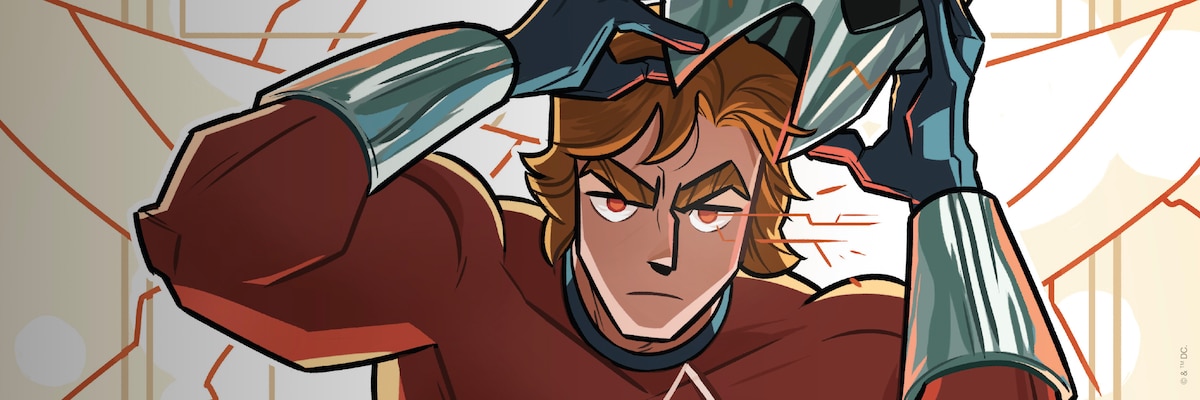
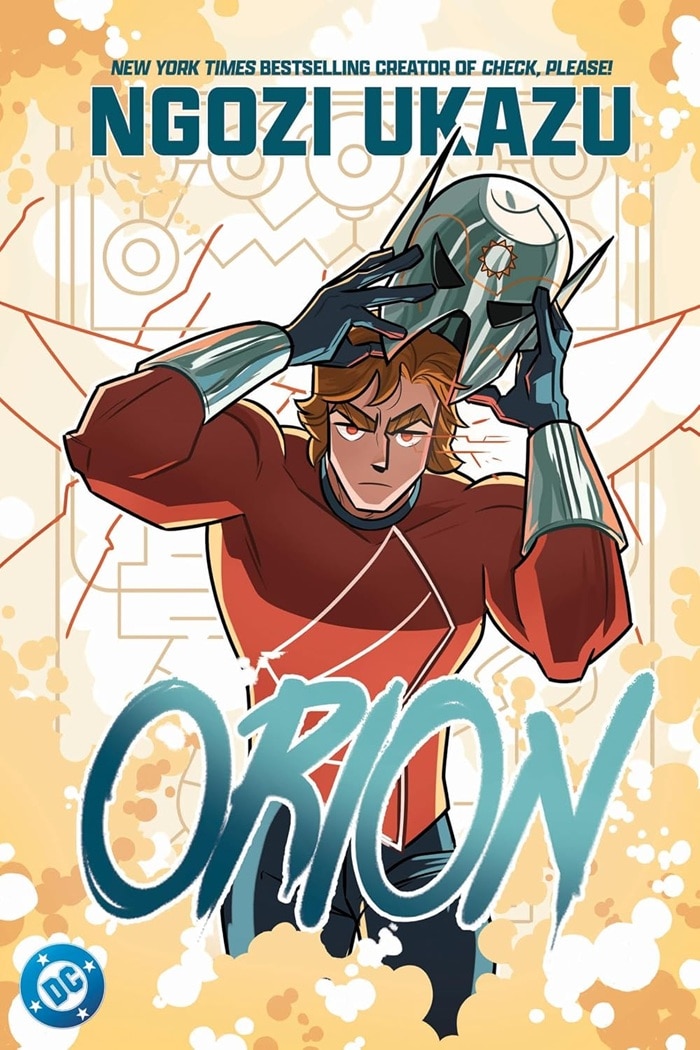
As the author and artist of 2024’s Barda, Ngozi Ukazu established herself as one of the most thoughtful, studious and inventive disciples of the great Jack Kirby, interpreting the heart of his Fourth World Saga for a new generation of readers. Now, Ukazu follows up her tale of finding love in a hopeless place with Orion, the story of the forsaken son of Darkseid who’s arguably the protagonist of Kirby’s entire saga. We recently spoke with Ukazu, asking her what makes Orion such a compelling protagonist, which other writers and artists have influenced her Fourth World tales and which surprising New God she ships with the star of her latest DC project!
Jack Kirby’s Fourth World Saga represents some of his most conceptually ambitious work, presenting a rapid fire of ideas before you can process them. How challenging has it been to form a narrative from the work Kirby left behind?
Call me a purist, but everything is there in the text. The themes of good and evil, the debate over nature versus nurture, the stakes of life and death—they are ripe for the picking. You just have to read closely and grab them. The narrative is all there. It’s easy. The hardest part has been pushing my own art and writing to match the hard-hitting and bombastic aesthetic that characterizes Kirby and the Fourth World. I’ve had to make my action more explosive and my coloring more psychedelic.
When it comes to forming a narrative, at the end of the day, I am in the business of adaptation. For many comic book fans turned artists like myself, there can be the desire to leave your stamp on your corner of the DC Universe. Maybe it’s because I’ve written my own comic series (a queer hockey comic called Check, Please!—think Young Adult Heated Rivalry from 2013) that I feel no need to reinvent the wheel on the Fourth World. My job is to fill in some of the gaps in the story (“WHERE did the Astro Harness come from?”) and present it to younger audiences.
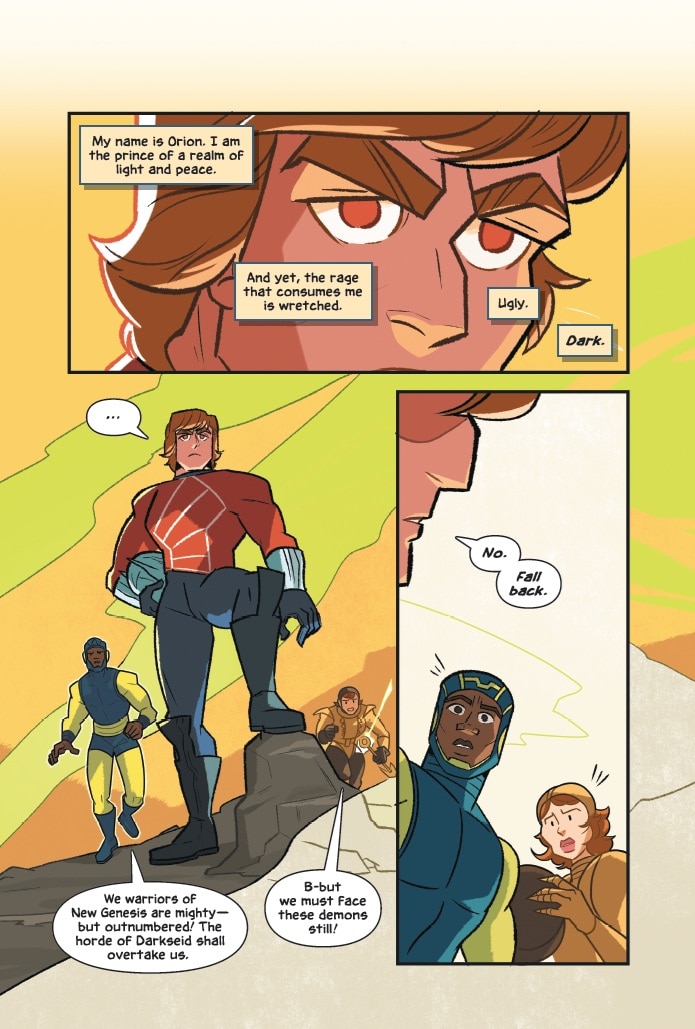
When we talk about Fourth World, we always talk about Kirby. But I’ve noticed not just his influence in Barda and Orion, but contributions to the Fourth World mythology by some of the writers and artists who have taken on that universe since then. What do you see as some of the most meaningful additions to the Fourth World since Jack Kirby’s tenure?
Walt Simonson’s Orion is not just a fabulous story, it’s one of the best interpretations of the character out there. I’m obsessed with the cataclysm between Orion and Darkseid. It’s the battle we were all waiting for!
Fun fact on that note. The only people who have told “solo” stories about Orion are Jack Kirby, Walt Simonson—and yours truly. The funny thing is that Jack Kirby and Walt Simonson both worked on Thor before working on Fourth World projects. Not to mention the Other Comic Company on DC.com, but should I go do a Thor run?
Who do you see as the “main character” of the Fourth World? What makes Orion compelling as a protagonist in comparison to his “Pact Brother” Mister Miracle?
Orion’s the main character! I mean, who started it all? Who’s on the cover of New Gods #1? (Though, by that logic, I think Jimmy Olsen is the protagonist of the Fourth World.)
Orion and Scott Free are the deuteragonists of the Fourth World. What makes both characters compelling is how their lives are forever intertwined with the Pact—the decision to swap them at birth—acting as the main catalyst.
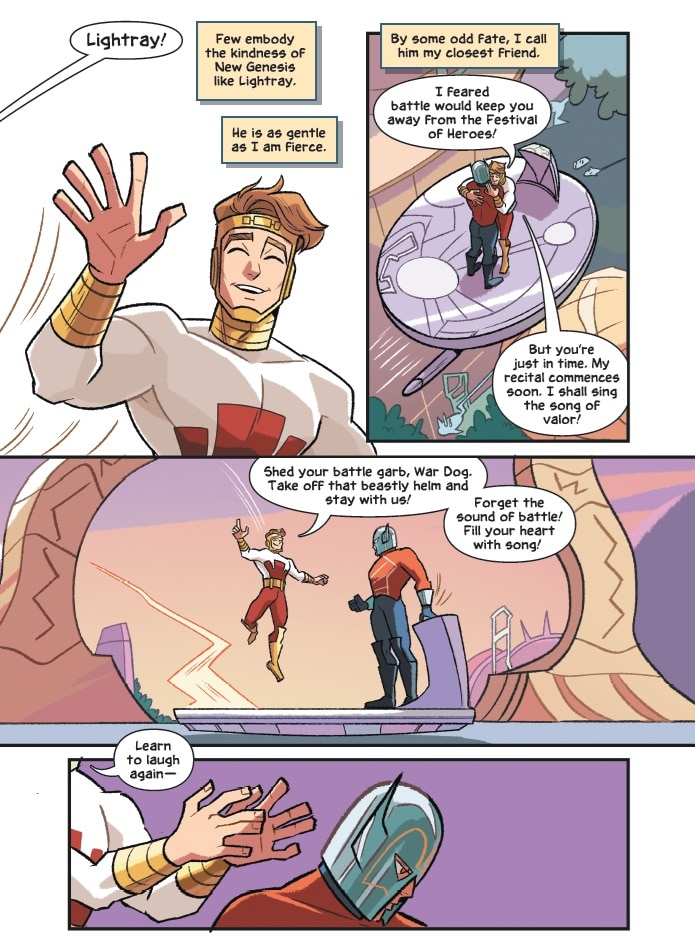
One of my favorite New Gods has always been Lightray, and you really give him the space to shine throughout this story. What can you share about his role in the pantheon and his relationship with Orion?
DC.com, let us address the elephant in the room: I’m a bigtime Orion/Lightray shipper! Do I actually see Orion and Lightray as soulmates-boyfriends? Legally? (I mean, literally?) My friends, who is to say? I am but a lowly graphic novelist. Kirby historians, I’ll leave you here to debate this argument in the university halls…
Lightray is Orion’s best friend and kind of like a sun deity in the messy Fourth World pantheon. For the narrative he serves as a foil. Kirby shows us everything Orion isn’t and how the celestial of New Genesis are—beautiful, valiant and joyous.
Where Lightray shines, however, is in his loyalty to Orion. There’s this one scene in New Gods #8 (1971), where after battling Kalibak, Orion loses his helmet. Without it, his maimed and deformed birth face is revealed. Lightray retrieves Orion’s helmet and sees Orion’s true face for the first time. He is neither repulsed, nor does he ask Orion to explain himself. He completely accepts Orion for who he is.
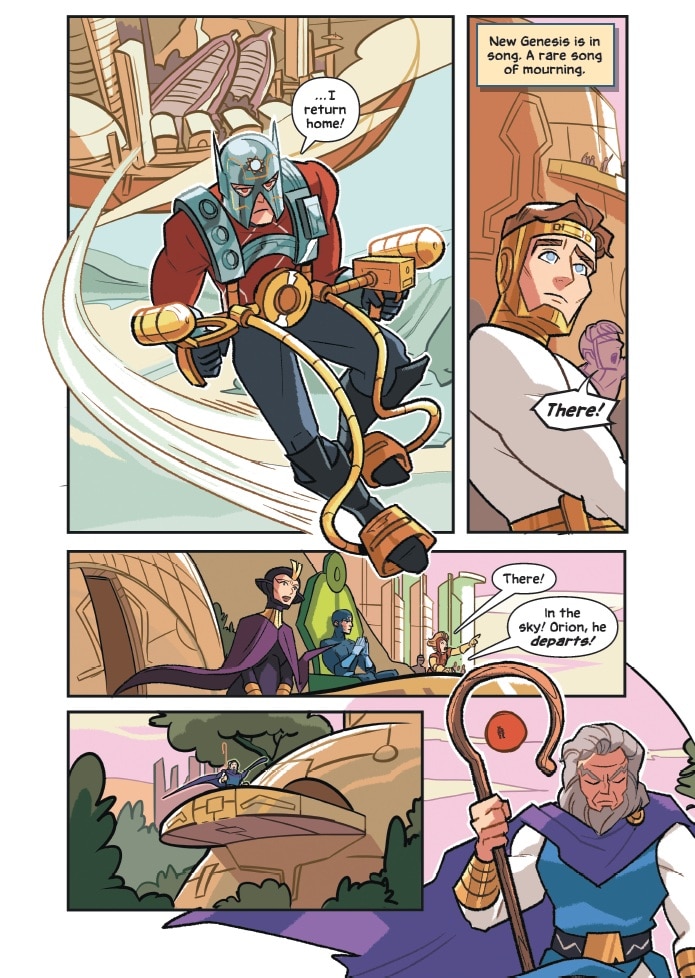
Barda and Orion are part of DC’s Young Adult line of graphic novels. What exactly makes these stories “Young Adult?”
As a genre in publishing, Young Adult stories feature protagonists between the ages of 14 and 25 and deal with themes about discovering one’s identity and finding one’s place in the world apart from one’s parents. It’s teens and twenty-somethings and their very important problems.
Barda follows the Fourth World character Big Barda as she discovers that despite her dystopian upbringing, she identifies as a protector and lover of beauty. She breaks free of Granny Goodness, her parental figure, and latches onto Scott Free who embodies her new beliefs.
Orion, similarly, is a YA book because it is all about identity: Orion struggles with his fierce nature and his desire to do good. Even though he’s coming to blows with the cosmic tyrant Darkseid, he’s still a son fighting his father.
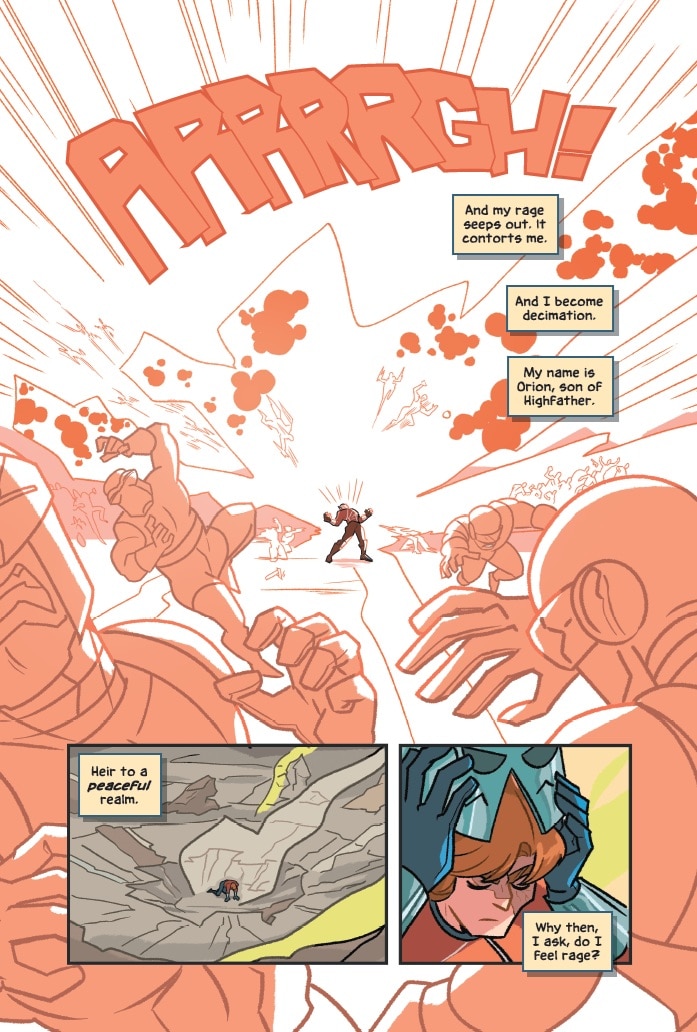
Thematically, the core of this book seems to be about the utility of rage. What makes that an important lesson for our readers? What can we learn from Orion, the Dog of War?
People often get Orion wrong and characterize him as a jerk. That’s a little boring to me. (Do people think he’s Guy Gardner? Is it the red hair?) His rage is so pure! His anger is so righteous! His fury so noble! It’s a rage co-signed by the Source, man. Why taint it with, like, typical alpha male arrogance? Yuck! (If anything, Orion is canonically clinically depressed. Let’s talk about that.)
Rage—intense anger—is an emotion that points to extreme injustice. In this case, it is rage toward the villainy of Darkseid who wishes to enslave all life in the universe. New Genesis is a place of diversity, empathy, widespread knowledge, equality and freedom—all things that Darkseid and fascist leaders hate. (Have we talked about Kirby fighting in World War II?) If Scott Free represents resistance and resilience against fascism, Orion embodies the righteous anger needed to dismantle it brick by brick.
So now, we’ve seen your Barda, your Scott and your Orion. I’ve got to ask, what’s your take on the Forever People?
I’ll be honest, DC.com, I don’t have one! …Yet! (And you’re getting that straight from the “source”!)
Orion by Ngozi Ukazu is now available in bookstores, comic shops, libraries and digital retailers as a softcover graphic novel.