SPOILER ALERT: The following interview contains spoilers from Supergirl: Survive #2.
On the eve of Krypton’s destruction, a scientist named Zor-El had the idea to send his daughter Kara to Earth, hoping she could keep an eye on her infant cousin Kal-El. Things didn’t quite work out that way, however, and thanks to suspended animation, Kal-El was already an adult by the time Kara reunited with him on Earth.
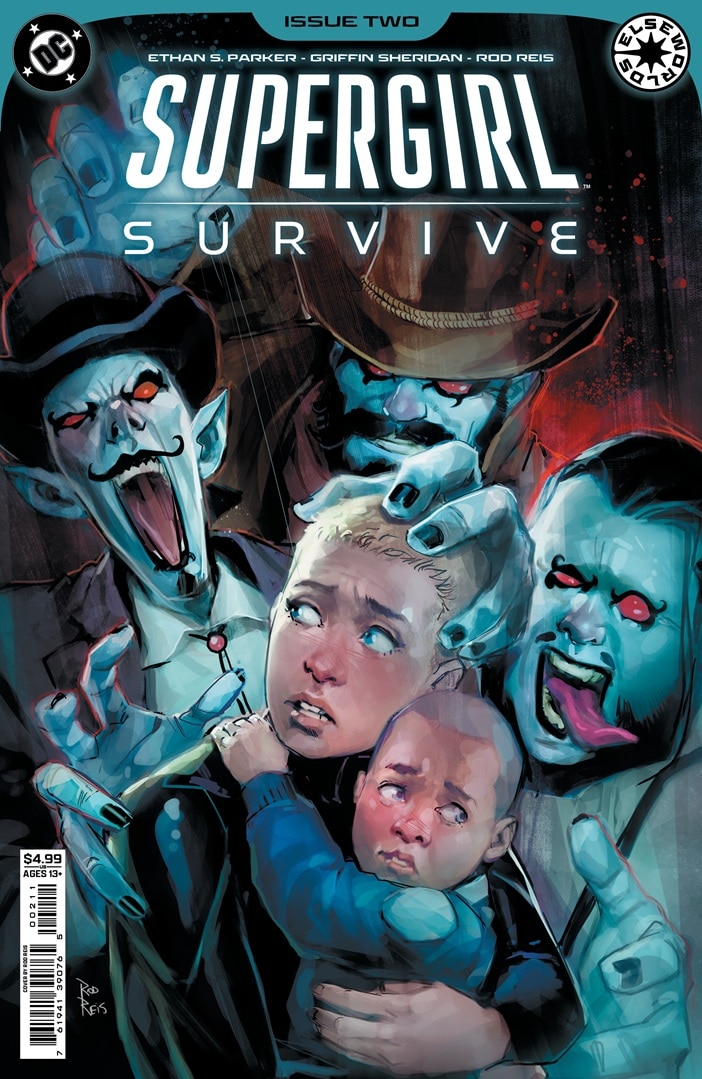
But what if Kara had been able to complete her original mission? What if she and baby Kal-El had escaped Krypton together? Supergirl: Survive is an Elseworlds series that explores this question, as Kara tries to protect her baby cousin from a galaxy where danger lurks around every corner. The limited series, which drops its second issue today, is written by Ethan S. Parker and Griffin Sheridan, the team behind the Eisner-nominated book Kill Your Darlings. We recently had a chance to chat with the writers about their plans for Kara, why the galaxy is a dangerous place to come of age and what we should make of the stunning way they ended issue #2.
I’ve read Kill Your Darlings and I’ve read Supergirl: Survive. I’m noticing a theme, so I have to ask—why are you two so mean to children?
Griffin Sheridan: We burned down Rose's house at the end of Kill Your Darlings #1, and then we blow up Krypton at the end of Supergirl: Survive #1. I don't know. I'm sure a therapist would have so much to say about it—the taking away of the safe space of the home and the destruction of the family. I think that is something that strikes a chord, not just on a personal level, but on a species-wide level. It is a throughline in what a lot of folks are experiencing right now.
Ethan S. Parker: I think it comes about very naturally because they're both coming of age stories, and we came of age in a time where being thrust out of your comfort world and into the real world is terrifying. It is for everybody, but I feel like especially at the time that we were doing it. It was just like, oh my god, we just got into the world and it's on fire. I think that a lot of people of any age can relate to that. Supergirl: Survive is about making your big premiere on the stage of the world, and then going, oh my god, the theater is burning down. Oh no!
There are versions of Kara’s origin where she was supposed to take care of baby Kal-El, and now we're seeing what that could have been like. How did you guys land on this particular version as a concept?
ESP: We had started having some conversations with editors at DC, and we were putting together some concepts that we wanted to pitch. One of the first ones that we came up with was Supergirl: Survive, with that title and that pitch of Kara and Kal, lone wolf and cub making their way to Earth across the universe. We're obsessed with the Super-Family and the cosmic side of DC, and that just felt like such a no-brainer for us.
When you're looking at what stories you feel like haven't been told yet, or what twists you haven't really seen, this always felt like one of the big what ifs for us with DC. What if Kara got to fulfill her original mission of looking after Kal, and there was no messing with time or anything like it? It came about so naturally, and it ended up being a window into a whole new way of looking at the DC Universe.
Lately, there's kind of been this subgenre in media, where you have the grizzled old guy taking care of the vulnerable child. But in this case, it's not Pedro Pascal, it's a teenage girl. Was that something that you had in mind when you were exploring the concept?
GS: I think what was interesting here was that it was that very familiar story thrust, but with a very different type of lone wolf. One of the most exciting parts about it for me is seeing someone who is not ready for the world, where typically these characters are grizzled and experienced. Kara is the exact opposite, she has no idea what she's doing, and that is the most interesting part of the whole thing for us.
ESP: I think a lot of readers will recognize the feeling of having to be a caretaker at too young of an age, and we know something about having to step up at a very young age. It's something that really does hone a character into being very heroic in my eyes. Kara being just forced into this position and going like, “Okay, I am what stands between this baby and the universe.”
That's a superhero, goddamn it.
You got to write dialogue for Superman, but he’s a baby. Was this challenging?
ESP: The way that Griffin and I split our work, I often end up taking the lead on dialogue stuff. The way Griffin will map out a story visually is he will so often find some of the best little visual moments for baby Kal. He'll find little funny things for Kal to do, or something funny for baby Kal to exclaim. It’s hard, because you don't want to be putting dumb stuff into Superman's mouth. You don't want him to be going like, “Goo goo…” or whatever. That feels dumb.
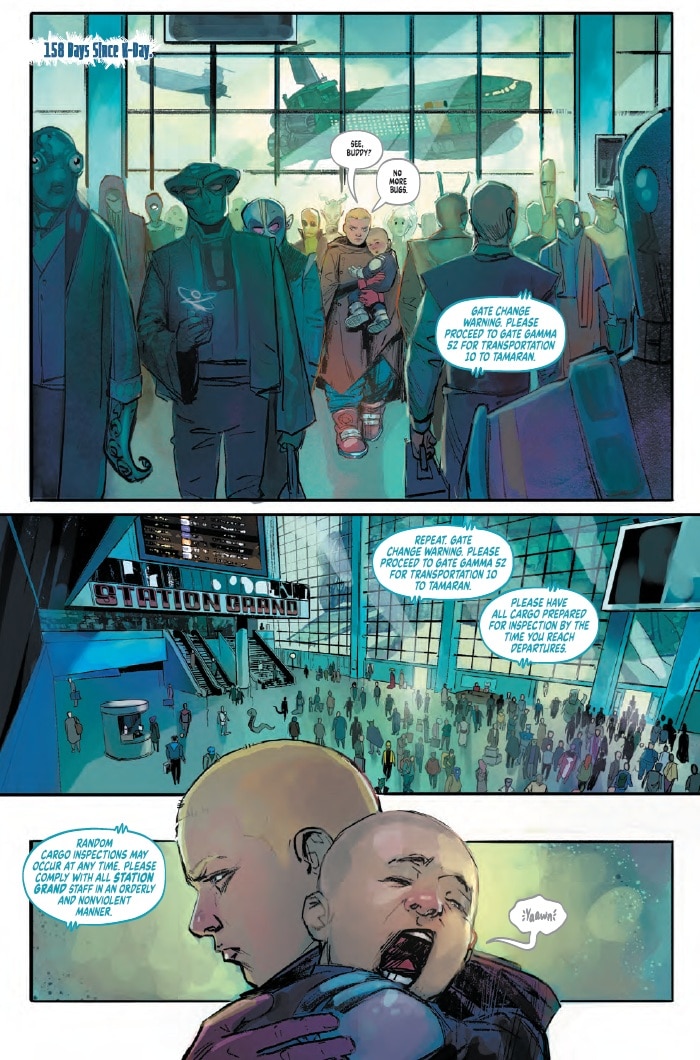
There's a moment in issue #2 where Kal picks up the word “lethal” from the situation that Kara and Kal are caught up in. He's at this age where he's going to start mimicking and copying, and that's not great because Kara and Kal are now every day in a really horrifying situation. So, he is starting to pick up some things that you maybe wouldn't want baby Superman to be picking up. He's starting to learn phrases from bounty hunters and cops. It's just a fun thought experiment, like if you take Superman all the way back to square one and you put him into all these new situations, like nature versus nurture, how much does he glean one way or the other? It requires a hilarious amount of thought for the question of what this baby is going to say.
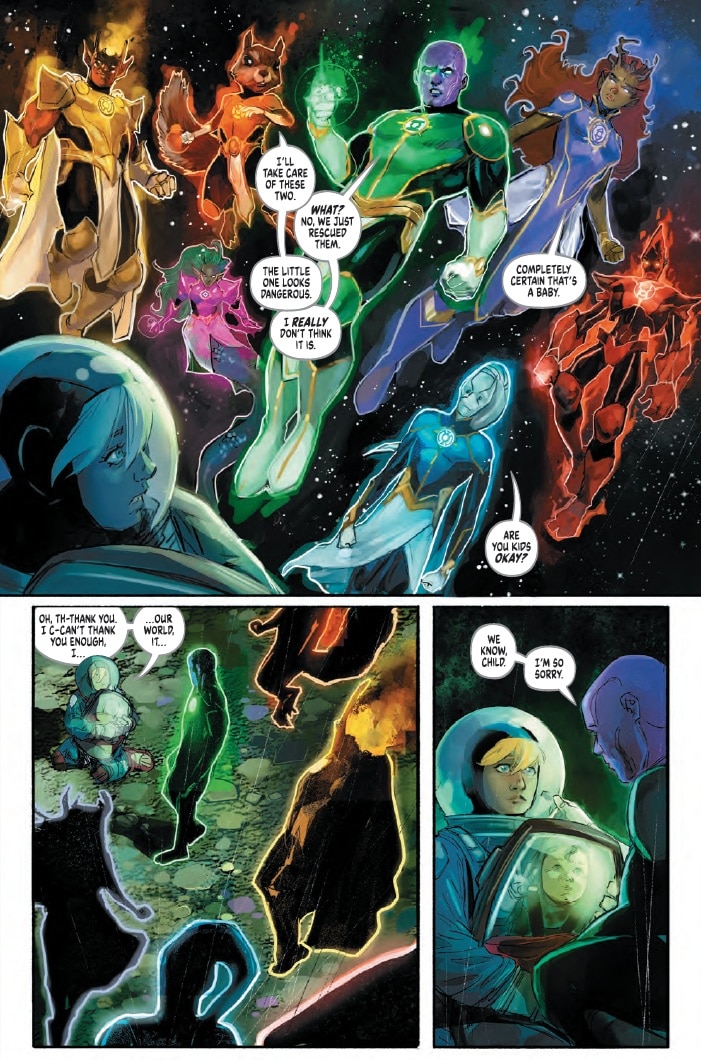
After escaping Krypton, Kara and Kal have found civilization, but they’re still not safe. Why is the galaxy dangerous for the last Kryptonians?
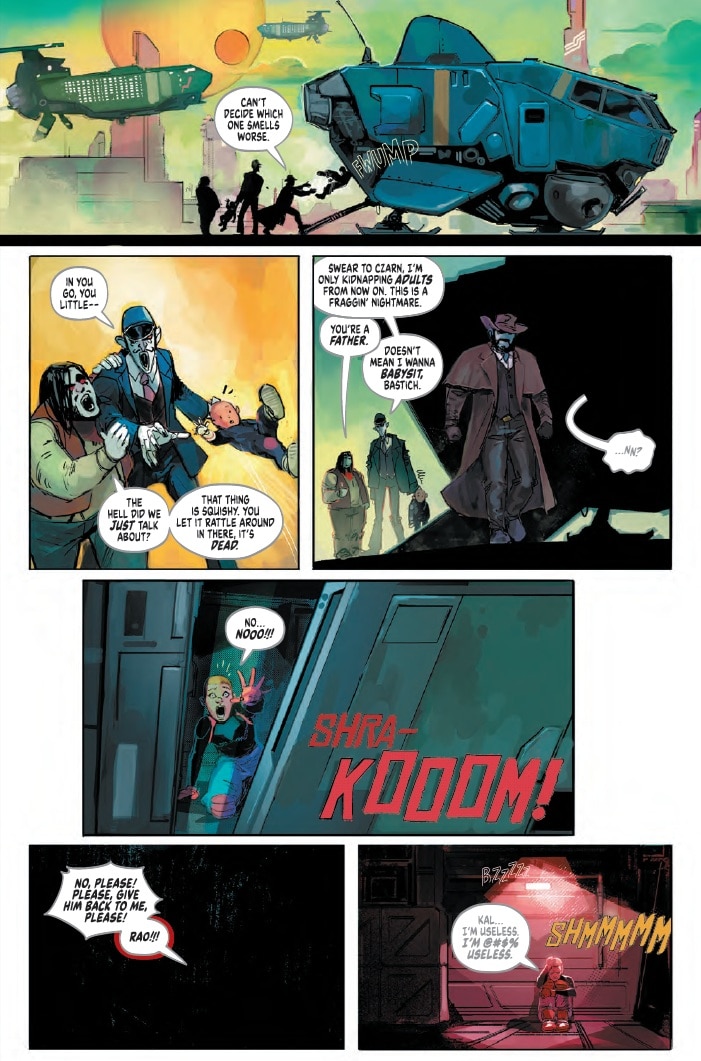
ESP: People want Kryptonian bodies, people want Kryptonian biology, because under the right circumstances, they're walking bioweapons. It was interesting to us the idea that part of what these two are trying to hide away from and what they're trying to stay safe from are bounty hunters and other interested parties who just want to use them for their own purposes. They might want to sell them on the black market, or might just want some vials of that Kryptonian blood because it might be able to make them an army of super people.
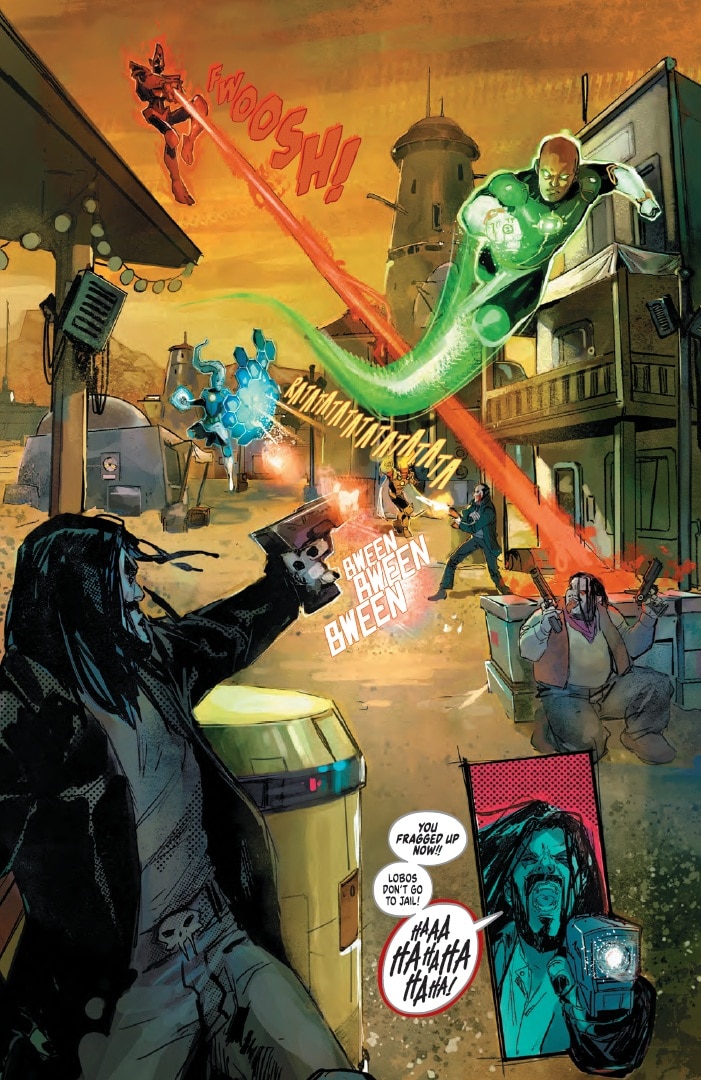
There's a section of this book that feels almost like a crime book. It was very exciting for us that Kara and Kal would end up in the middle of a shootout with outlaws and cops. They're constantly in over their heads and in danger. Finding the cops, you would think that should feel like a big relief, but the Lanterns are complicated, especially this version of the Lanterns, where it's all the colors together. It was important to us that even though they do quickly find themselves with space law enforcement, it doesn't necessarily feel like a safe haven.
What is it like working with artist Rod Reis?
ESP: Rod Reis was our first choice of artist for the series, which made it so insane that he actually came on board the book. I don't know if our editors are genies or what, but they made it happen, and it has been a dream come true. Rod brings the world of Supergirl: Survive to life with such outlandish color and zaniness as the DC cosmos deserves, but also such warmth and sweetness and humanity.
GS: We are doing something so visually different in each issue, so every issue is a tall order for Rod, and every single time he goes above and beyond anything that we're expecting. Every time pages come in, it's just a joy. And while we're talking about excellent collaboration, our editors Chris Conroy and Matt Levine have been so collaborative. They've been just an absolute joy to work with and have totally helped make sure that we are pulling off this balancing act as well as we can. We couldn't have done it without them.
We’ve got to talk about that ending for issue #2. What the frag?!
ESP: That's where we really start showing our hand that this book can kind of go anywhere. As soon as you think you know where we're headed, we're turning left.
GS: It's true. There can be no semblance of comfort at any point in this book. It's unfortunate for Kara and Kal, but we're kind of hellbent on making the journey as treacherous for them as possible. Even though something like Kara getting a Blue Lantern Power Ring seems like it would be good, it seems also like a little bit of a monkey's paw in the hands of someone as hurt as Kara is at that moment. Who knows what sort of means it could be used for in that kind of setting?
What can readers expect from the rest of the series?
GS: We're going to be jumping around in time a little bit, and so we're going to cover a lot moving forward. We're trying to make sure that each issue showcases another moment of this odyssey that Kara and Kal are on. I can say that in every issue moving forward, we're introducing a new version of some iconic Super-Family character. This book genuinely excites the hell out of me and Ethan, and we are immensely proud of it.
ESP: Not only have you never seen Supergirl like this before, but there are so many of the great DC heavy hitters showing up in this book, and you’ve never seen any of them like this before. We’re really excited to introduce these versions to you, and to show you why this had to be our first book at DC.
Supergirl: Survive #2 by Ethan S. Parker, Griffin Sheridan and Rod Reis is now available in print and as a digital comic book. You can now read Supergirl: Survive #1 on DC UNIVERSE INFINITE.