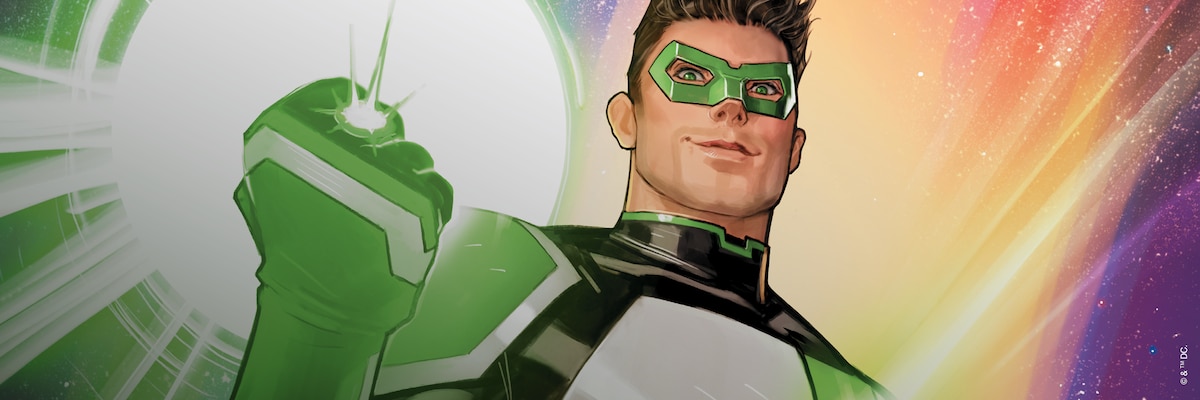
If you first got into DC Comics in the 1990s, then there are three things I can guess about you: your favorite Robin is Tim Drake, your favorite Flash is Wally West and your favorite Green Lantern is Kyle Rayner. But to reduce that to their ’90s ubiquity would be to look past what made them such symbols of their time. In Kyle’s case, how did one man bear the torch of the entire Green Lantern Corps for ten years? Unlike his predecessor, it wasn’t through any innate merit. What makes Kyle Rayner special is the fact that he wasn’t special at all.
When people cite Batman as their favorite superhero, they often give the reason that, unlike Superman, Wonder Woman or Aquaman, anyone could potentially be Batman. That’s a little disingenuous, though, considering Batman’s vast preexisting wealth and mastery of an endless variety of skills any one of which would take a normal person a lifetime to achieve. In Grant Morrison’s definitive lineup of the JLA in 1997, amongst the gods and royalty of his peers, Kyle was the only hero who had, until just recently, been a normal person.
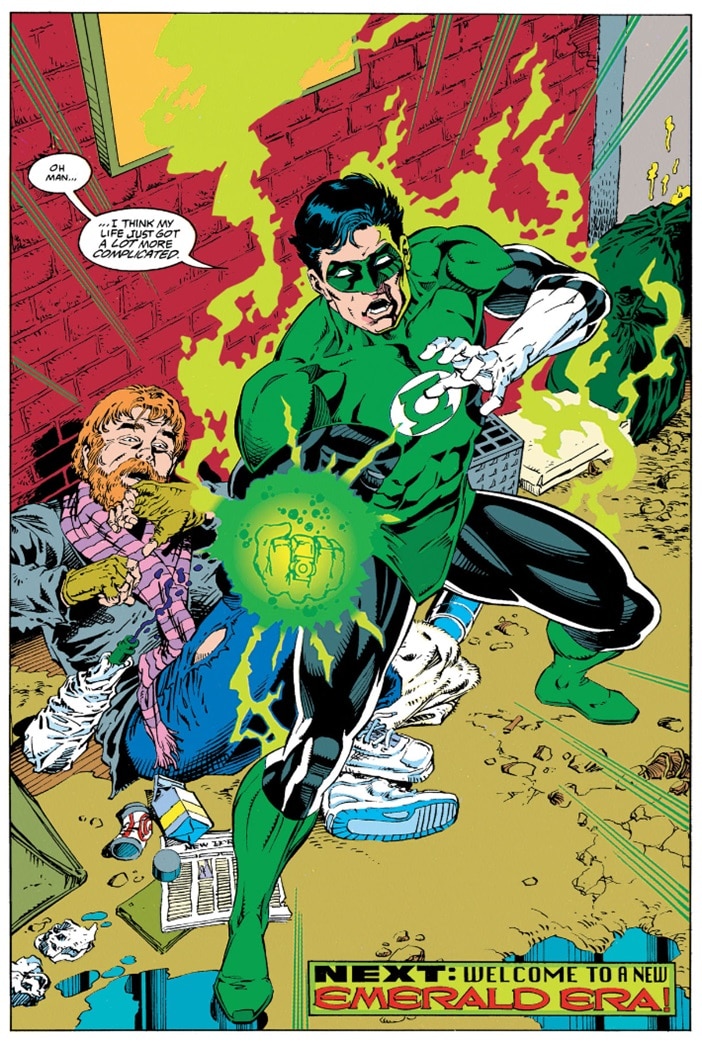
When we first met Kyle in 1994, the Green Lantern saga had just undergone its most dramatic shakeup in history. Driven to megalomania by a great personal tragedy, the once great Hal Jordan had sunken into villainy, demolishing the Green Lantern Corps in a bid to take personal control of reality. Given no time for the traditional methods of seeking out a worthy successor, one Guardian of the Universe reached out to the first person he could find in a desperate attempt to keep the Green Lantern alight. That person was struggling young Gen X artist Kyle Rayner, just trying to figure out his own life when the fate of the universe was thrust upon him.
In the 1990s, young adults like Kyle, more or less the main readership of titles like Green Lantern, were going through a relatable transition. The countercultural movement of the ’70s and the hyper-capitalist backlash of the ’80s had given way to a zeitgeist of directionlessness where the question of self-identity was largely undefined at best, and depressingly nihilist at worst. The children of the ’90s were a people without a purpose, trapped between a culture of their elders’ nostalgia and an entirely unknowable future of the 21st century.
Herein was Kyle’s greatest strength. He was no “man without fear,” but a person like any of us, if we were suddenly given great purpose. What would we do with such a gift? Instantly fall into the model of the world’s greatest heroes? Goof around a little for self-gain? Or maybe try to hide or discard it, as a curse?
Through multi-year runs by Ron Marz and Judd Winick, Kyle’s tenure as Green Lantern through the nineties and aughts was definitively one about a person first and his heroic identity second. Green Lantern became a title about the burden, the power and the responsibility that the ring bestowed on its wielder. It gave us the infamous “refrigerator incident,” a shock to readers that superheroics have real stakes when you have something to lose. It gave Kyle neighborhoods of rich characters to inhabit, friends and lovers to find and lose, and a sense of purpose as he began to tackle the issues of his time during the Winick run, in much the same way Dennis O’Neil and Neal Adams deployed Hal Jordan in the 1970s. In fact, as he became a background player in favor of Geoff Johns’ cosmic Hal revival, one might say that Kyle was the last Green Lantern to feel like he belonged first and foremost on Earth.
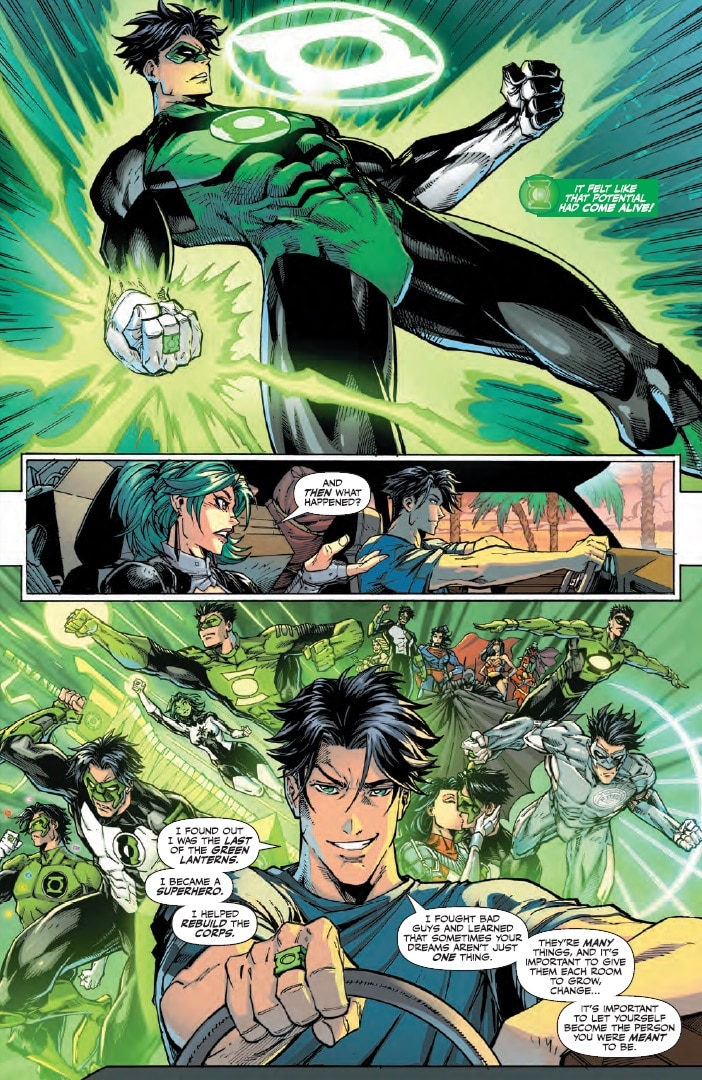
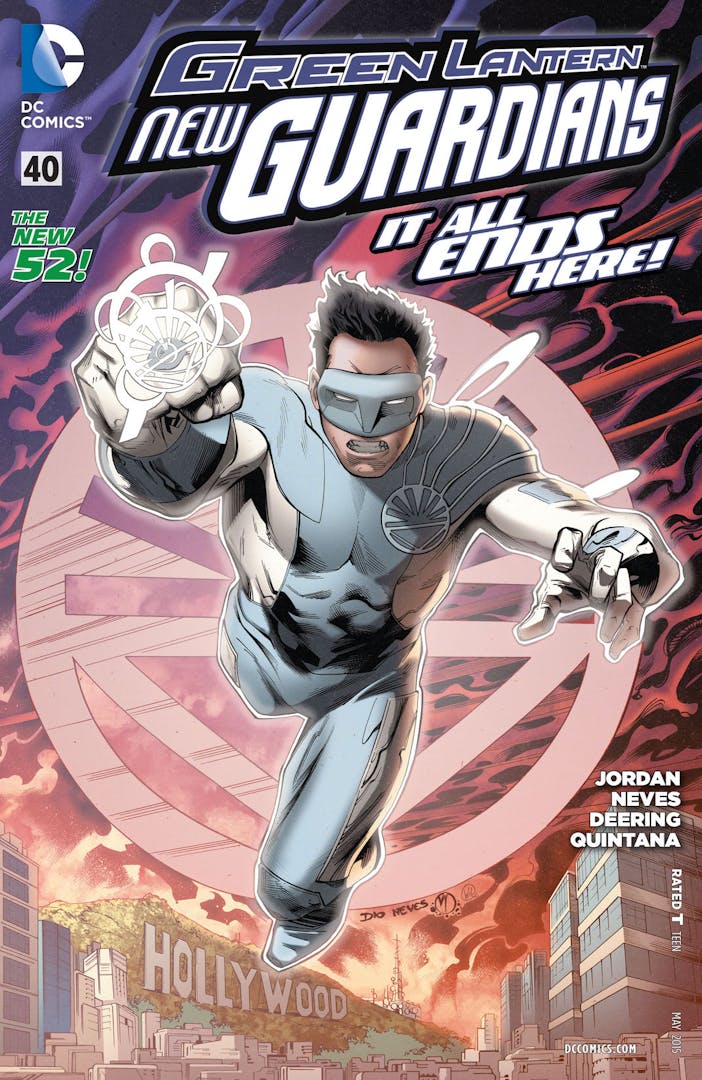
The strength of the next two human Green Lanterns introduced after Kyle, Simon Baz and Jessica Cruz, was in overcoming their personal fears. How does that make them different from Kyle? Unlike the Lanterns before or after him, fear and courage was not a binary upon which he operated. Kyle has been the most human of any Green Lantern to bear the ring, feeling hope and compassion as fervently and wholly as he felt rage and avarice. He’s not truly a character who stands for one color out of a box of rings, but one who feels all emotions, like anyone reading this article has at some point in their life. That’s why Kyle Rayner’s ultimate fate was to become the White Lantern—the most powerful hero in the Lantern mythology, with the ability to wield the power of every ring.
Because here’s the secret of Kyle Rayner, and what makes him stronger than Hal Jordan, Sinestro or anyone else to ever bear the ring. Here’s why he proved himself to Ganthet as the Torchbearer. It’s the same reason Ganthet was comfortable giving that ring to anyone he found on Earth—because every one of us has that power. In a cosmos shaped by emotion, we are not mere creatures of will or fear. We all contain universes inside us. Our emotional strength, our ability to adapt and exist in any situation, is what makes us stronger than any Guardian and makes our lives more beautiful. Every one of us has been given the power of the entire emotional spectrum. And just like Kyle Rayner, our job is to figure out what to do with it.
Green Lantern #33, featuring the return of Kyle Rayner, is now available in print and as a digital comic book.
Alex Jaffe is the author of our monthly "Ask the Question" column and writes about TV, movies, comics and superhero history for DC.com. Follow him on Bluesky at @AlexJaffe and find him in the DC Official Discord server as HubCityQuestion.
NOTE: The views and opinions expressed in this feature are solely those of Alex Jaffe and do not necessarily reflect those of DC or Warner Bros. Discovery, nor should they be read as confirmation or denial of future DC plans.