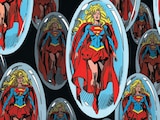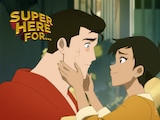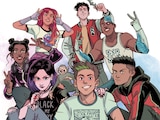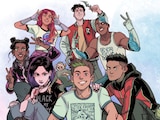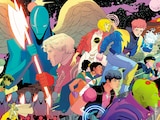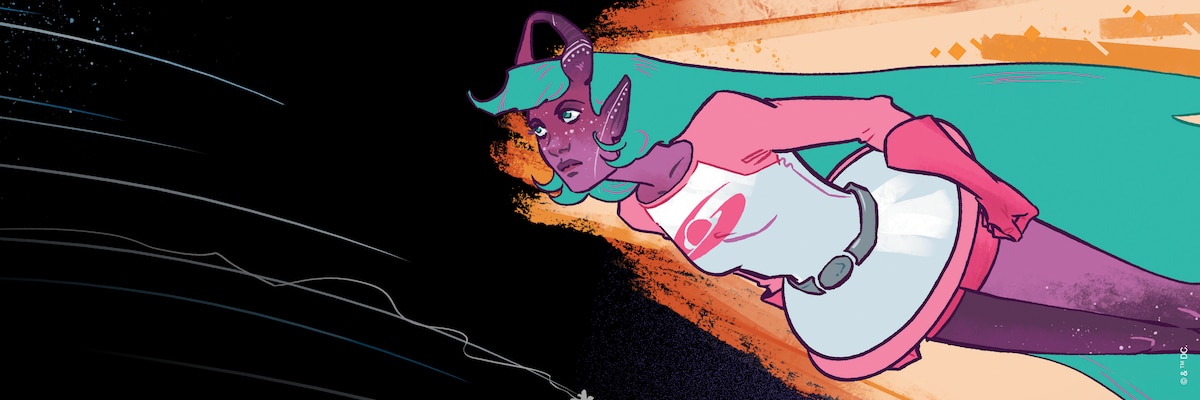
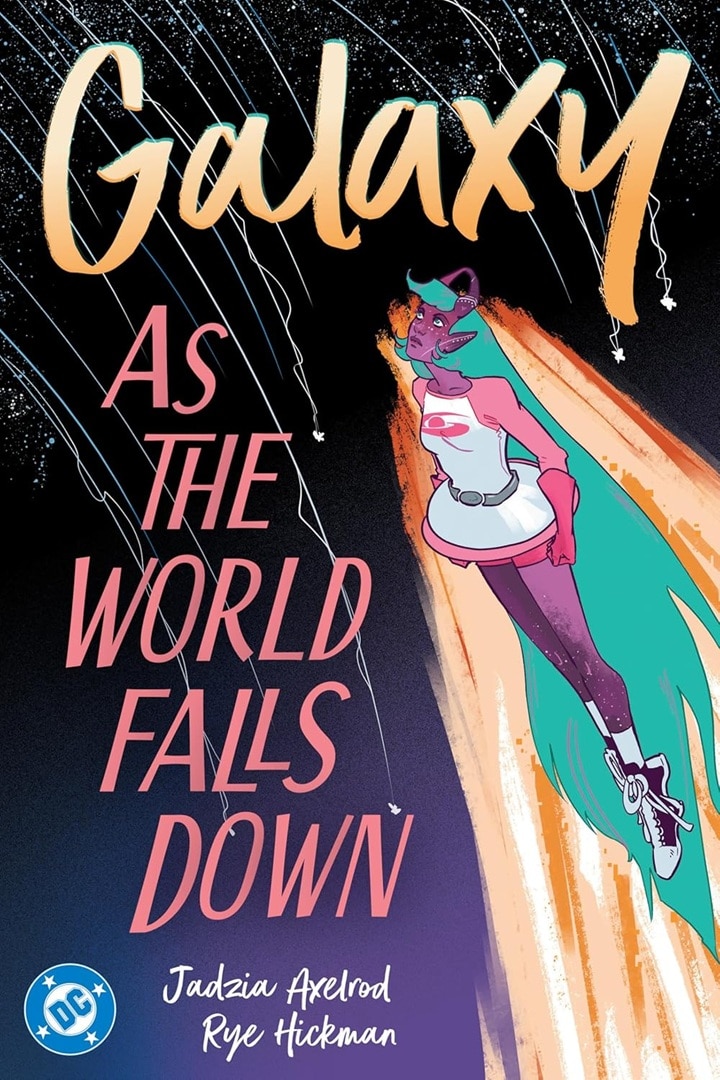
Four years ago, Jadzia Axelrod and Vash Taylor presented a new hero for our age in Galaxy: The Prettiest Star, the alien princess from a destroyed world hiding on Earth while coming to terms with her sexual and alien identity. Since then, we’ve seen Galaxy show up in Hawkgirl, DC Pride and various holiday collections, as well as the just released Justice League Intergalactic Special and the upcoming Dream Girls. But for Galaxy fans, there’s little more exciting than Axelrod’s return to YA graphic novels for Galaxy: As the World Falls Down. Teaming up with Bad Dream: A Dreamer Story artist Rye Hickman, As the World Falls Down finds Taylor Barzelay battling the same alien race that destroyed her home world with the welcome support of Superman, her best friend Dreamer and…Ma Hunkel?
We recently spoke with Axelrod about her much anticipated sequel comic, discussing the arc of Galaxy’s journey so far, what it’s like collaborating with Nicole Maines and how it pays to fill a narrative niche.
Galaxy is, to my mind, the most notable character to have originated in DC’s Young Adult graphic novel line to make the jump into main continuity. How did that happen, and what do you think has kept her so enduring?
When I was writing Hawkgirl, I realized that I needed another character to bounce off Kendra, because Kendra’s very terse, very dry, and you need someone to be a little more ebullient next to her. So, I needed that, and I needed—to make my cockamamie plot work—a magic person, or someone who specialized in energy, or something like that. And then I realized that I had created, without meaning to, a Galaxy-shaped hole in the plot.
So, I was like, “Can I just plug Galaxy in there?” And everyone at DC was like, “Yeah, that’s a great idea. Galaxy: The Prettiest Star is a hit. We’ll get some Galaxy readers reading Hawkgirl, we’ll get some Hawkgirl readers reading Galaxy. There is no downside. By all means, put her in.”
I just aged her up a bit, so that she and Kendra are more contemporaries, as opposed to an adult and a teen. And people really enjoyed Adult Galaxy, who is a different character from Teenage Galaxy and fun in different ways. They really responded to that, so she’s been popping up in other places.
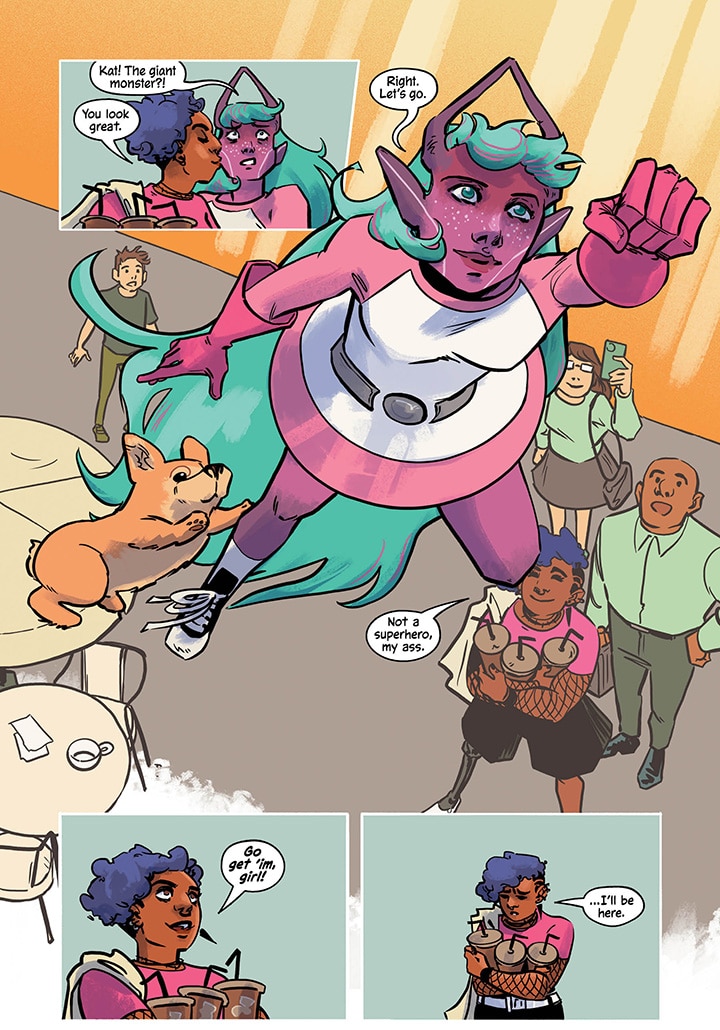
That’s actually my next question. You’ve been writing a lot of Galaxy at two different stages in her life. As a teenager in these graphic novels, and as a young adult in the Justice League Intergalactic Special and the upcoming Dream Girls miniseries. How do you approach her differently, at these different stages?
One thing I had to do when I was thinking about putting her in Hawkgirl was to plan out what has happened to Galaxy in between Galaxy: The Prettiest Star and Hawkgirl. How does that shape the character now? What insecurities has she put away? What new ones does she have? Which ones stick around? I have that map, which we might never see in print beyond a handful of stories, but I still know what has happened to her between her awkward teenage years and her cool, but still awkward, adult superhero years.
I want to talk to you specifically about the most surprising and delightful character from the DC Universe to play a major role in Galaxy: As The World Falls Down: the Golden Age Red Tornado, Ma Hunkel. What made Ma the right match for Galaxy?
Number one, I love Ma Hunkel. I’m a huge fan of those old Scribbly stories, and Ma Hunkel and her Red Tornado adventures in them, in particular. So, that is a character that is always near and dear to my heart, and I feel like has gotten a short shrift in modern appearances. They never seem to have the spark and the verve that the Golden Age Ma had. One exception, of course, being Erica Henderson’s Ma Hunkel in the recent Harley & Ivy: Life & Crimes series, which is pitch perfect.
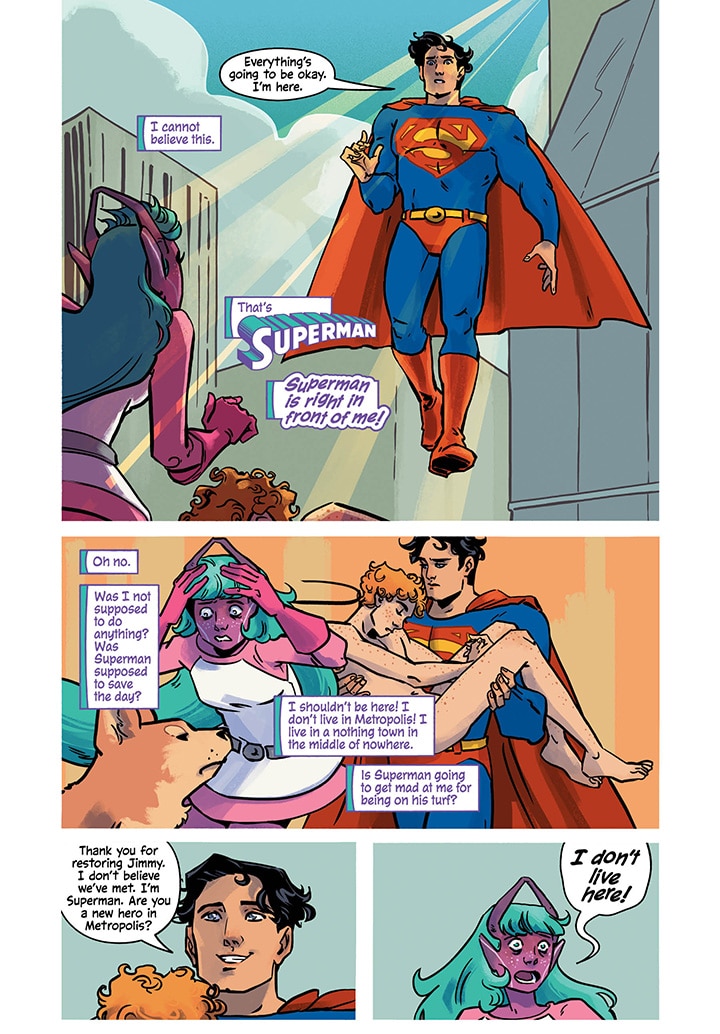
So, I love her, and I’m always trying to fit her into every DC project. But it really worked to have her here as a mentor because she is DC’s first female superhero. To have her and Superman, these iconic characters who were here at the beginning of DC’s superhero oeuvre, to usher Galaxy into superheroics in general, felt really cool and really nice.
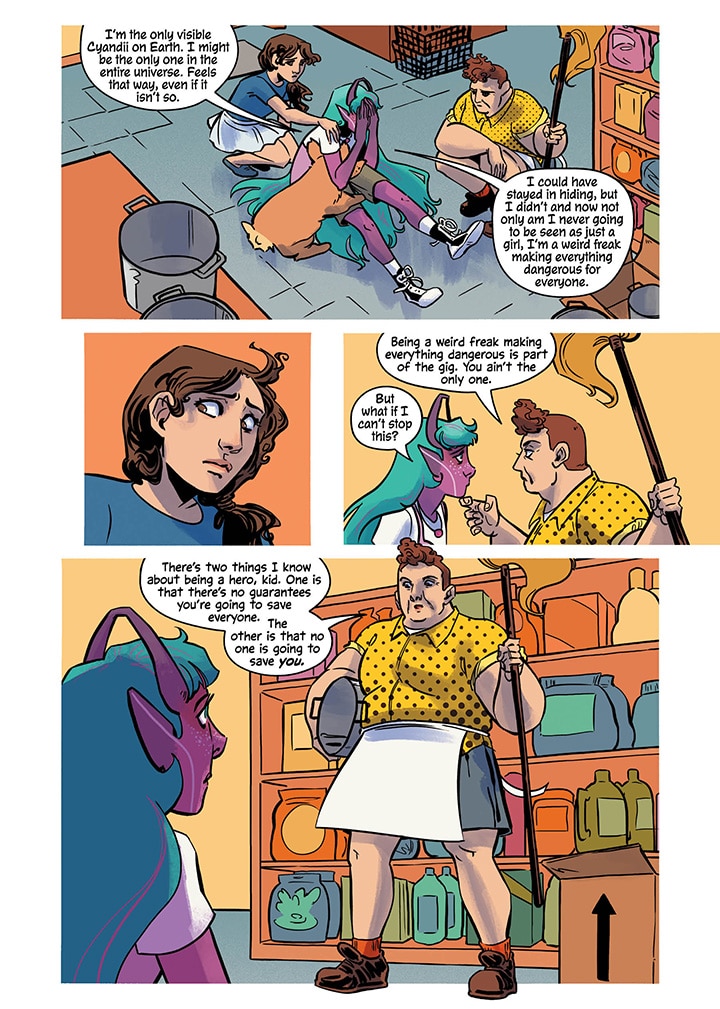
And also, Ma Hunkel is not a standard comic book woman, in that she’s not built like a supermodel or an athlete. She’s short and dumpy and broad, and I love that about her. To have that non-conformity in a female character in a story about a trans girl trying to find herself and worrying about her own body as seen by others, and to have a woman there who is not what a Western culture would say is a “beautiful, gorgeous woman,” but just…a woman. To have that there felt really important.
I think you’re the first person to ever insinuate that Superman and Red Tornado are the twin pillars on which all superheroics are built. But I don’t hate that idea.
It’s because they are very opposite perspectives, and that’s why they work so well in the book. Superman has a literally lofty perspective—he sees things from above, he flies, he’s invulnerable. He is able to allow for a lot of introspection. So, when he talks to Galaxy, he’s like, “Let’s talk about how you can protect yourself emotionally.”
And then, to have Ma Hunkel, who is not bulletproof, who cannot fly, who throws herself into danger because there’s no one else there, she’s the one who says, “You gotta watch out because this job could kill you, and it’s killed other people I know. I’m still around because I got out. So, that’s something you need to think about before you start doing this seriously.”
Let’s discuss what I think people associate Galaxy with the most: her friendship with Dreamer. They’ve been a huge part of each other’s stories in recent years, including this book. As two characters who are deeply connected to their originators, how did that association start and develop?
It started with Nicole’s book, Bad Dream: A Dreamer Story. She had written a script that had some cool trans girls in it. It was another thing with a Galaxy-shaped hole that needed to be filled! And the editor, Sara Miller, suggested Galaxy be a cool trans girl in it. And Nicole [Maines] read Galaxy: The Prettiest Star and fell in love with it, and blurbed the book right on the cover. She fits perfectly into that story. To have that character in there as an older trans girl who is also an alien and has to deal with things that Nia has to deal with, but also other things that Nia doesn’t have to deal with, to have that perspective really helps that story.
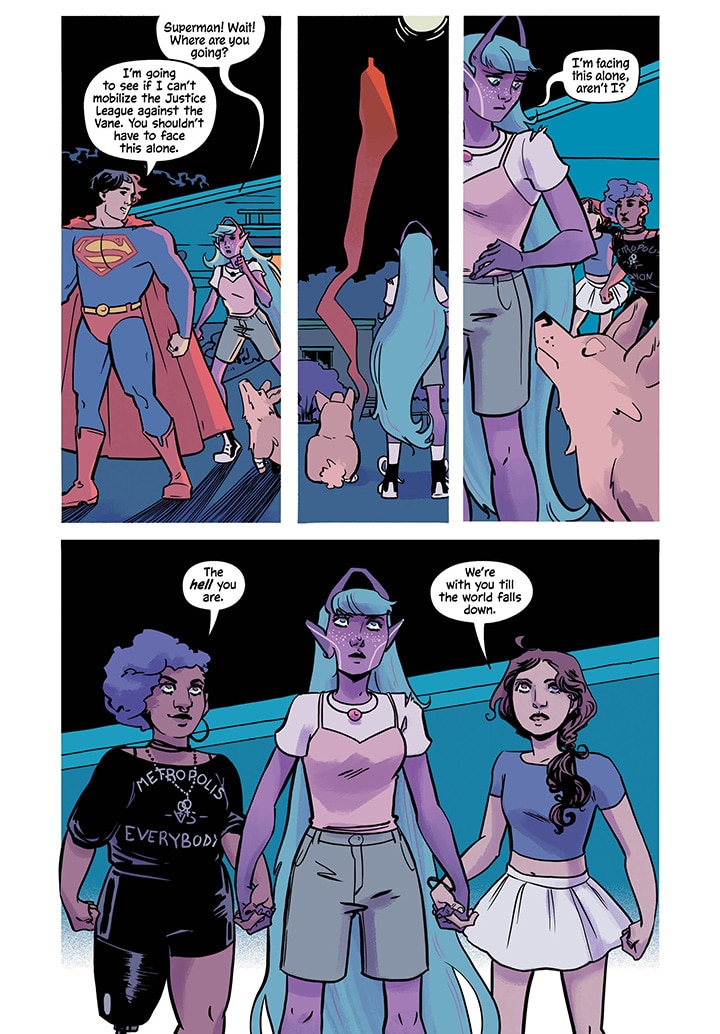
So, it came out of being in that book. I talked to Nicole about the character of Galaxy, who she is and what she does, and we texted back and forth a bunch, and I really like what Nicole did with Galaxy, and especially with Argus, and how she really captured the characters in her book. So, it was very exciting for me when I was plotting out this book to be like, “Well, Dreamer has to be in this one too, because they’re best friends now.” To show the beginning of that friendship in Bad Dream, and to take that and be like, “So why are these two best friends?” It’s one thing to have a traumatic experience with someone you just met outside a convenience store. It’s another to be ride-or-die forever. So, what happens to make them as tight as we know they are? To tell that story was a lot of fun.
So often, trans characters are siloed. They’re the one trans character, and they only hang out with other cis characters. To have two trans characters, and to have them be best friends and not rivals. It’s never “Who’s better, Galaxy or Dreamer?” It doesn’t matter who you think is better, because they think the other one is amazing.
In each of these interviews, I like to bring in a question from the larger DC community over on the DC Official Discord server. For you, the question was about the idea of collaborating on a comic with a co-writer. How do two writers write a comic? What is the division of labor? What’s the creative process involved?
I don’t know how other people do it, and certainly, Nicole and I talked about a bunch of different ways to do it, involving dividing up the pages, or one of us doing a script and then tossing it to the other person who would then do a pass, and then tossing it back. We talked about a lot of things. And really, because we are friends, because we text all the time and have hung out in real life and enjoy each other’s company, it was like, “Why don’t we just hop on FaceTime and open up a Google doc we can both see and just write it together?”
And that’s what we did! It was a lot of talking things out, saying things aloud to make sure it sounded right and felt right, adding scene descriptions and important acting cues for the artists, and all that stuff. It was a lot like writing by myself, only Nicole was there.
Galaxy: The Prettiest Star is an overtly queer story with pretty clear themes about realizing your identity and expressing it to the world, no matter the consequences. If there’s another theme behind As The World Falls Down, how would you describe it?
Galaxy: As The World Falls Down is about what happens after you come out. It’s about claiming your identity as a queer person, as a trans person. In the book, that’s echoed in claiming your identity as a superhero—figuring out what that means, what parts that people see in you that you keep, and what parts you decide are not what it means for you. It’s a lot about, now that you’ve found your identity, what does that mean?
Galaxy: As the World Falls Down by Jadzia Axelrod and Rye Hickman is available as a softcover graphic novel in bookstores, comic shops, libraries and digital retailers this week.