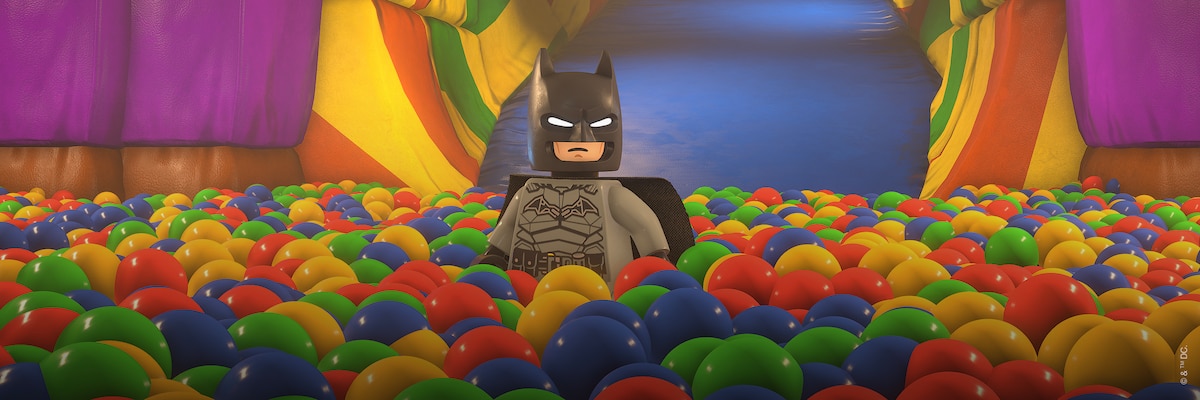
As a video game, LEGO Batman: Legacy of the Dark Knight plays thrillingly like a follow-up to the Arkham games that fans have been craving since the series’ conclusion over ten years ago. The hallmarks of the flowing combat system, the explorable Gotham City and the array of gadgets and detective work are all present. But from the moment you press play, there’s a clear difference in tone. Frequent slapstick comedy, tongue-in-cheek references to all incarnations of the character in film, television, games and comics (but especially film), and simply a more genial nature between the characters and their setting than you typically see in a Batman story make Legacy stand out among its spiritual forebears.
Putting aside the obvious fact that you’re controlling a LEGO minifigure in a world made entirely of plastic bricks, the reason boils down to that in the Arkham trilogy, players were inhabiting the role of Batman, while here, players are essentially playing with Batman. The Arkham games are about Batman as a character, while Legacy is about Batman as a toy.
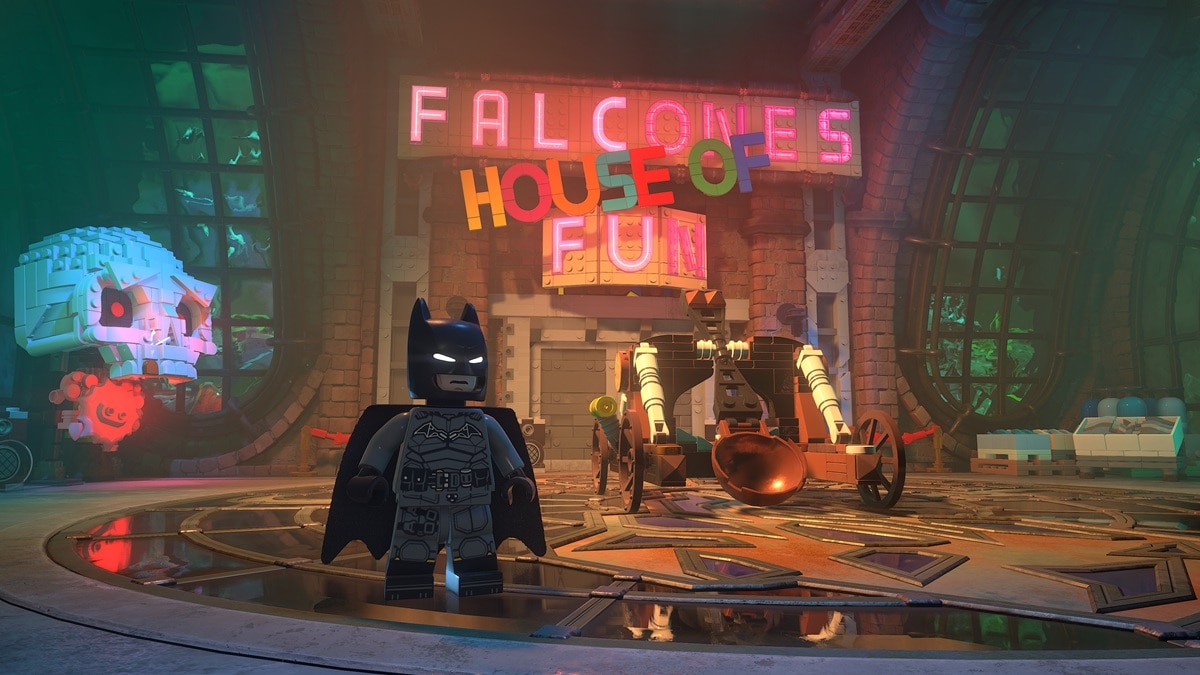
But even so, why is light comedy the primary language of that toy? Through the original trilogy of LEGO Batman games, the cinematic movies with Will Arnett, and the direct to video LEGO DC Super Heroes line, the LEGO incarnation of Batman has always been more ready with a joke…or to be the butt of one. And yet, there are few characters in comics who otherwise demand to be taken so seriously as Batman. The entire premise of Batman’s arch-nemesis is asking him why he’s so serious. But when presented with LEGO Batman, even the most hardcore Frank Miller fanatics have to crack a smile. How does he keep getting away with it?
At the risk of over analysis, maybe it’s worth examining the elements of how the LEGO Batman sub-franchise inherently lends itself to humor.
We could start by talking about the character proportions. Heads, limbs and blocky bodies like we see in LEGO minifigs are not built to be taken seriously. But I’d suggest that first and foremost when discussing LEGO is recognizing the element of play. It’s a brand which has almost become its own medium, not just around construction, but freedom of expression and creativity. If you’re strictly following the rules on building an exact simulacrum of what’s on the box, you’re missing out on the easy adaptability of a LEGO set. Subversion of expectation is one of the corners of the brand.
This is where comedy comes in. The two basic elements of a joke are an establishment of expectations, followed by a surprising subversion. In its freedom of construction, LEGO is designed to be subversive.
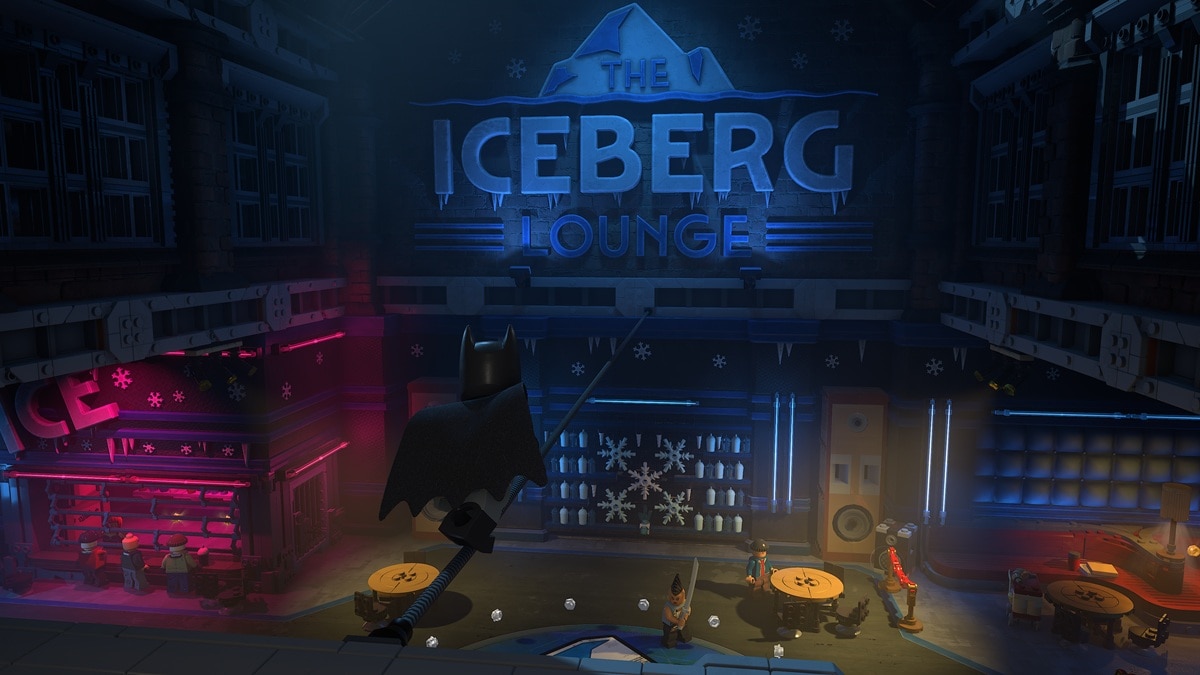
This has been the formula ever since LEGO got into the branded set game, but particularly as Legacy of the Dark Knight developer Traveller’s Tales (aka TT Games) became LEGO’s go-to game studio in 2005. The formula has always been this: take a series of films, whether they’re Star Wars, Pirates of the Caribbean or Jurassic Park, divide them up into their key sequences and make each of those a level in a world. Each sequence has at least two playable characters, to allow for cooperative play. Along the way, acknowledge iconic moments with playful parodies and reinterpretations.
When it comes to adapting Batman, however, TT Games has had to change up their usual methodology. There is no single Batman continuity, after all. For the first two LEGO Batman games, their approach was to tell an original story, incorporating a showcase of the characters in the vast cast of Gotham City—much like the entry level approach to Batman comics provided by stories like The Long Halloween and Hush, but with an emphasis on action and comedy. (The third was, for some reason, a loose adaptation of Geoff Johns’ Green Lantern saga, only with Batman and Brainiac.)
In Legacy, we find TT Games returning to their classic formula of adapting movies, but with an ambitious twist: a continuous narrative spanning years of Batman’s career, weaving all of his cinematic adventures from 1989 to 2022 into a single story. Here, Keaton, Bale and Pattinson are all the same Bat, and that LEGO playfulness provides the clickable bricks that keep them all together, emulating that feeling of a child at play with all the toys in their box. If you don’t approach it with a certain degree of absurdity, it doesn’t work.
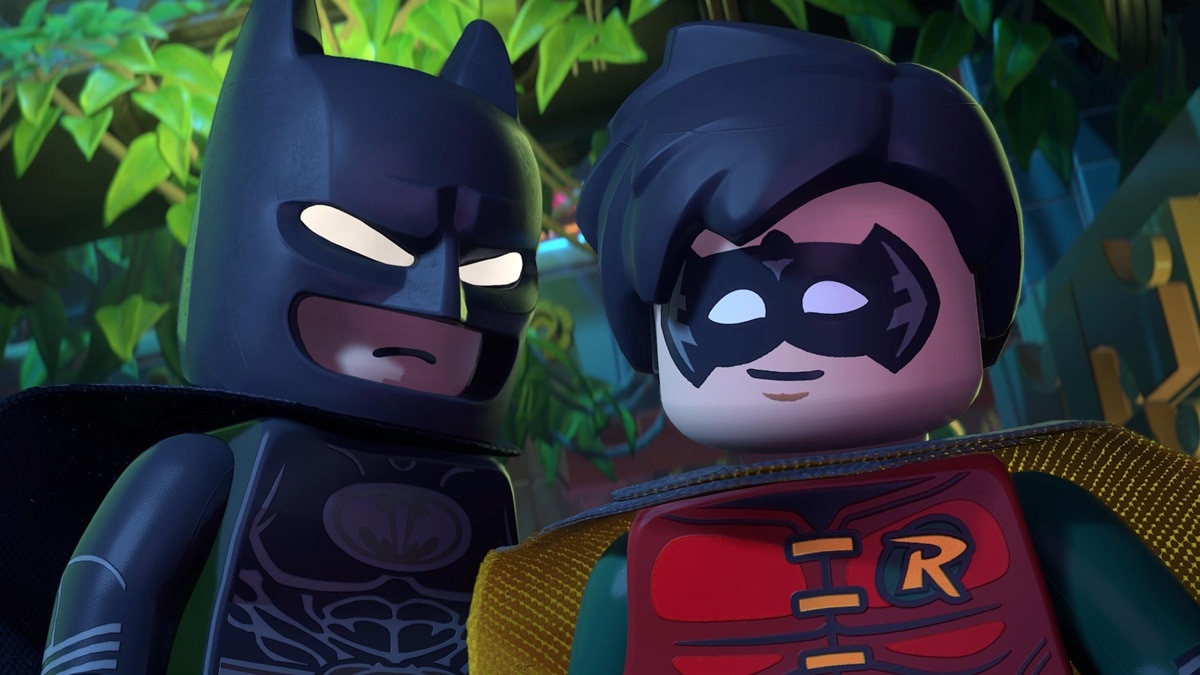
But comedy isn’t just what keeps disparate narratives together. Let’s revisit that TT Games formula just for a moment. One of the strongest bricks in their foundation is cooperative play. LEGO games can be played solo, but it’s always been clear that they’re not really designed to be played that way. It’s always Qui-Gon and Obi-Wan, Frodo and Sam, Batman and Robin. They’re simple enough that a young child can play, while an older player can play alongside them and appreciate the clever references to a beloved world.
Because as much as it is about creativity and expression, LEGO is about family—a literal building experience that a parent can share with their child. This is emphasized in Legacy through its contrivances that always allow a second player, even though it’s interpreting films in which Batman ostensibly works alone.
One of the very first moments in the story features a young Bruce sharing his love of his hero, the Gray Ghost, with his father. Thomas Wayne tells his son that the Gray Ghost was a little different when he was a kid, but a part of his life all the same. It’s an acknowledgment that Batman’s Legacy is the one that we share with our loved ones, playing and laughing together.
But if I can offer one tiny criticism, they really should have called the game LEGOcy of the Dark Knight. I mean, come on.
LEGO Batman: Legacy of the Dark Knight is now available for PS5, Xbox Series X|S and PC. Look for it this September on Nintendo Switch 2.
Alex Jaffe is the author of our monthly "Ask the Question" column and writes about TV, movies, comics and superhero history for DC.com. Follow him on Bluesky at @AlexJaffe and find him in the DC Official Discord server as HubCityQuestion.
NOTE: The views and opinions expressed in this feature are solely those of Alex Jaffe and do not necessarily reflect those of DC or Warner Bros. Discovery, nor should they be read as confirmation or denial of future DC plans.