Here we are for another month of hard-hitting DC mysteries! I’m Alex Jaffe, better known to the DC Official Discord community as HubCityQuestion—where, every day I provide answers to the perplexed and curious DC fans and readers looking to understand more about the intricacies of our weird and wonderful world. Here are just a few of the many great questions I’ve received over the past month, shared to better educate you all.
Fr4n asks:
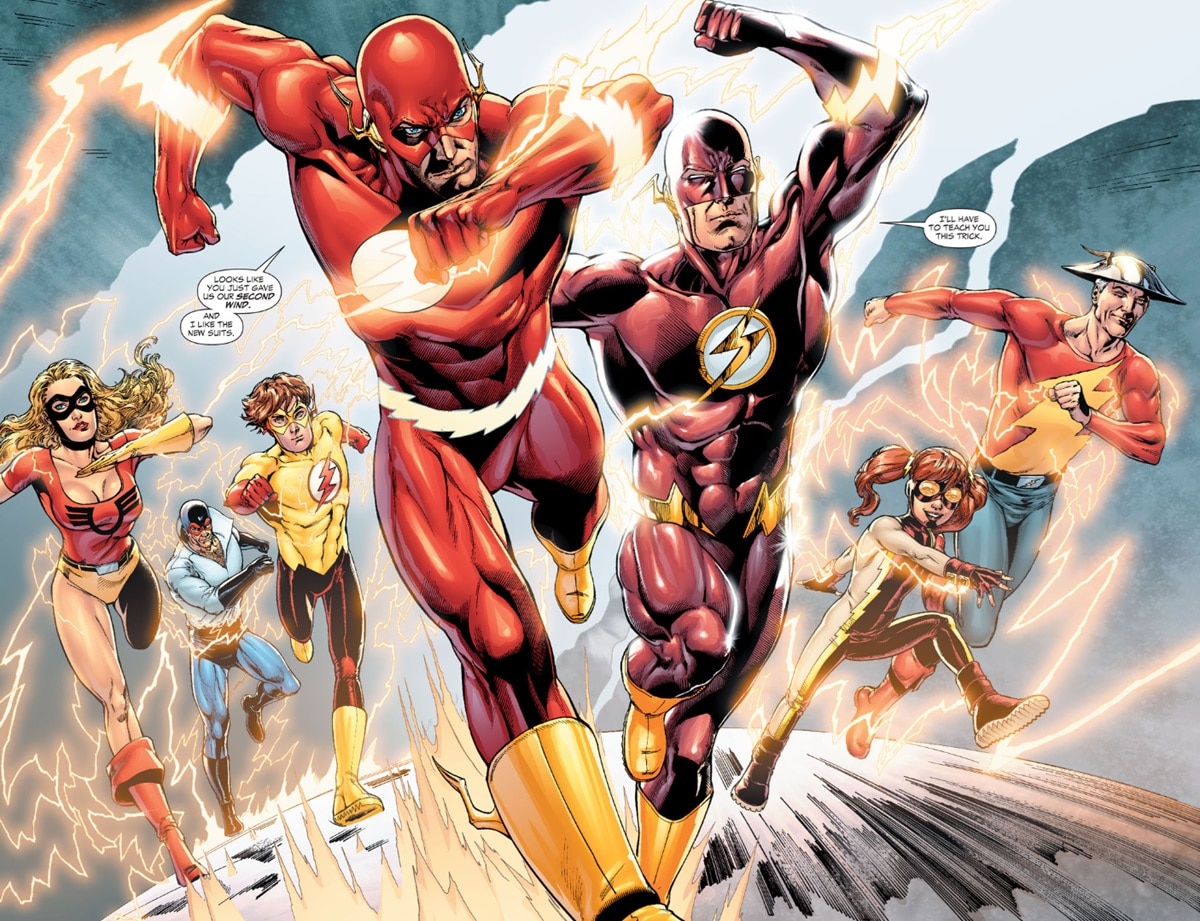
How do I tell the difference between Barry and Wally when they're in their super suits?
It’s not always easy. When Wally West first took up the role of the Flash after Crisis on Infinite Earths, he wore Barry’s exact costume. The only way you could tell at the time it was Wally was because you knew Barry was dead. Up until Barry returned in 2008’s Final Crisis, you didn’t really have to worry about it because, special circumstances aside, if you saw the Flash in the red bodysuit before Crisis, it was Barry, and if you saw him afterwards, it was Wally.
Wally’s suit design did go through some subtle changes as his post-Crisis solo series progressed, and there are some ways to tell them apart today when they’re operating at the same time. First, and most obvious, are the lenses. Most of the time, Wally West’s cowl as the Flash has opaque white lenses, whereas Barry’s does not. Second is the lightning pattern on his suit, especially at the belt. Barry’s Flash costume usually presents that lightning as a straight horizontal line across, while the two ends of the lightning around Wally’s midsection come to a point. And lastly, the red of Wally’s suit is noticeably darker than Barry’s, which usually becomes apparent when compared side by side.
Also, sometimes, especially in comics from the second half of the 2010s, Wally wears an even more distinctive costume from Barry: one with an open cowl design, exposing his red hair to the elements, a trait unmistakable for the blonde Barry Allen.
However, none of these rules hold universally true. Sometimes, especially in Elseworlds comics or tie-in media, Barry or Wally might appear with some or all of the trademark distinctions of the other. In which case, your only recourse is to pay attention to context clues. This may be hard to hear, but you will eventually find that it is often the case that the only way to answer a question about a comic is to read the comic.
Mirtilo asks:
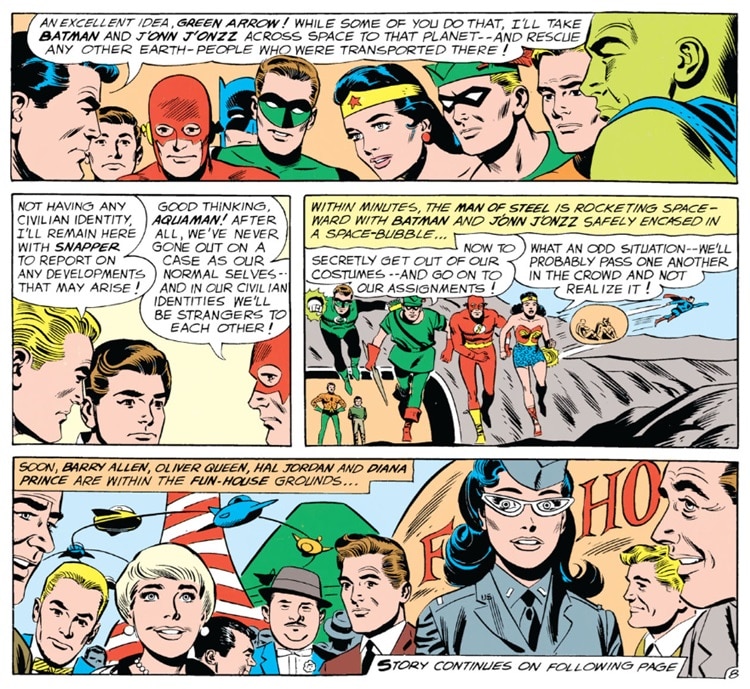
Why do some comics have those “to be continued on the next page” texts? What’s the point?
You’re likely reading a comic that was originally printed between the 1950s and 1980s. Those “continued on next page” captions are remnants to how these issues were originally published, with advertisements inserted throughout the book. Traditionally, most of the earliest comics were published in an anthology format. When you saw an ad, it was one indication that one story in the issue had finished, and if you turned the page past the ad, you’d find the next story beginning. But as multi-part and book-length stories became more popular, it became standard to notify the reader that just because they had reached an ad page, that wasn’t necessarily the end of the story. Once you flipped past the ad, you could continue reading right where you left off.
Dragon Moth asks:
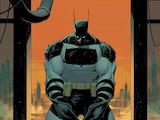
Were No Man's Land and Bruce Wayne: Fugitive the first time that Batman had a character from outside his mythos as the primary villain of a story?
For those less familiar with turn-of-the-century Batman comics, these were two major Batman events where it was eventually revealed that much of the action behind the scenes was being manipulated not by one of Batman’s classic influential enemies like Ra’s al Ghul or the Penguin, but Lex Luthor. And while I’d say those were the first major Batman events where the main antagonist didn’t originate from a Batman title, it wouldn’t be the first story where that happened.
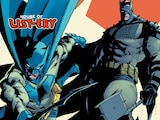
To honor the spirit of this question, I think we have to first discount team-up scenarios where Batman would take on villains with his cohorts in the Justice League of America, or with Superman in issues of World’s Finest from the 1950s and onward. I also would eliminate Batman’s earliest team-up stories, as he occasionally featured throughout the 1940s as a rare guest on the Adventures of Superman radio serial.
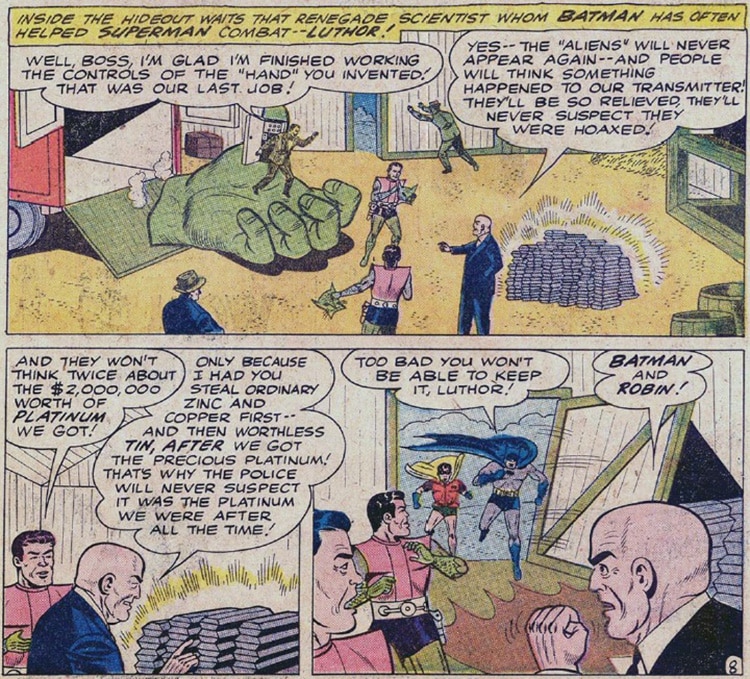
With all that out of the way, I believe the honor of Batman’s first unaided clash (Robin notwithstanding) with another hero’s enemy would still happen to be Lex Luthor, but in a much earlier story—the cover feature of 1960’s Batman #130, “The Hand from Nowhere.” It would be the only time Luthor would face Batman and Robin without Superman present for over thirty years.
benny asks:
When was the Green Lantern suit made to be part of the ring? I seem to remember the suit being separate based on the ’60s Hal Jordan comics.
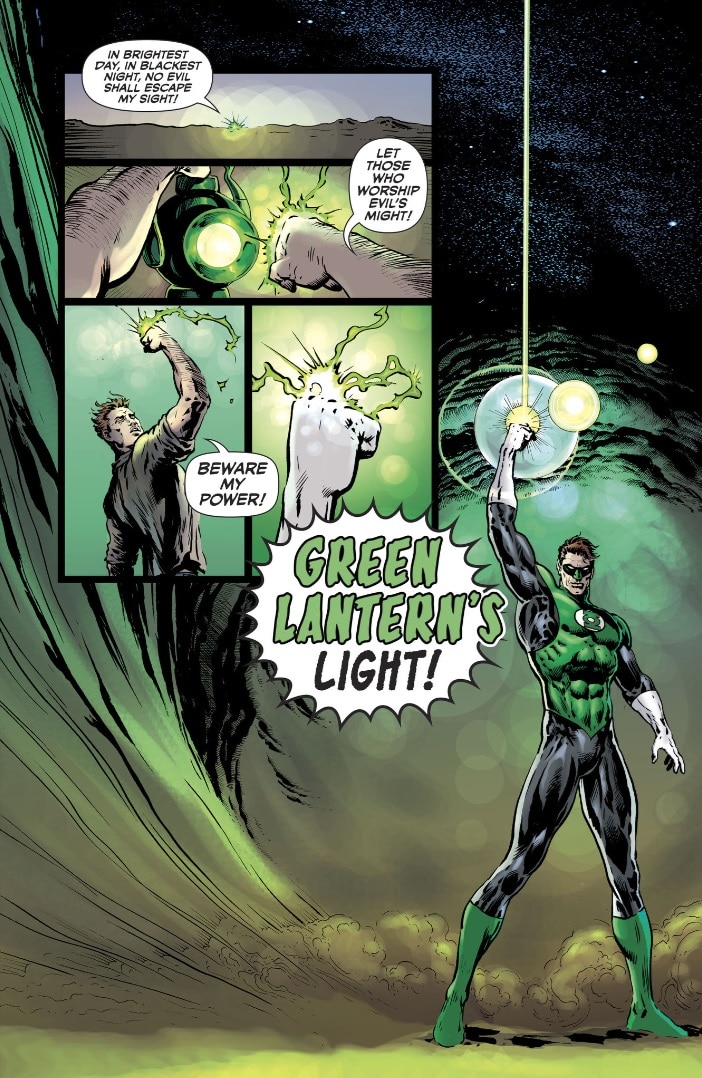
When we first meet Hal Jordan in Showcase #22, a dying Abin Sur does in fact bequeath him not just his ring, but his uniform as well.
By Green Lantern #3, we see that, like Superman, Hal sometimes keeps Abin Sur’s costume on under his normal clothes, and on other occasions, retreats to his dressing room at Ferris Aircraft to change. But we see that Hal has the ability to generate a suit for himself for the first time in Green Lantern #5, where he starts using the ring to disguise Tommy Kalmaku as himself. By Green Lantern #6, Hal is using the ring to create multiple illusionary replicas of himself at a time. Jumping ahead to Green Lantern #34, we see a rogue Guardian transforming Hal from his street clothes to his Green Lantern uniform for the first time. Four issues later, Tomar-Re does it again to Hal in Green Lantern #38. Between those two incidents, it may have occurred to Hal that he could simply enact the transformation through the ring himself, as he can be seen doing so later in that same issue. By the time John Stewart is recruited to the Corps for the first time in Green Lantern #87, John is never given a physical suit at all—it’s all done by the ring.
Kris asks:
Can you give a breakdown of all the relationships Batwoman has had in comics? I wanna get a nice roundup of that before jumping into Batwoman's new #1 soon for Next Level.
We get the gist throughout Kate’s initial appearances that she’s had a significant string of lovers, but few we’ve seen on panel. For the ones we have, we can take this chronologically:
We can start with Sophie Moore, a fellow cadet that Kate was involved with at West Point. Their relationship was why Kate had to leave the military.
One of Kate’s first relationships after coming out was with Renee Montoya, while Renee was still not public with her sexuality. They would later have an on-and-off romance during their respective superhero careers.
During 52, we meet another of Kate’s exes, a doctor named Mallory Kimball. She looks after Vic Sage when he starts dying and Renee turns to Kate for help.
In the first issue of Batwoman: Elegy, we see Kate getting broken up with by a woman named Anna, feeling neglected for Kate’s secret double life taking priority over their relationship.
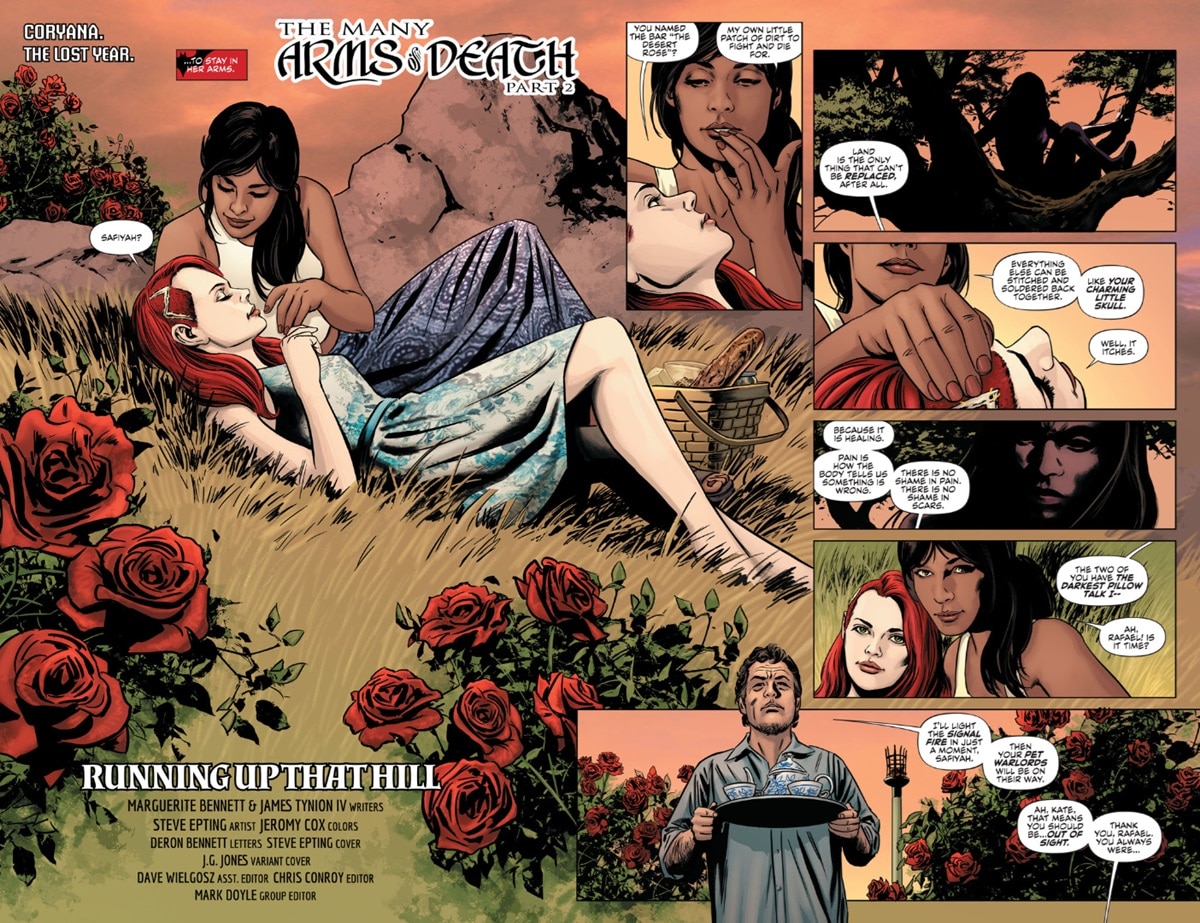
Early in Kate’s independent career as Batwoman, she became involved with Safiyah Sohail, arms dealer and leader of the pirate nation of Coryana, a relationship that would come into play again in the 2017 Batwoman series.
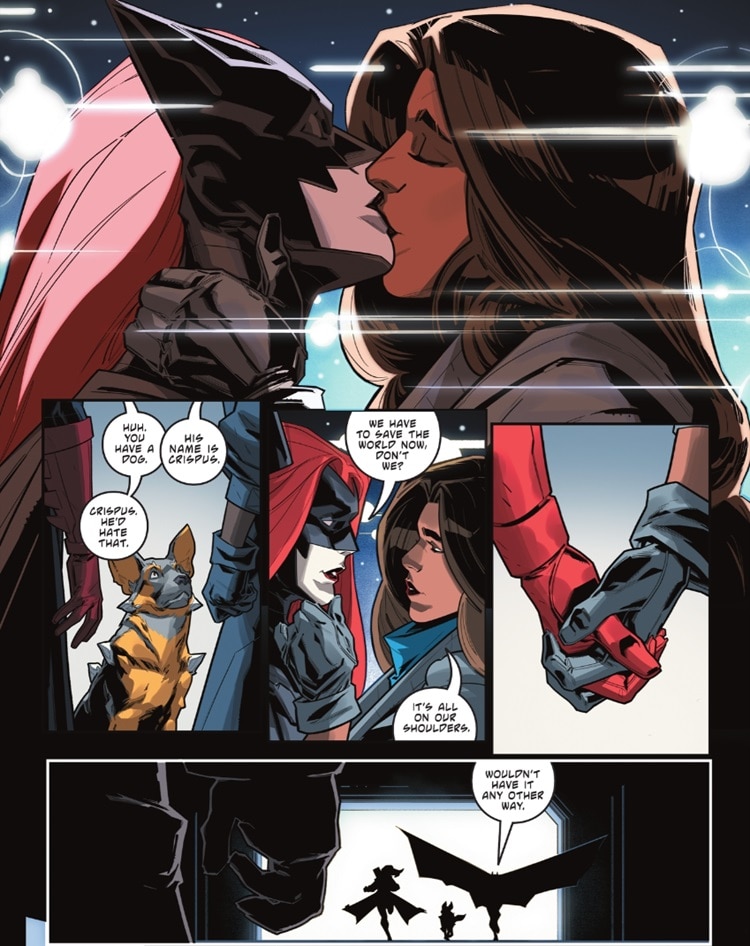
Kate gets involved with Detective Maggie Sawyer in the New 52 Batwoman series, and they even get engaged. That falls apart though, and Batwoman falls under the thrall of the villain Nocturna, but whether you’d count that as a relationship or not is up to you.
Finally, in a recent holiday special, Batwoman was seen on a date with Enigma, the Riddler’s daughter. Whether anything further came of that is…well, an enigma.
The Absolute asks:
What is the difference between the Orrery of Worlds and the Multiverse?
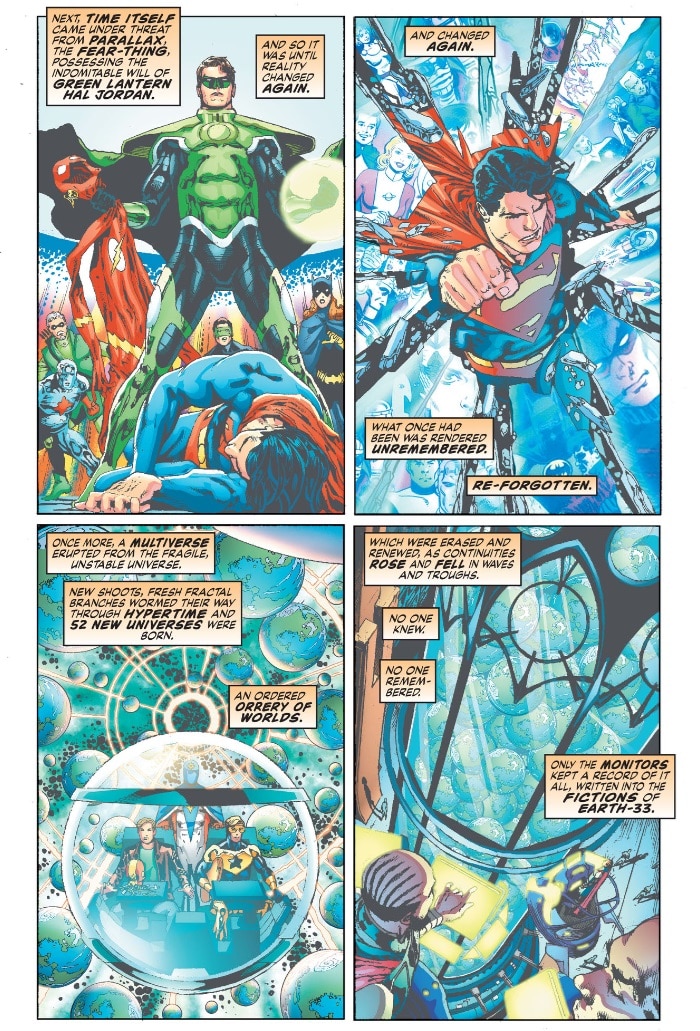
Coined in 2014’s The Multiversity, “The Orrery of Worlds,” a term mainly used by the Monitors, refers to the collection of infinite universes which exist within the multiverse. While not synonymous with the Multiverse, the Orrery does represent most of its contents, excluding the metaphysical realms of the gods, and the Monitors themselves. Functionally, it’s how the Monitors refer collectively to the worlds placed within their charge, whereas the “Multiverse” can be just a little bit broader. Unless you’re a Monitor, or perhaps a god, the distinction is mainly academic.
Sparkling Gold Unicorn, Runenoblade, TheManTheMyth and many, many others since I began answering questions for the DC community in 2018 all ask:
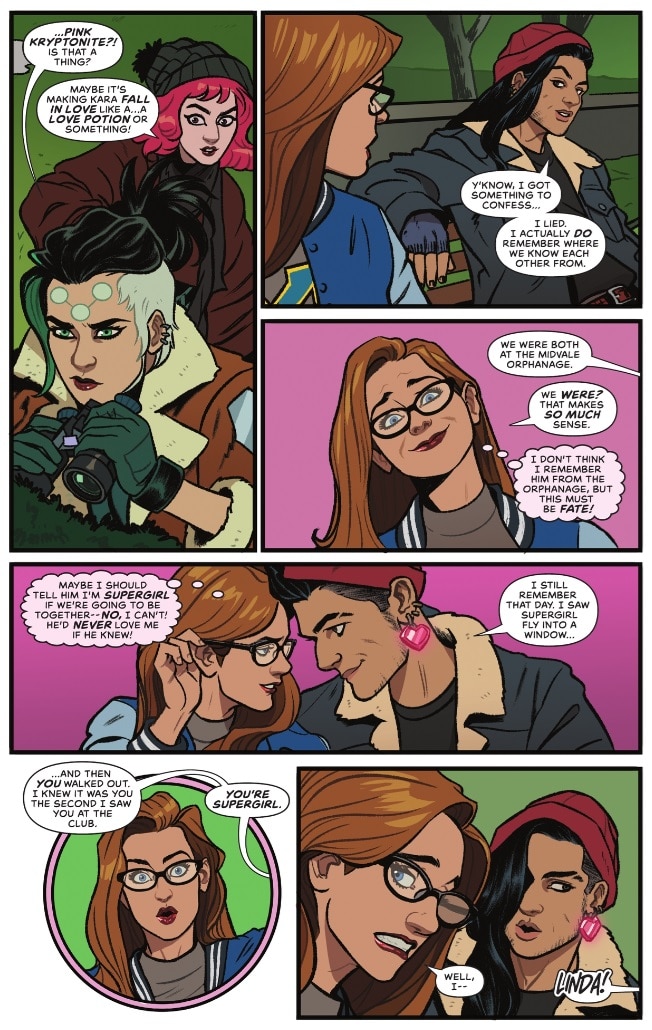
“What, exactly, does Pink Kryptonite do?”
Pink Kryptonite has been the subject of a great deal of fan discourse since it was first introduced in a single panel at the end of Peter David’s Supergirl #79 in 2003, as part of a gag which hasn’t aged too well where Superman is seen suddenly acting in a way that many might describe as flirtatious with Jimmy Olsen. Since then, despite never featuring any more significantly in the comics, speculation on this obscure Kryptonite variant has run rampant far beyond its significance as an off-color joke. The speculation was compounded by an additional appearance more than a decade later in the animated series Justice League Action, where exposure appeared to transform Superman into a woman. The truth was that outside of that one panel of that one issue, the comics went on continuing to operate as if the conversations about Pink Kryptonite simply weren’t happening and hadn’t been persisting for over twenty years. That is, until now.
In a two-part Valentine’s Day story, Supergirl writer Sophie Campbell took us back to Pink Kryptonite in issues #9 through #10 to finally reveal the canonical, in continuity truth about this variant of the mineral remains of Supergirl’s irradiated homeworld. As we finally learn here, Pink Kryptonite affects Kryptonians in much the same way that a love potion, or Cupid’s arrow, might affect a mere mortal, igniting within them a deep infatuation with the closest person in their proximity. Ms. Campbell has my eternal admiration and respect for arriving at such an elegant solution to this longstanding canonical question, and I salute her for making the rest of my question-answering days that much easier in this extremely specific regard.
And that’s all the time we have this month! I’ll be around in the DC Official Discord if you need an answer. You only have to ASK…THE QUESTION.
Alex Jaffe is the author of our monthly "Ask the Question" column and writes about TV, movies, comics and superhero history for DC.com. Follow him on Bluesky at @AlexJaffe and find him in the DC Official Discord server as HubCityQuestion.
NOTE: The views and opinions expressed in this feature are solely those of Alex Jaffe and do not necessarily reflect those of DC or Warner Bros. Discovery, nor should they be read as confirmation or denial of future DC plans.