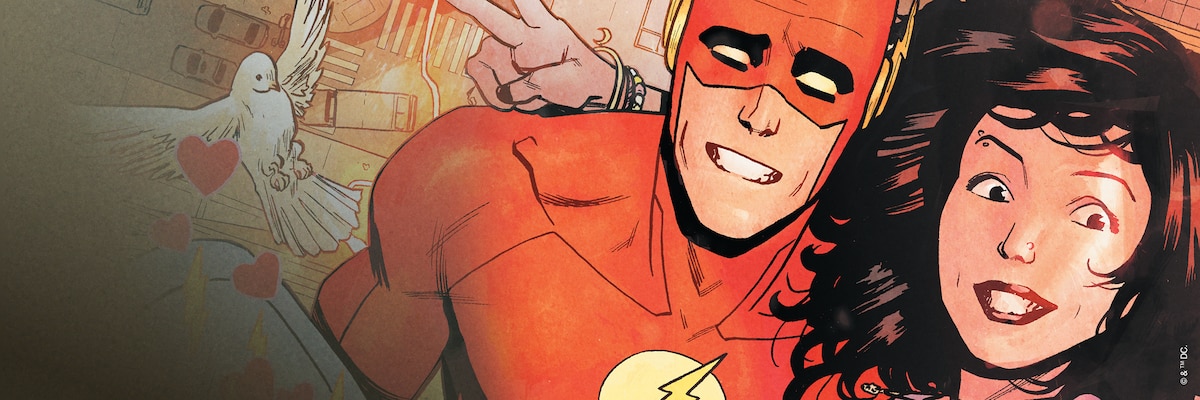
If you’re a certain kind of comic fan, the admittance of Marvel, Star Trek and Krypto: The Last Dog of Krypton writer Ryan North into the Flash Family is one of the most exciting developments of DC Next Level. With webcomic bona fides going back more than twenty years, Ryan feels like exactly the right person to leave his commentary on a character as impossible as the Flash, a hero known for exceeding lightspeed like he’s checking the mailbox in the morning. After speed-reading The Flash #31, the first issue of his new run with artist Gavin Guidry, we got a few nanoseconds to sit down with North to talk Wally vs. Barry, favorite Rogues and how super speed isn’t always enough to save the day.
Let’s start with an easy one: what is the Speed Force, and how does it work?
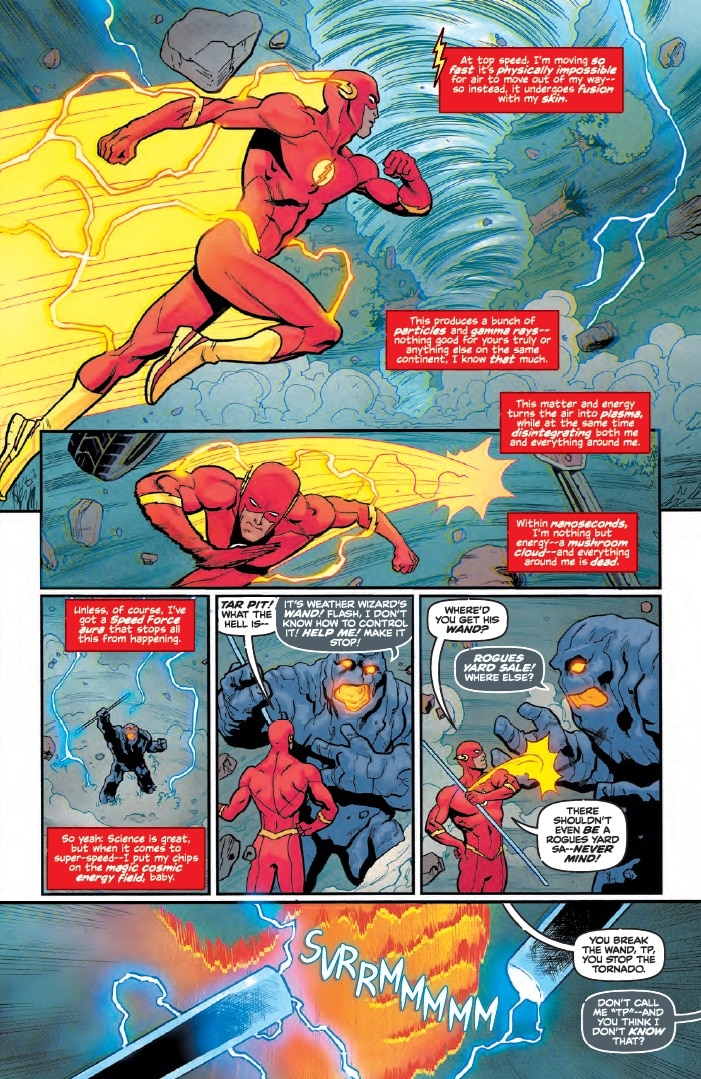
So, the Speed Force, in my mind, is a manifestation of the writer’s desire to have Wally West run really, really fast, and not be a nuclear explosion. It is the comic book science thing that lets us have the fun part that we want to do in the book. Very Doyleist answer. The Watsonian answer is it is a mystical thing that connects all speedsters in the DC Universe. I just think it’s such a nice shorthand. “Don’t worry about it—Speed Force.”
Writing a character who can approach basically any problem by doing it super fast feels like a little bit of a challenge. How do you come up with problems that the Flash can’t easily solve?
So, this is the joy and the challenge of writing The Flash. So many of the ideas you have boil down to either the Flash runs too fast, or the Flash can’t run fast enough. I feel like those stories have been told a million times. We’ve seen them. Not that they’re bad stories. I love a story where the Flash needs to run faster than he’s ever run before. The challenge is what else can you do with this guy? How do you come up with a story that can’t be solved by being fastest?
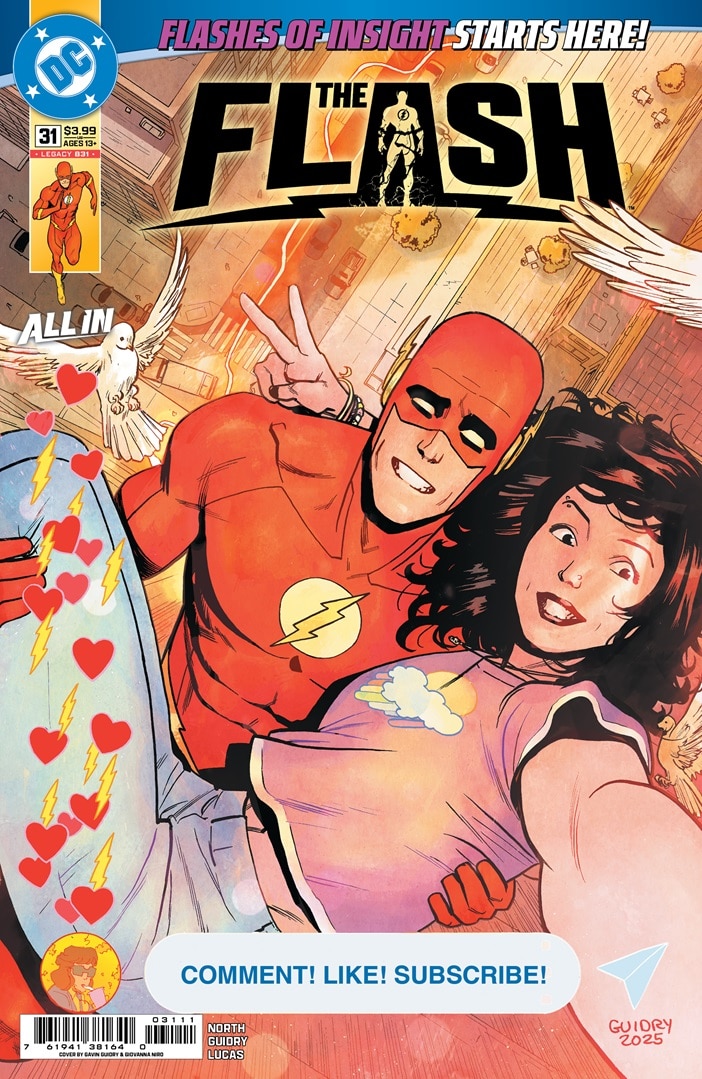
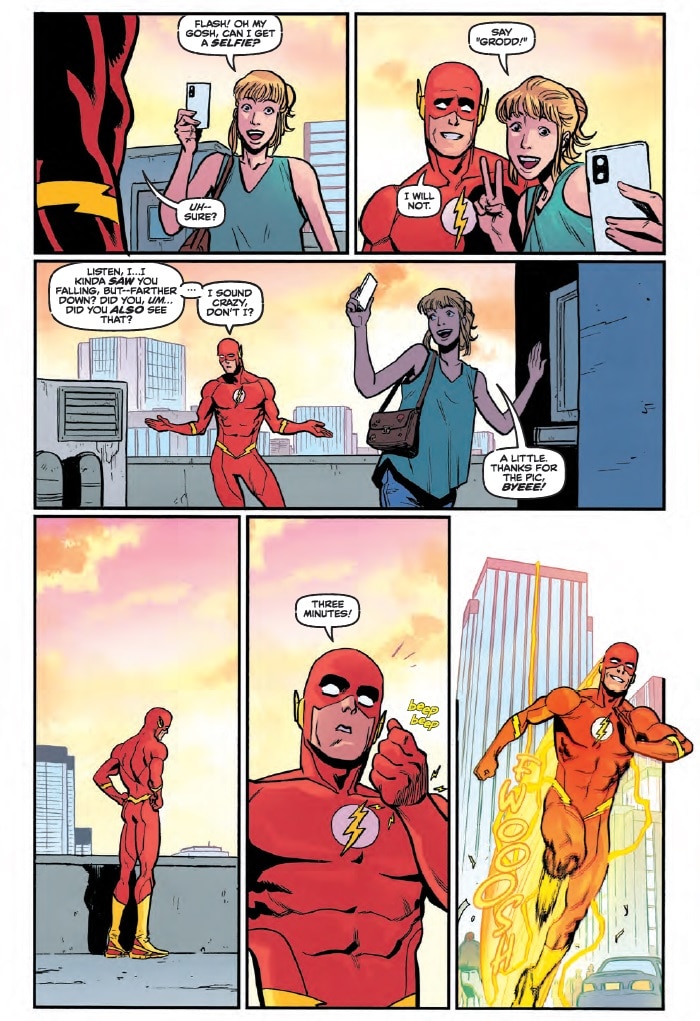
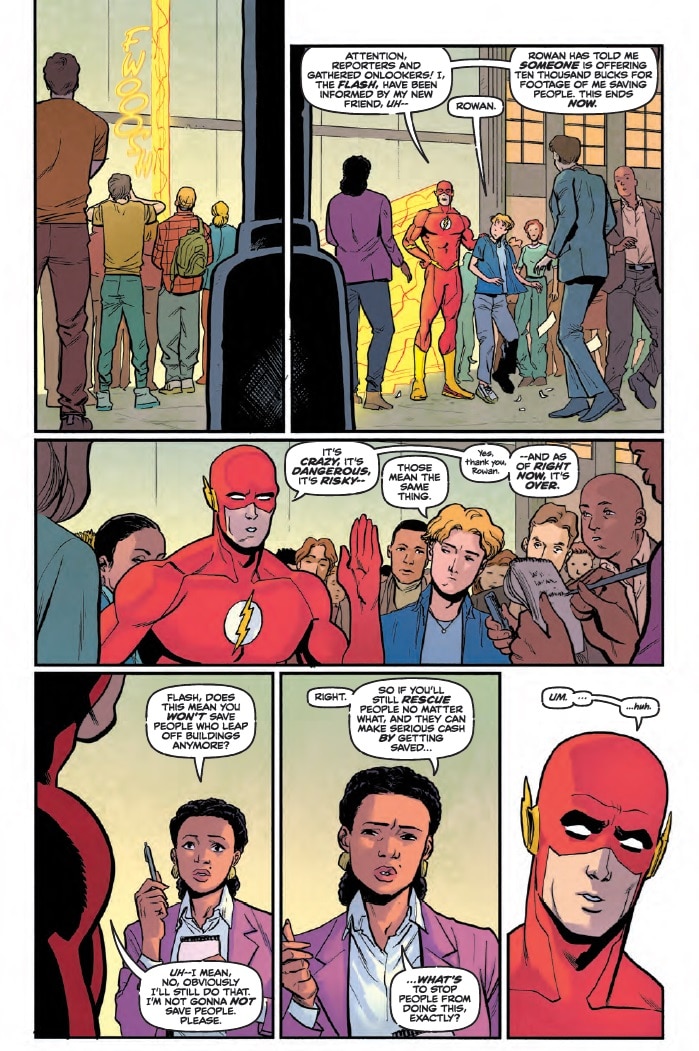
I think there’s a lot of different ways you can do that. The one we have in the first issue is there’s this social media trend of jumping off a building with a camera and recording yourself being rescued by the Flash. Because of course he’s going to do it. That’s not a thing he can solve by running faster. People are just going to do it more.
When you were first announced for this book, my first question to myself was, “Is this going to be Barry, or is this going to be Wally?” I’ll admit I was a little surprised when I found out you’d be taking on a Wally book. What do you think separates a Wally West Flash comic from a Barry Allen Flash comic?
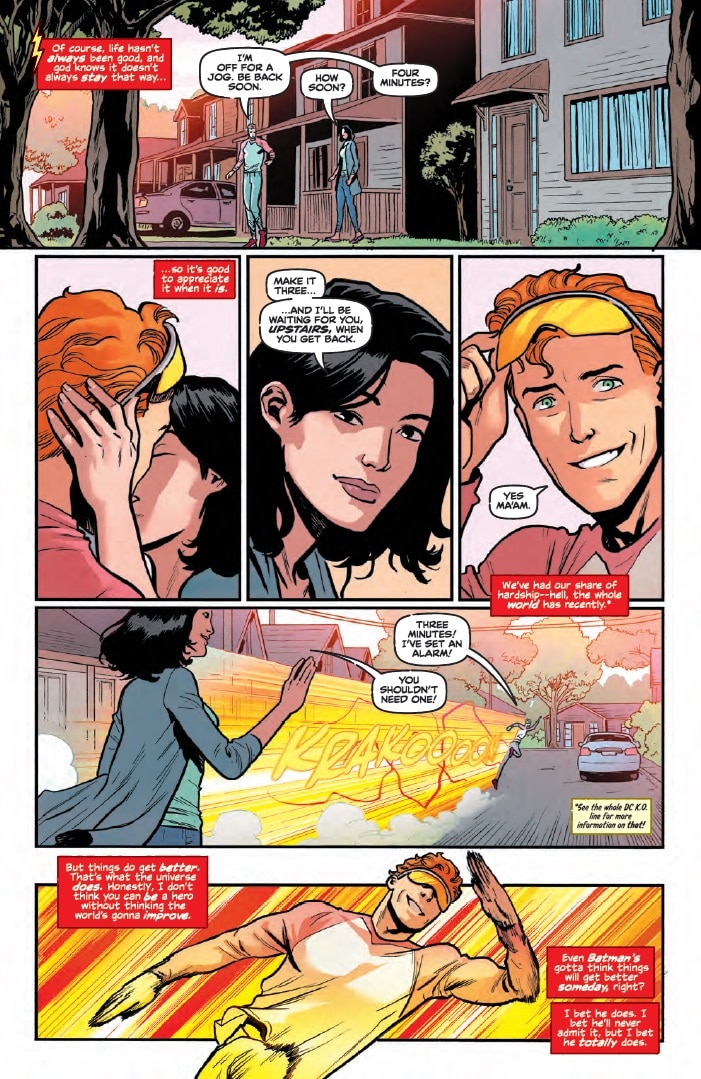
Barry has always, to me, been a police scientist. He’s a science guy. And Wally is the sidekick who made it. He’s the guy who just really loves being a hero. He loves that he has the Speed Force. He doesn’t have the analytical mind that Barry has, but he has a joie de vivre about doing what he’s doing and getting to do what he gets to do that’s really infectious. He gets to get up every day and be the Flash.
Reading this first issue, I detected a lot about how he enjoys a more casual, personal relationship with his city than most heroes do. How do you see the dynamic between the Flash and his hometown?
I think you hit the nail on the head there. It goes back to that joy of it, right? He gets to be the Flash, and I think for most people, outside of the Rogues, that’s an intrinsic good. It is a good thing to have the Flash running around the city, fixing crimes. And when it comes to the Rogues, I think what makes him so unique in comics in general is that I see him as someone with a sincere interest in helping these people. You can’t ever imagine Batman and the Joker ending up in a canoe together, but you can imagine that for Wally West and Captain Cold. It’s not a very comfortable canoe, but he’s willing to give them the rope to see what happens. And I love that relationship.
Batman’s never going to tell the Riddler, “Let’s get a drink after this.”
Yeah, Batman’s not going to be like, “Come on, man. We all got families. It’s 6:00 PM.” But Wally can.
Saying this now, I realize there’s this connection to Squirrel Girl, the Marvel character I wrote for five years, where she doesn’t like her villains from the start, but she’ll try to find a way in and try to make them friends. And Wally’s not quite there, but I think they have more than an adversarial relationship with each other.
It’s almost like he’s their parole officer. He’s expecting better for them.
Yeah! He wants better! “Come on, guys! You said you wouldn’t do it!”
I’d be remiss not to ask you about my favorite aspect of The Flash as a title, and what I think defines it going back to at least the Silver Age—the weird, hyper-specific villains who always show up with these really distinct powers. I want to know if you have any favorites from that established gallery who might make a return, or plans to introduce some of your own.
One of the joys of writing this book is you get all these great Rogues. I didn’t have them in my outline when pitching to my editors at DC. I just said, “We’ll fight some Rogues, don’t worry about it.” And then we get to them, and it’s like, “Who am I going to use? Who do I get to play with in this issue?” He doesn’t show up in the first issue, but I have Weather Wizard’s technology there. What a great power.
And I love that you have Tar Pit there, specifically one of Wally’s villains.
Tar Pit! It’s great! One of my favorite covers of all time, and this is an early one—is it Abra Kadabra, where the Flash is turning into a puppet, and he says, “I have the strangest sensation that I’m turning into a puppet”?
Perfect cover. Perfect premise. Perfect thing to be saying or thinking. Because it implies he knows what it’s like to turn into a puppet. The core of it is fun.
There was a time in the ’90s and the 2000s when we were like, “We are a serious medium, and we don’t do jokey things. Everything is very serious.” And we are a serious medium, absolutely. But it’s one of the mediums where you can go as big and wild as you imagine, and there’s no real roadblocks to making that happen.
With these interviews, I like to take the most popular question from the DC Official Discord server for whichever creator I’m interviewing. This is what people want to know from Ryan North right now: As a writer with some background in addressing super science, can we anticipate the return of Flash Facts?
…So, I love Flash Facts. I think they’re great. The instant I heard that question, I thought, “They SHOULD be there.” They’re not there…yet. I will be shocked if they don’t show up.
I’ve got one more question. Some of my favorite works from you in the past have been your multiple path stories like To Be Or Not To Be and Warp Your Own Way. Right now, you’re writing about a hero who is, among other things, famous for going back in time to fix his past mistakes.
[laughs]
Is there anything there…?
Um… There is something that is at least adjacent to what you’re describing in an upcoming issue. There is some fun stuff with that. Not necessarily going back and changing decisions, but…this is the first script I ever sent in that had an attached spreadsheet. I went “full Ryan” on this.
The Flash #31 by Ryan North, Gavin Guidry and Adriano Lucas is now available in print and as a digital comic book.