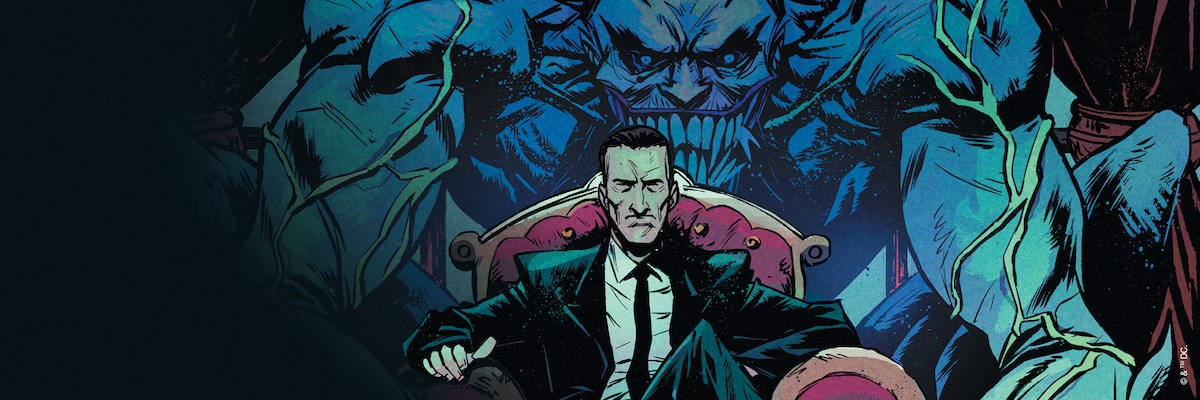
In Absolute Batman #15, the true form of Scott Snyder and Nick Dragotta’s Joker for the heightened, Darkseid-driven Absolute Universe was finally revealed to us. He’s a figure more draconic than human, a primordial evil that stalks humanity, taking joy from our despair.
Like the card that bears his name, the Joker has endured with greater legend and potency than any other Batman foe because of his versatility. His “madness” allows his character to bend and change to fit any story, without breaking the credulity of what he is meant to be—a clown, a killer, a monster.
In Absolute Batman, we’re witnessing a culmination of over fifteen years of meditation that Scott Snyder, one of the most impactful Batman writers of the modern age, has placed on the most iconic villain in comics. Throughout his body of work, Snyder presents a Joker who is the farthest thing from an agent of chaos. There is no stigma of mental illness about him, or excuse to his villainy. Snyder’s Joker has always been a methodically deliberate avatar of evil itself, his only laughter reserved for mockery of virtue and compassion.
The Dark Architect
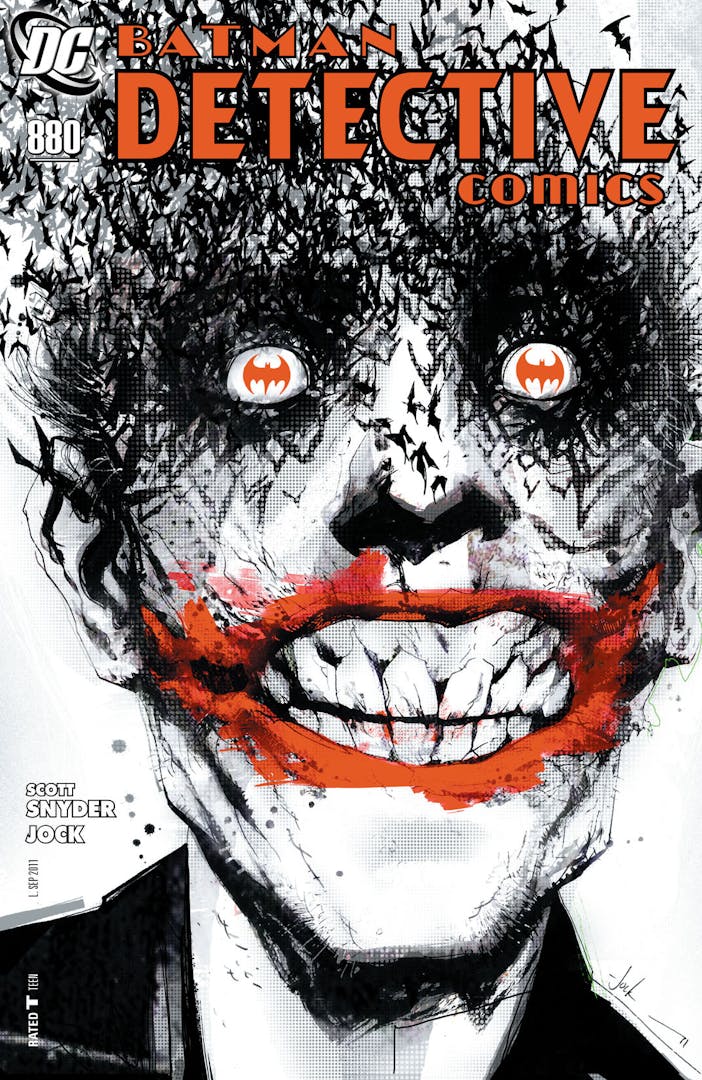
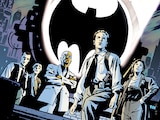
The first time Scott Snyder wrote the Joker, the story wasn’t even really about him. At least, not directly. In Detective Comics #880, set during Dick Grayson’s tenure as Batman, Commissioner Gordon discovers the visage of his first wife, the elder Barbara Gordon, fully Jokerized in his home bathtub. As we discover, the Joker himself had nothing to do with it. It was actually orchestrated by the commissioner’s son, the disturbed James Gordon Jr.
The moment was a shocking inflection point in a story about how evil begets evil, culminating in a haunting, open-ended look at a horrifying future for Gotham’s next generation. Even when the Joker himself is not the operator, his influence has spread to the point that he no longer needs to be. Here we see that the Joker has perversely realized his own version of Batman’s dream—that the symbol he represents has become bigger than himself and will continue to endure. This is the process by which a joke becomes a meme. In time, it no longer matters where the material originated, it becomes its own concept in the social fabric of how we relate to one another.
No court would deem the Joker responsible for James Gordon Jr’s actions. But here, in this early story before Snyder would become so synonymous with Batman, he establishes his thesis that what we consider the Joker is more than a man, but an act.
The Devoted Companion
Snyder made his most indelible mark on Batman history during the New 52, as he took the reins of the ongoing Batman series along with artist Greg Capullo. The series wasn’t always about the Joker. The greater overarching theme, as established in the landmark Court of Owls, was that the Gotham City Batman considered his own was bigger and had more dimension to it than he had always assumed. But when the Joker did appear, the high concepts would inevitably become very simple.
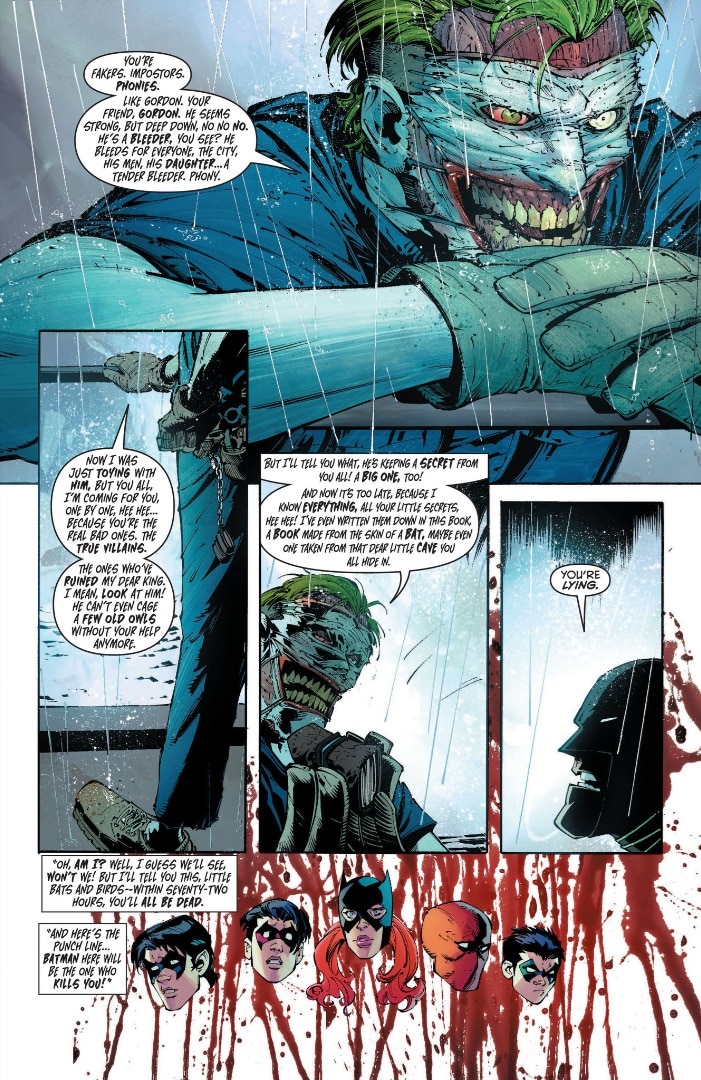
In the Joker’s world, Snyder supposed here, there are really only two people that matter. Like a court jester to a king, the Joker is cast here as a comic for an audience of one. Gotham is the stage on which he plays, but it’s all for Batman. Everything else, as so maliciously burned through by the Joker in Snyder’s Death of the Family, is extraneous. The lovers, the friends, the children—they don’t belong here, the Joker submits. All that matters is the conflict of good and evil, and that’s an act which only requires two.
The Dragon
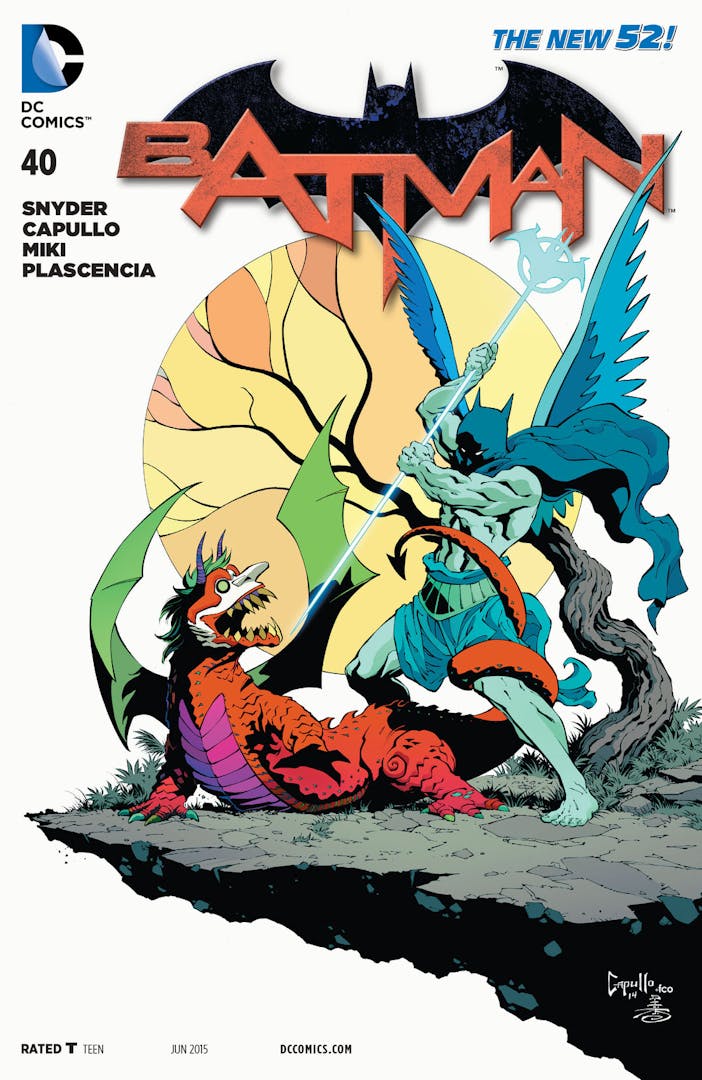
Death of the Family’s follow-up, Endgame, gets deeper into the idea of the Joker and what he represents. The cover of Batman #40, patterned after the classical imagery of St. George, depicts Batman slaying a Joker-faced dragon, on a stark white background—an image which should be familiar, in its own way, to those who have seen the striking reveal of the Absolute Joker’s true form on the cover of Absolute Batman #15.
Playing back into the idea of Snyder’s complex Gotham, we see here a Joker who may have always been a part of the city, with sightings of the wicked, pale figure dating back generations. Evidence suggests that like Vandal Savage or Ra’s al Ghul, the Joker has a chemical in his blood, “Dionesium,” which always allows him to return from certain death. Endgame supposes the Joker as no less than a representative of the concept of evil not for the sake of selfishness or personal gain, but as its own virtue. He is the devil Batman must defeat if he ever hopes to redeem the damned soul of the city.
And awash in Dionesium at the end of their battle, for a time, he does. Batman and the Joker are both cleansed. They each abandon their former identities. For a year, the man who was once evil itself just feeds the birds in a park. But no subversions last forever. Not to ideas this powerful. Like the Joker awakening from catatonia in The Dark Knight Returns, as Batman returns to the cowl, so must his opposite.
The Last Laugh
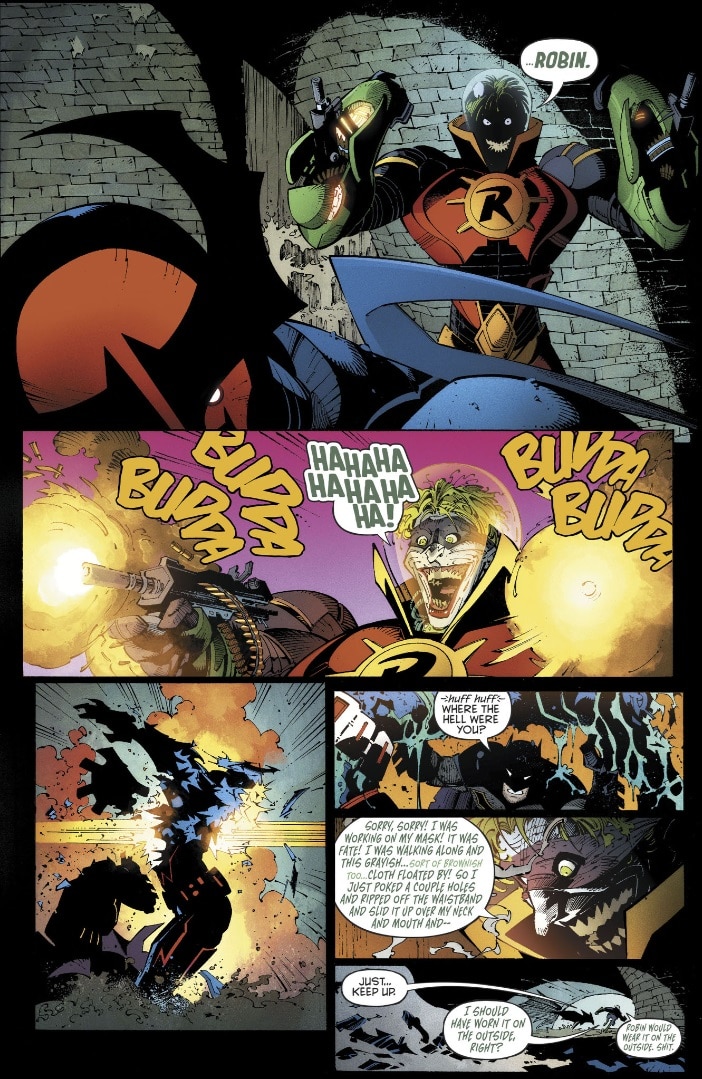
Scott Snyder and his New 52 Batman artist Greg Capullo, always escalating each arc in their collaboration to a new extreme, brought an apocalyptic coda to their run in the DC Black Label series Batman: The Last Knight on Earth—wherein a Batman beyond the end of the world finally grants the Joker, now a Dionesium-powered disembodied head, his fondest wish: now, finally, with the rest of the planet dead, corrupted or defeated, the Joker can be Robin.
To what end? Nothing less than defeating another Batman. When the symbol of good becomes twisted to evil, Snyder posits that this corruption can only be repelled by good and evil in their purest forms. Say what you will about evil, but at least the Joker is honest about what he is. Without establishing a clear premise, you wouldn’t have a very good punchline. A chimeric compromise of good and evil is something neither extreme can tolerate.
We see this again, of course, with Snyder’s establishment of the Batman Who Laughs—a Batman mutated by succumbing to his greatest temptation, the murder of the Joker. In his Metal saga, Snyder casts the Batman Who Laughs as the ultimate adversary of the DC Universe: The Joker’s cruelty as applied to a man whose greatest defining character trait is that no matter what, he always finds a way to win. In Dark Nights: Metal, it once again comes to both Batman and the Joker to defeat this profane middle ground between them together.
The Absolute Joke
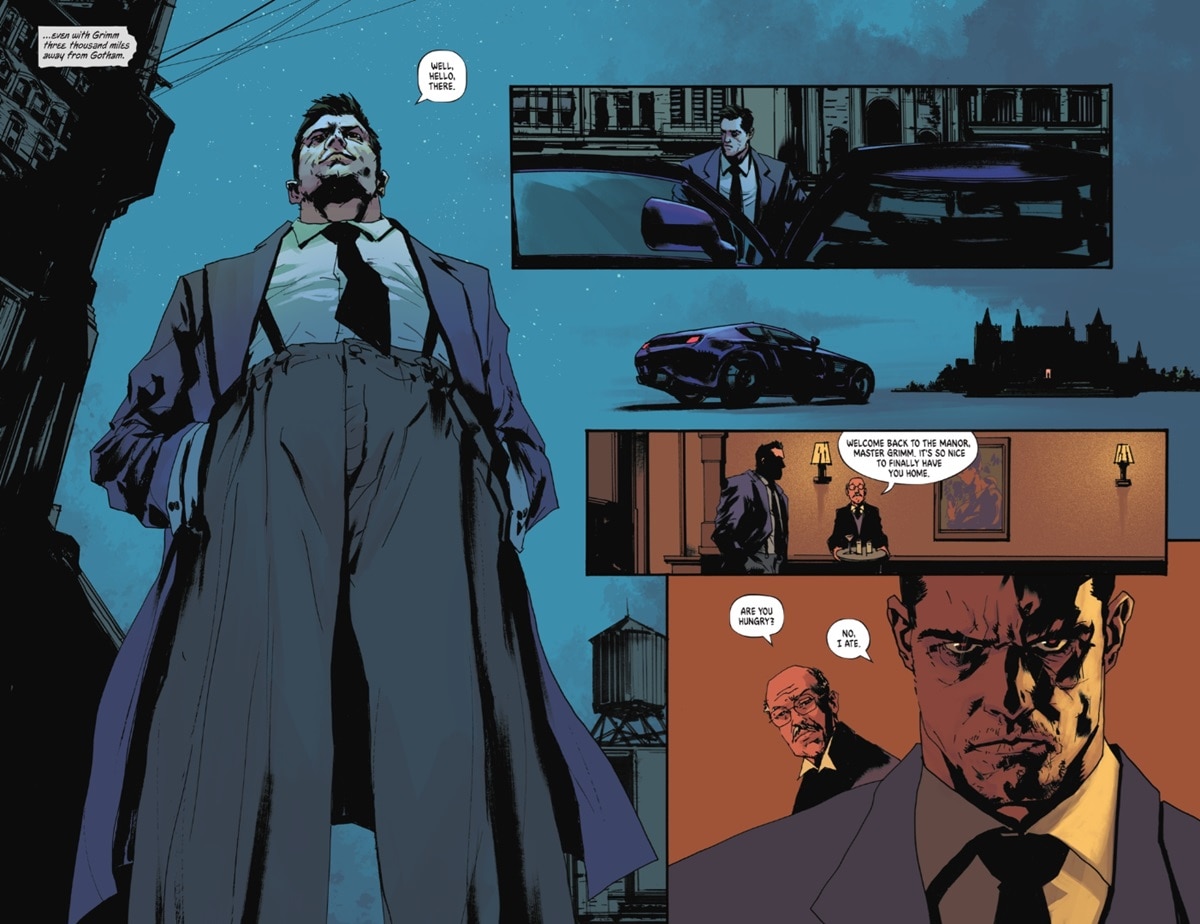
Just as Snyder’s last statement on the Joker was with the Batman Who Laughs, we first meet the Absolute Batman’s counterpart at the end of Absolute Batman #1, where he’s given a new twist. Now named ironically for his mirthlessness, the richest man in Gotham could accurately be described as the Joker Who Never Laughs.
But why should he? A comedian doesn’t laugh at his own jokes. And as we learn painstakingly through the horrible history laid out in Absolute Batman #15, every corner of the Absolute world that society touches is his joke on all of us. As in Endgame, we are reacquainted with a Joker who has been haunting and poisoning a world and its ideals for longer than any man could be alive. As in his very first Batman stories, the Joker’s evil spreads far beyond his direct actions, expressing itself here as a corporation actively dictating the lives of every person on Earth in its own way.
And just as in Death of the Family…we can all see where this is going. At the end of it all, when Batman’s friends and Joker’s pawns are all expended, it’s coming right down to the two of them. In every story Scott Snyder has ever told, be it directly or ideologically, the Joker always gets his way.
Let’s see if he still wants it when it comes.
Alex Jaffe is the author of our monthly "Ask the Question" column and writes about TV, movies, comics and superhero history for DC.com. Follow him on Bluesky at @AlexJaffe and find him in the DC Official Discord server as HubCityQuestion.
NOTE: The views and opinions expressed in this feature are solely those of Alex Jaffe and do not necessarily reflect those of DC or Warner Bros. Discovery, nor should they be read as confirmation or denial of future DC plans.