Each Friday, we'll be letting a different DC.com writer share what they'll be reading over the weekend and why you might want to check it out. Here's this week's suggestion for a perfect Weekend Escape!
Let’s start this edition of Weekend Escape by getting something out of the way…We3 is not an easy read for animal lovers. If you have a beloved pet and/or are overly empathetic to furry creatures in fiction, you might want to mentally prepare yourself before reading writer Grant Morrison and artist Frank Quitely’s Vertigo miniseries masterpiece. When I first devoured it, upon its initial release in 2004, I barely flinched. That was before my wife and I got our first puppy. Upon rereading it this week, We3 left me shaking.
All that said, if you haven’t read We3, you should. If you haven’t even heard of We3, which I suspect may be the case for a lot of you, you should definitely pick it up. At only three tight issues, it remains one of the best, most accessible comics that Morrison has ever written and one of the most intense, emotional and thrilling journeys you’ll take in the medium. And if it gets you to take in a new furry friend after reading it, it wouldn’t be hyperbole to call it life-changing.
The Premise:
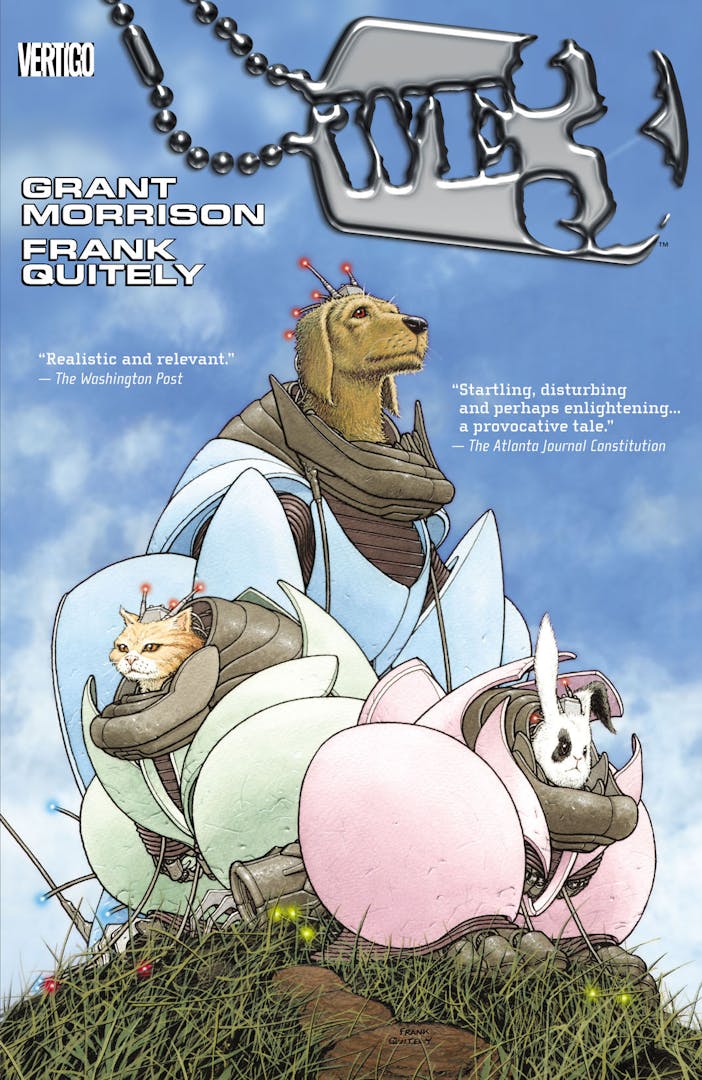
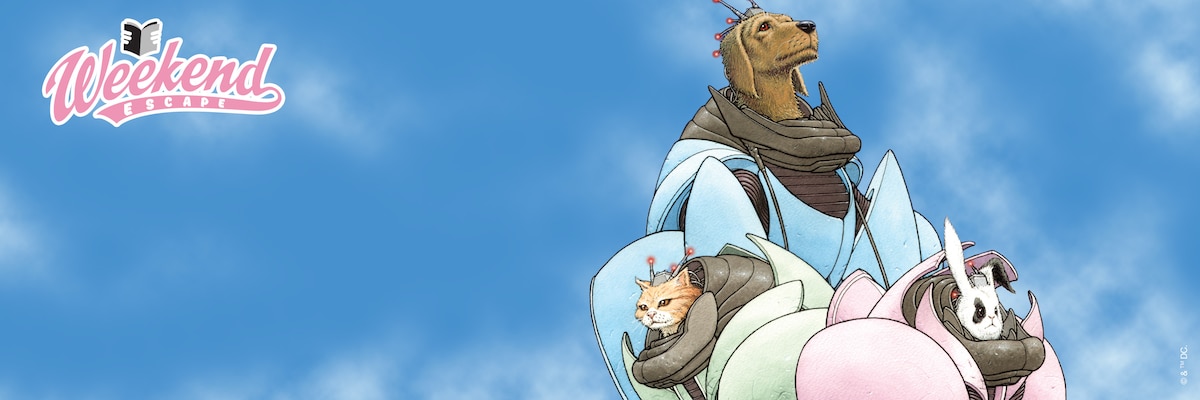
We3 operates in the grand literary tradition of Scottish author Sheila Burnford’s 1961 children’s novel The Incredible Journey—in which two dogs and a cat travel 300 miles to get home. It also echoes such contemporary fables about animal testing as Robert C. O’Brien’s Newbery Medal-winning Mrs. Frisby and the Rats of NIMH and William Kotzwinkle’s World Fantasy Award-winning King Rat. In We3, the animals are a stolen dog (named Bandit), a cat (Tinker) and a rabbit (Pirate). Secretly operated on by the military, they’re encased in mech suits and transformed into cybernetic killing machines. They escape their captors, only to wreak havoc on the many, many soldiers assigned to retrieve them as they try to go “home.” They eventually face an even more deadly cyborg.
Let’s Talk Talent:
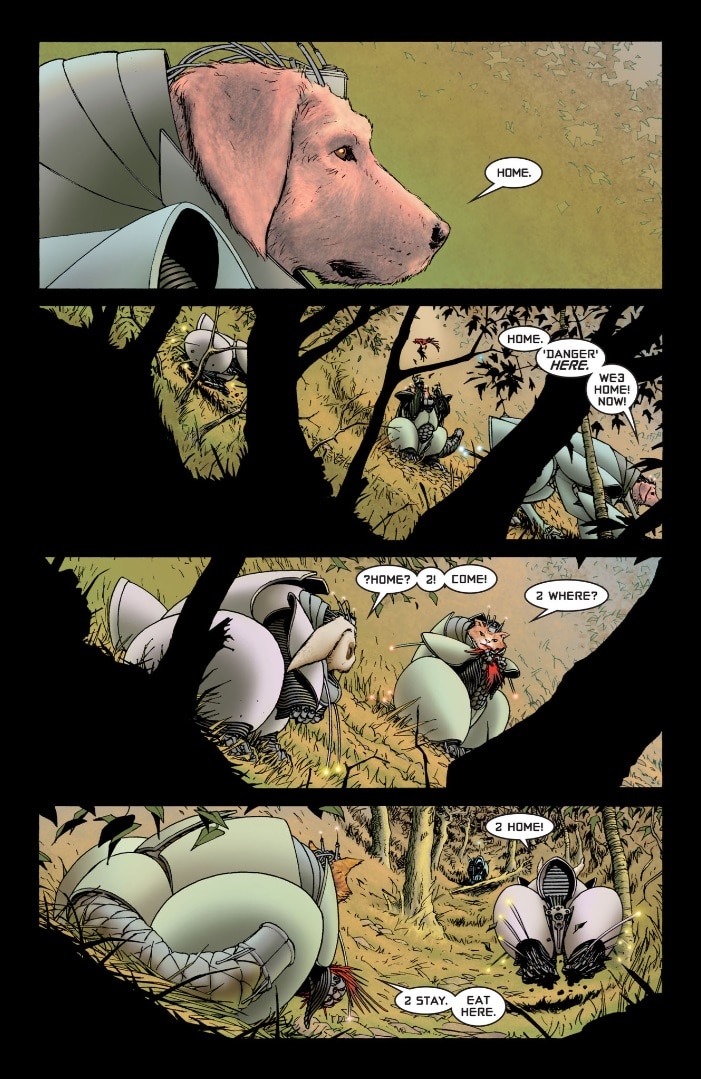
Morrison was operating at the height of their powers when they wrote We3. After establishing themself with post-modern epics like Animal Man, Doom Patrol and The Invisibles, they’d take a similarly cerebral approach to bestsellers like Seven Soldiers, Final Crisis, The Multiversity and All-Star Superman, which was also illustrated by Quitely. But We3 is the tightest work yet by mainstream comics’ own Thomas Pynchon. A heartbreaking, chilling little scream into the moral wilderness of the 21st century, it’s as thoughtful as anything they’ve written.
Frank Quitely, ably inked by Jamie Grant, delivers some of his best visuals. DC’s most idiosyncratic artist of the new millennium, his work is well deserving of all the praise its received. But at this point in his career, Quitely’s craggly-faced human figures could sometimes be too idiosyncratic for new readers. Not so his depiction of animals, which winds up heightening our sympathy for their plight. Plus, Morrison lets Quitely tell much of the story visually, which results in some of the artist’s most striking layouts.
A Few Reasons to Read:
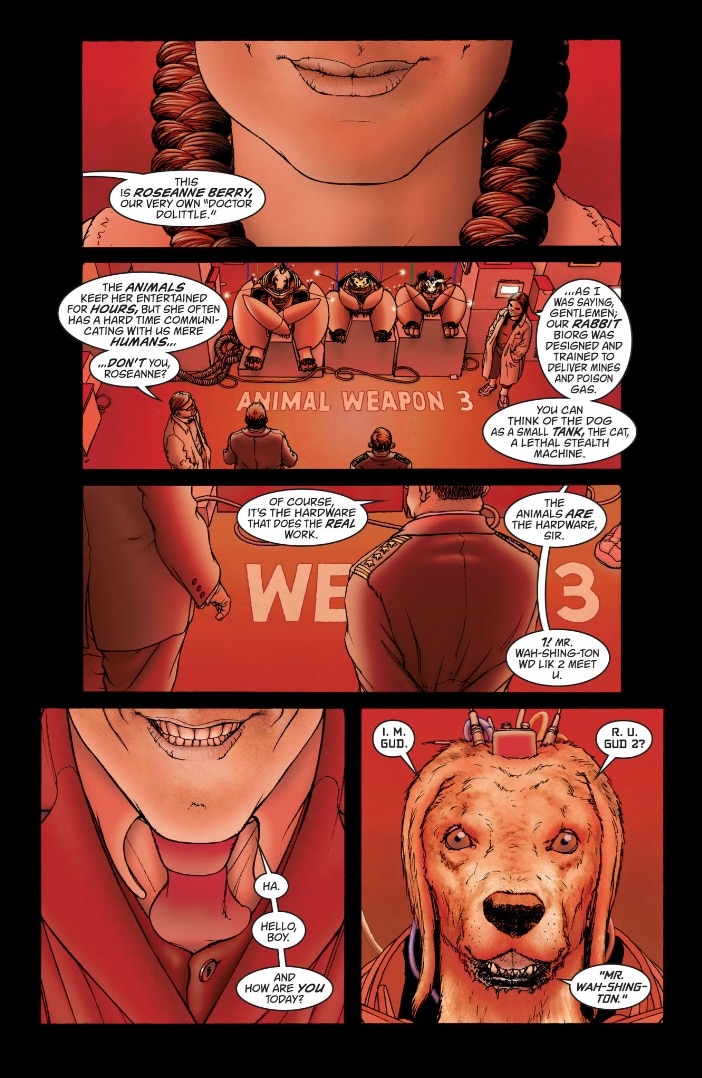
- Sadly, Morrison’s story has aged all too well, given the vigor with which today’s corporations are rushing into anthropomorphic artificial intelligence, no matter the end result. Another reason I found We3 far more disturbing this time around.
- We3 won two Eisner Awards in 2005: Best Penciler/Inker for Quitely and Best Lettering for Todd Klein. It was nominated but lost Best Limited Series to Darwyn Cooke’s DC: The New Frontier (which was also the subject of a recent Weekend Escape). There’s no shame in that, of course. Cooke’s work is masterful. But of the two, it’s We3 that serves as a better introduction to the medium for new comics readers and the perfect self-contained gift for casual fans…provided they can appreciate intelligent science fiction that isn’t afraid to go for the jugular. Literally in this case.
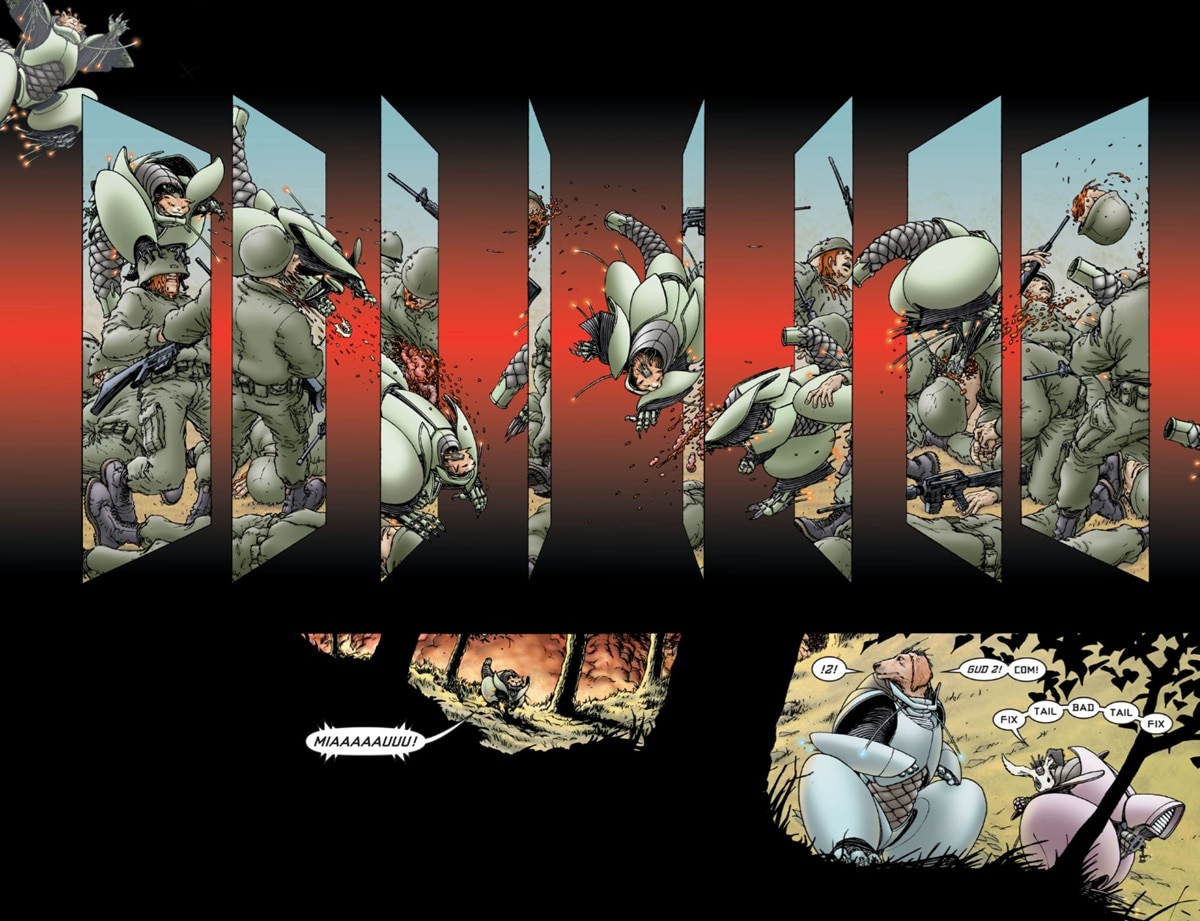
- At the same time, We3 was remarkable in the way it pushed the visual medium. Quitely’s work, while always remaining accessible, enters the experimental, testing the boundaries of what it means to tell a story visually. Every page of this book serves as proof that there’s no one way to draw a comic book and functions as its own unique work of art.
- DC Films Co-Chair and CEO James Gunn has never hidden his love for Morrison’s work, elements from which have found their way into Peacemaker, Creature Commandos and last year’s Superman film. In March 2003 on Facebook, Gunn expressed interest in adapting We3 to film. The book is likely to have inspired his take on Rocket Racoon in the Guardians of the Galaxy movies, and particularly Rocket’s fellow surgically mechanized critters in Guardians Vol 3. If you’ve seen that film, We3 touches on some of the same themes.
Why It’s Worth Your Time:
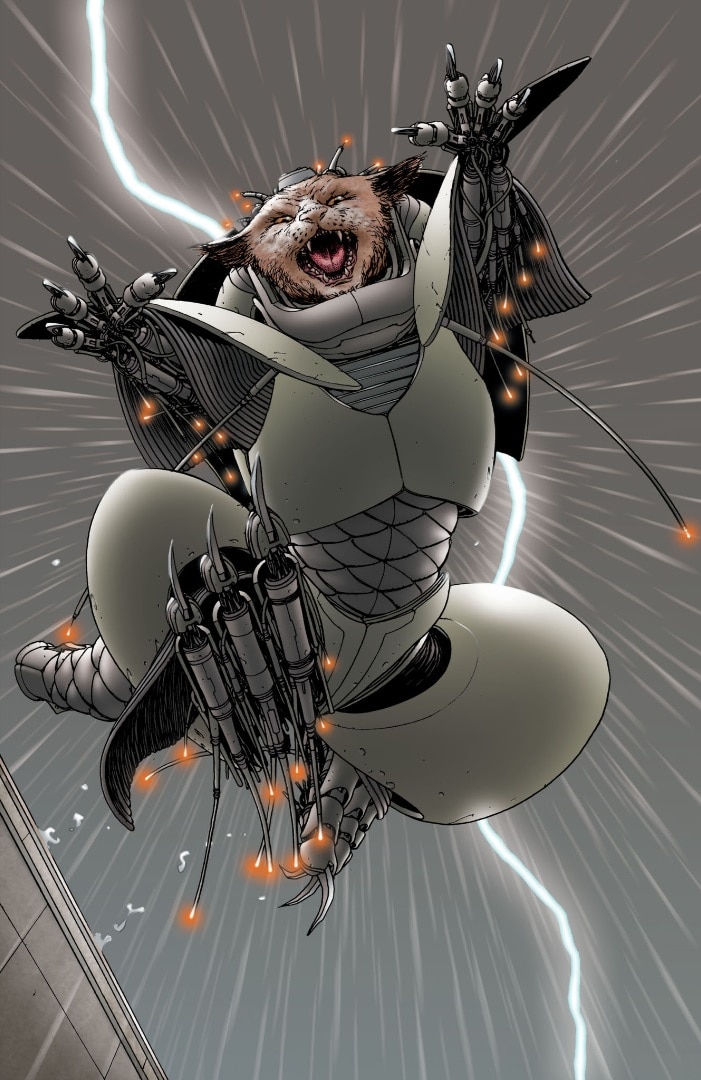
Like the original Robocop, We3 is a propulsive, high-tech, brutally violent variation on Mary Shelley’s Frankenstein. It’s a brilliant, impactful cautionary tale about those arrogant enough to think they can master nature, and the innocents they sacrifice in trying to do so. It might make you angry. It might make you cry. What you won’t do is forget it any time soon.
We3 by Grant Morrison and Frank Quitely is available in bookstores, comic shops, libraries and digital retailers as both a standard softcover graphic novel and in a new DC Compact Comics Edition. It can also be read in full on DC UNIVERSE INFINITE.
Joseph McCabe writes about comics, film and superhero history for DC.com. Follow him on Instagram at @joe_mccabe_editor.
NOTE: The views and opinions expressed in this feature are solely those of Joseph McCabe and do not necessarily reflect those of DC or Warner Bros. Discovery, nor should they be read as confirmation or denial of future DC plans.