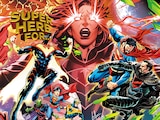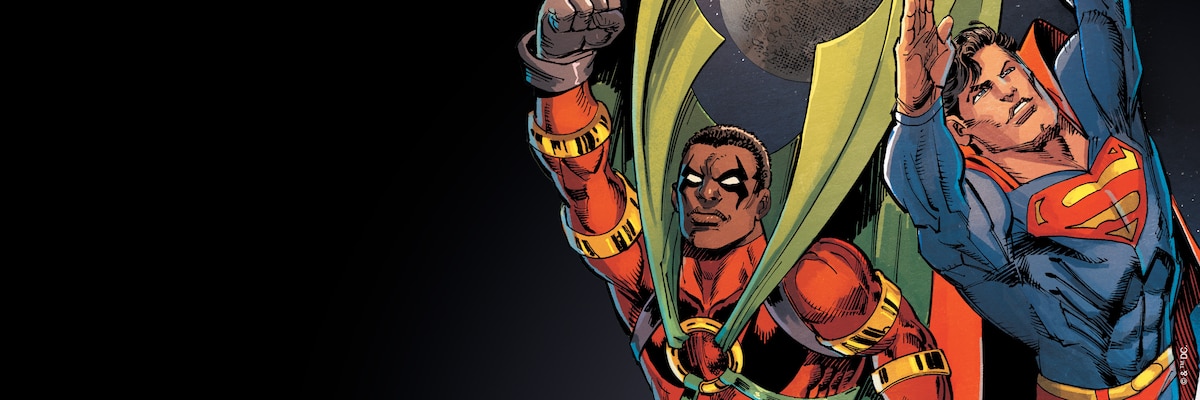
Ever since 1994’s “Worlds Collide,” the heroes of the Milestone Universe have had a connection with the heroes of the DC Universe. The problem is that no one has been able to define what exactly that relationship was.
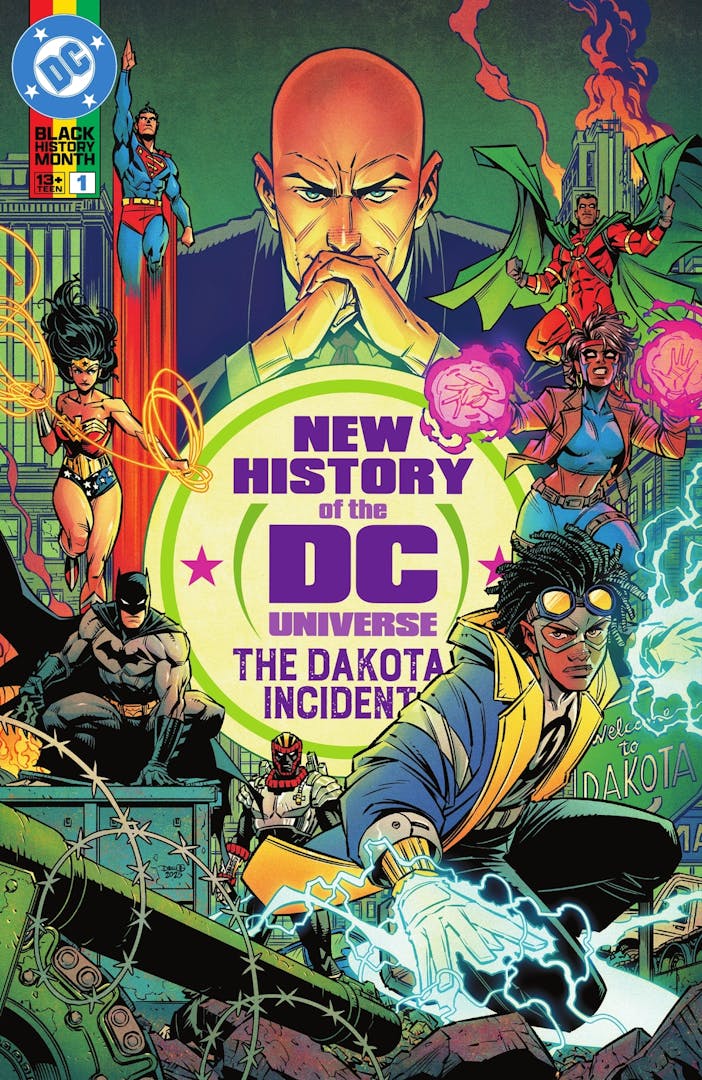
With the publication this week of The New History of the DC Universe: The Dakota Incident, that’s finally changing. Spinning out of last year’s timeline-setting The New History of the DC Universe, The Dakota Incident expands on events only hinted at in the original Mark Waid-penned series that explain once and for all where Static, Hardware, Icon and the other heroes of Dakota fit in. Written by a team that includes Joseph Illidge, Stephanie Williams, Morgan Hampton and Nikolas Draper-Ivey, and drawn by artists including Carlo Pagulayan, Valentine De Landro, Fico Ossio and Edwin Galmon, it’s a pivotal chapter in understanding just how inseparable the two superhero universes truly are.
To gain a sense of how it came together, the differences between this new crossover and “Worlds Collide,” and the role Milestone continues to play in today’s comic book sphere, we spoke with Illidge, who’s worked extensively within both universes and wrote the script for The Dakota Incident’s first act.
In The New History of the DC Universe, seeds were planted that inferred Milestone’s new continuity in the DC Universe. Was that planned from the beginning, or were both the Milestone and DC elements developed separately and put in conjunction with each other later?
It was a combination. When we began talking about it over a year ago and Marquis Draper, the editor, brought the writers together, [Senior Editor] Brittany Holzherr was in the room, as was [New History of the DC Universe writer] Mark Waid. Mark’s got the most encyclopedic knowledge of the DC Universe and he used that to help take on the Herculean task of compressing it in a digestible timeline. Brittany also understands all the levers of the DC Universe. Both worked to seamlessly fuse the Milestone Universe with the DCU in a way which was organic and made sense.
But the conversation to meld the two universes together came up sometime before The New History of the DC Universe was published, so it was a plan from the very beginning.
What’s noticeable in The New History for eagle-eyed Milestone fans is that the detail of the Big Bang (the event that sparked the beginning of the Milestone Age of Heroes) taking place during a protest—as opposed to a gang war—goes back to the revamped origin from 2020. How much of that version and the subsequent Season One of Milestone stories was incorporated in this current version of Milestone’s new backstory?
It’s interesting because the Milestone Universe is more frequent in its reboots than the DC Universe. What we tried to do with this is what I would call the “Absolute Batman #1 approach” in which Scott Snyder was able to seamlessly take touchpoints from throughout the most seminal Batman stories and bring ingredients together for a new kind of narrative. What we’ve done is create a new kind of continuity that brings elements from the original Milestone iteration from 1993-1997 and the Milestone Returns iteration, and add some new elements to the mix.
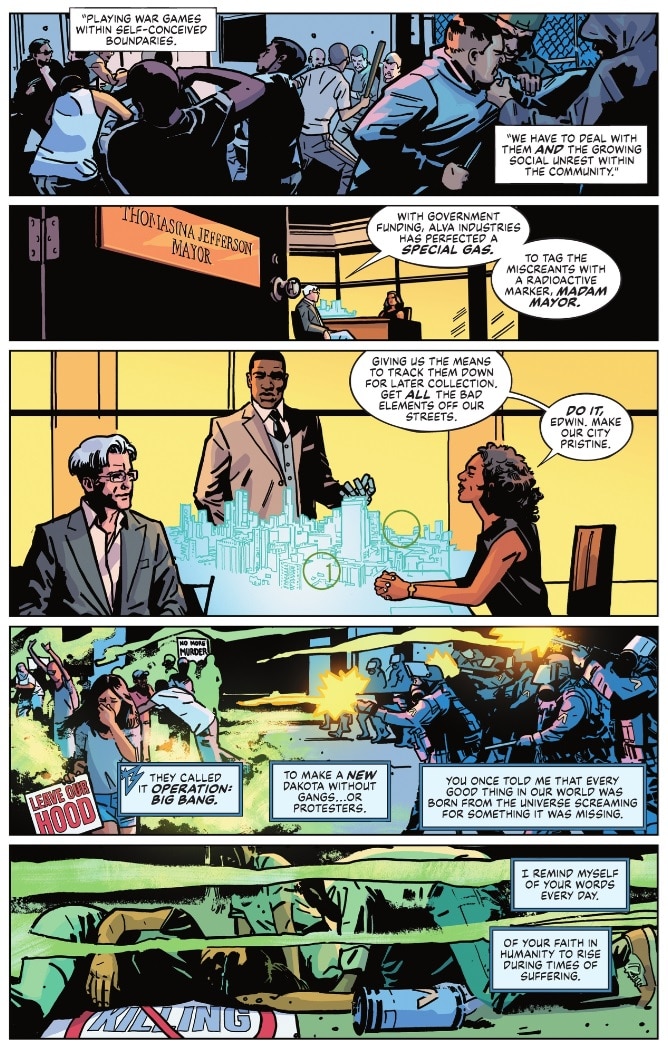
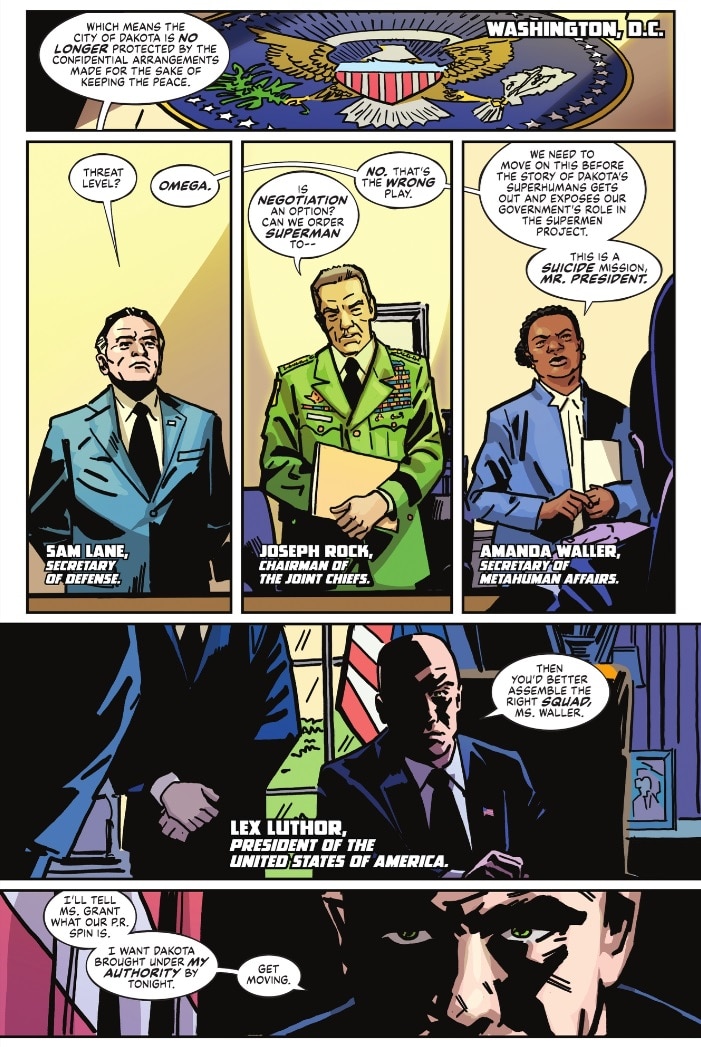
Regarding the continuity, this story takes place during the reign of Lex Luthor as the U.S. President. What was the decision to square the Dakota heroes’ career during that period of continuity?
Part of it was figuring out what the story is about. Once that’s done, you look for organic touchpoints in the DCU continuity that can be brought to bear, which can help increase drama and raise the stakes for the characters. There must be a universal sense of stakes, for both the DC heroes and Milestone heroes. If you look at continuity, the emergence of Milestone and Lex Luthor’s time as the President of the United States happen within a seven-year period. What Mark had to do with The New History was to compress decades into mere years. So that compression of time made the confluence of those two things work out perfectly.
I enjoyed the scenes between Bronze Tiger and the Milestone characters. The diversity of personality spoke to what made Milestone successful with the realization of grounded, fully dimensional people who happened to be superheroes. Were the ways in which the different characters would contrast with each other considered when coming up with this story? Can we expect to see more interaction between the Milestone and DC characters in the future?
What we’ve set up is a great reemergence for the Milestone heroes in the DC Universe. This story takes a naturalistic approach to characters, which was always essential in Milestone’s storytelling.
I feel like one of the best things in crossovers is when they reveal in characters things we would not usually have seen. When you have that colliding of worlds, new revelations can occur with characters. We definitely aspired to achieve that with this story.
Speaking of the colliding of worlds, you worked in the old Milestone offices during the first crossover with DC, “Worlds Collide.” Has incorporating the new Milestone Universe into the DC Universe been more difficult now than it was during that crossover back then?
I think it was easier, and I’ll tell you why. The first “Worlds Collide” crossover specifically dealt only with the Superman office. That story didn’t have the entire DCU to work with, and it was spearheaded by Dwayne McDuffie and Mike Carlin, who were the editors. What they created was amazing, but what we have is a much larger stage to deal with. Because of that, you can bring in other interesting characters.
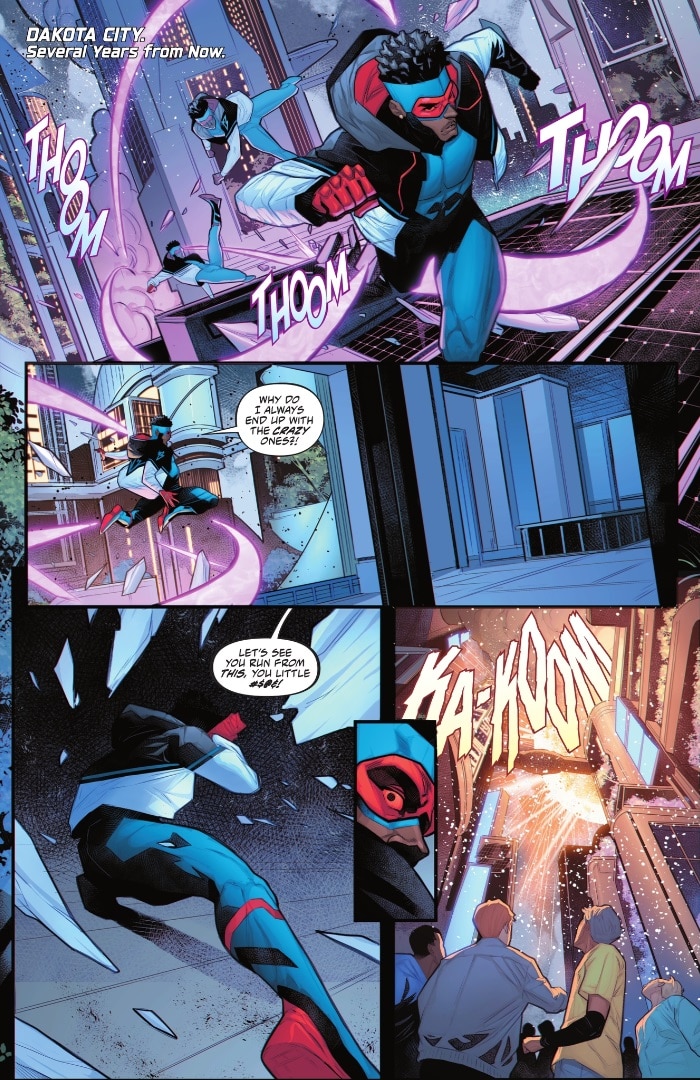
This story begins with Amistad Ervin a.k.a. Beacon, who is also appearing in the current Batman/Static crossover which takes place in the characters’ future. Through him, we’re traveling back and forth in time, seeing the wide scope of the Milestone trajectory. Was that also something intended from the beginning?
Beacon’s inclusion was crucial to the story because what The Dakota Incident is dealing with is the future of the Milestone heroes, not just in a publishing context, but a continuity context. We wanted to show that what was at stake was the future of heroism in the Dakota palette of heroes. Will the Dakota heroes’ representations make it to the era of the Legion of Superheroes and Batman Beyond? Is Milestone forever? It’s a metatextual statement that the future of the Dakota heroism was at stake. Beacon being a part of that, his future being in danger, and him having to travel in the timeline for the final confrontation with Virgil Hawkins—that’s all at the core of what this story is. What’s at stake is the future of heroism.
Is now a prime time to reintroduce Milestone in a stronger form than it was in 1993? Has the potential for the universe evolved? Or has the reality of the current comic book industry made it more difficult?
Number one, I don’t think there’s a stronger version of Milestone than Milestone Comics from 1993-1997. It can’t be beaten by any other superhero universe. Its potency, its distinguishing qualities, and its global view of heroism and representation of people is unparalleled. The industry at that time…if you sold 400,000 of a book, it was not viewed as a success. So, I don’t know if the industry has evolved.
What I think has evolved are the stakes. Because the stakes are higher, it’s all or nothing now. But we’re in a unique position here. For one, Milestone comic books benefit from a vast cosmology and stage that is the near 100-year-old DC Universe. I feel like this is a perfect confluence of events for the return of Milestone and a new age of Milestone heroism.
We recently lost Jesse Jackson. With that in consideration, would you say the “mission” of Milestone has changed or has it remained the same since 1993?
The mission continues, but the need for the mission has heightened. We are in a time of great change, and this great change demands fighting for heroism. It demands daring, it demands risk. Taking chances. It demands more expansive thinking and hope. Milestone represents all of that.
Final question. Who is your favorite Milestone character and what is your favorite Milestone book?
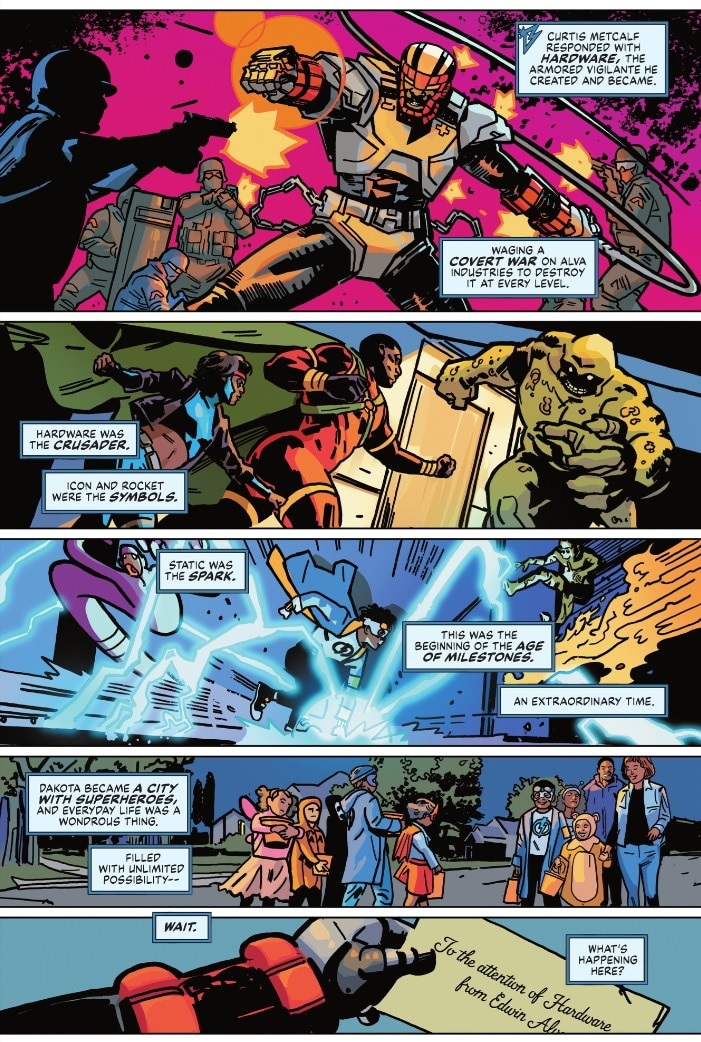
Rocket is my favorite Milestone character, and my favorite Milestone book from the original run is Hardware #1. It’s one of the best first issues of a superhero comic book series ever produced in the North American space.
The New History of the DC Universe: The Dakota Incident #1 by Joseph Illidge, Stephanie Williams, Morgan Hampton, Nikolas Draper-Ivey, Carlo Pagulayan, Valentine De Landro, Fico Ossio, Edwin Galmon and more is now available in print and as a digital comic book. It can also be read in full on DC UNIVERSE INFINITE.