Gotham City is a busy place, with a lot going down each and every week. In this monthly column, Joshua Lapin-Bertone helps you stay on top of it all by letting you know what you should be paying attention to within the Bat-Family…and why.
There’s no place like home. Unfortunately, home has a way of hurting you in a way no other place can. Pamela Isley learns this the hard way in Poison Ivy #40, but if you know anything about Ivy, then you know this is nothing new for her.
If you haven’t been reading G. Willow Wilson’s Poison Ivy series, then you’re missing out on one of the most interesting books DC is putting out. The comic’s writer since its 2022 debut, Wilson has crafted a long-running saga for Ivy that feels like a prestige television drama. It’s an ongoing storyline that keeps on building with twists, turns and fascinating character development. Considering the comic was originally supposed to be a six-issue limited series, it’s an impressive feat. Not bad, Ivy!
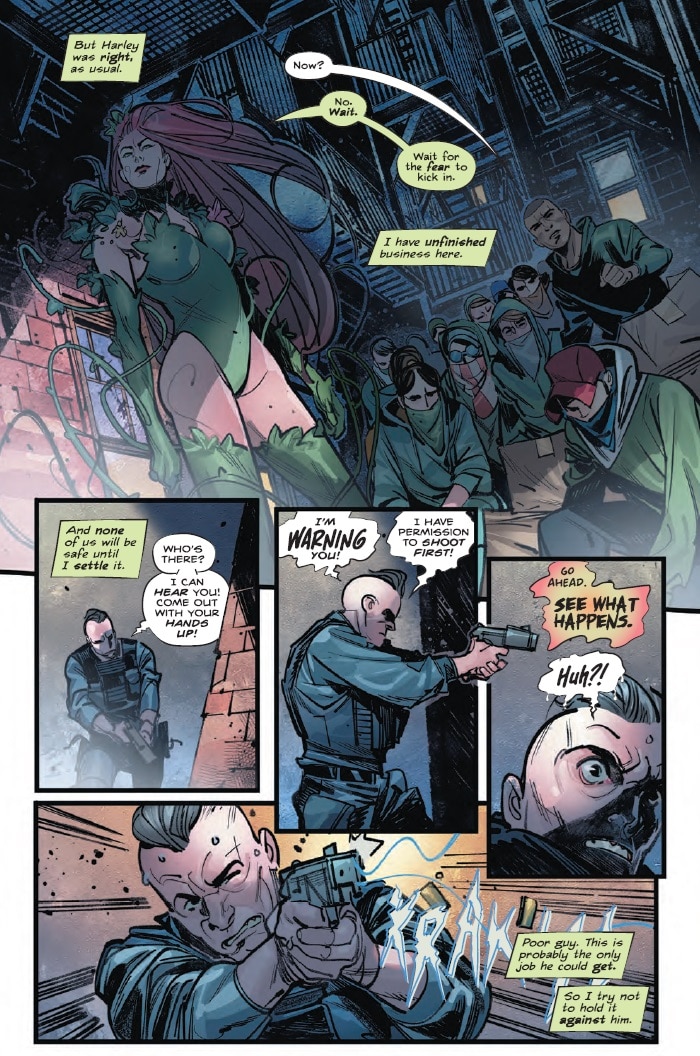
Poison Ivy #40 sees Pamela returning to Gotham. I’ve always been curious about her relationship with the city. After all, Gotham is a sprawling city, which isn’t ideal for a nature lover like Ivy. Wouldn’t she be happier somewhere else like Smallville or Happy Harbor? From a narrative standpoint, we need Ivy in Gotham or she can’t hang out with Harley or fight Batman, but why does she choose to return to the city?
We get some insight into this through Ivy’s narration: “I’ve always had a love-hate relationship with this city. It’s the place where I first heard the earth screaming. The place where I fell in love. I’ve shed so much blood in these streets that the asphalt might as well be part of my body. I hate leaving it almost as much as I hate coming back.”
This helped me see Gotham through Ivy’s eyes and realize why she’s so drawn to the city. Love it or hate it, Gotham has shaped Pam as a person and it’s a big part of her identity. In fact, as Ivy’s connection to the Green grows, Gotham seems to be one of the last remaining parts of her humanity, and whether she wants to admit it or not, she isn’t ready to let that go.
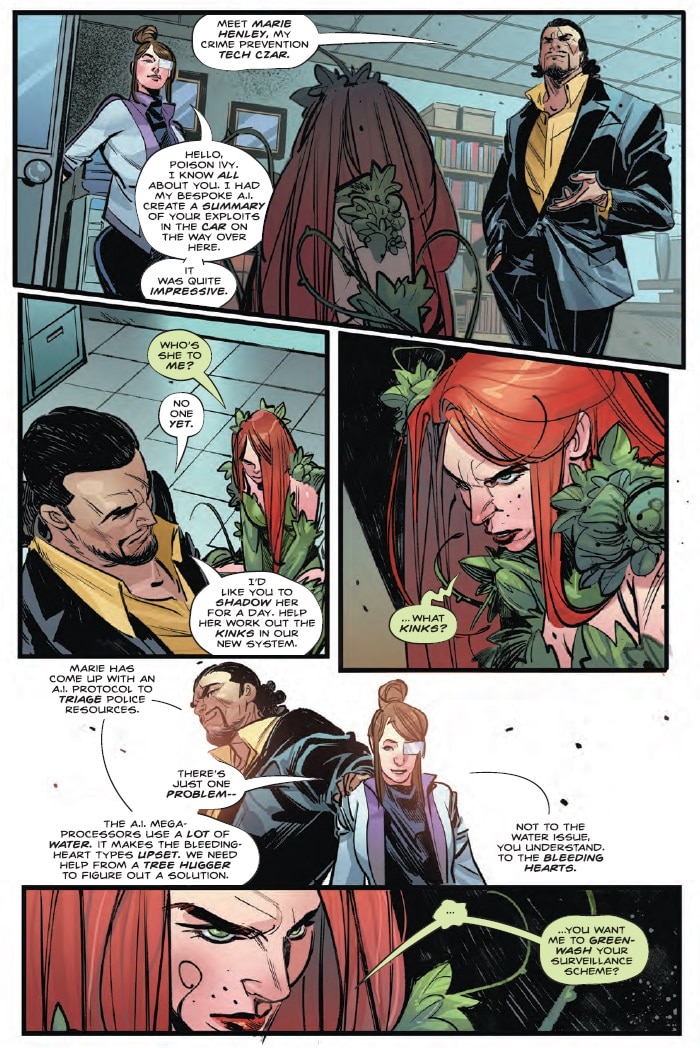
This is where the love-hate relationship that Ivy mentions comes in. Pam returns to Gotham with good intentions, trying to negotiate a ceasefire with Commissioner Vandal Savage, but everything blows up in her face. In exchange for her freedom, Ivy promises to help make the city’s AI systems more eco-friendly. Unfortunately, this arrangement only lasts a few pages. Ivy quickly realizes that the AI program is not only exploiting the community, it’s also exploiting nature. Savage has deceived her and Gotham has let her down again.
Credit to Wilson and artist Davide Gianfelice because this moment really made me see Ivy in a new way and recontextualized a lot for me. Realizing Savage’s new program was exploiting the city, Ivy felt betrayed, and her life has been full of betrayals. Her former mentor Jason Woodrue betrayed her, which is how she became Poison Ivy in the first place. More recently, Ivy felt that same sense of betrayal every time Harley returned to the Joker.
G. Willow Wilson comes back to this theme throughout the series. In Poison Ivy #38, we see how emotionally devastated Ivy is after learning that her friend Janet Mitchell has betrayed her. She’s also been manipulated by an agent of the Green named Bog Venus. We saw Ivy serve as the ambassador between the Green and the Grey, but that role was filled with its own betrayals and manipulations (seriously, you all need to catch up on this series). Ivy has been manipulated and betrayed her whole life, and Wilson is showing us what that does to a person.
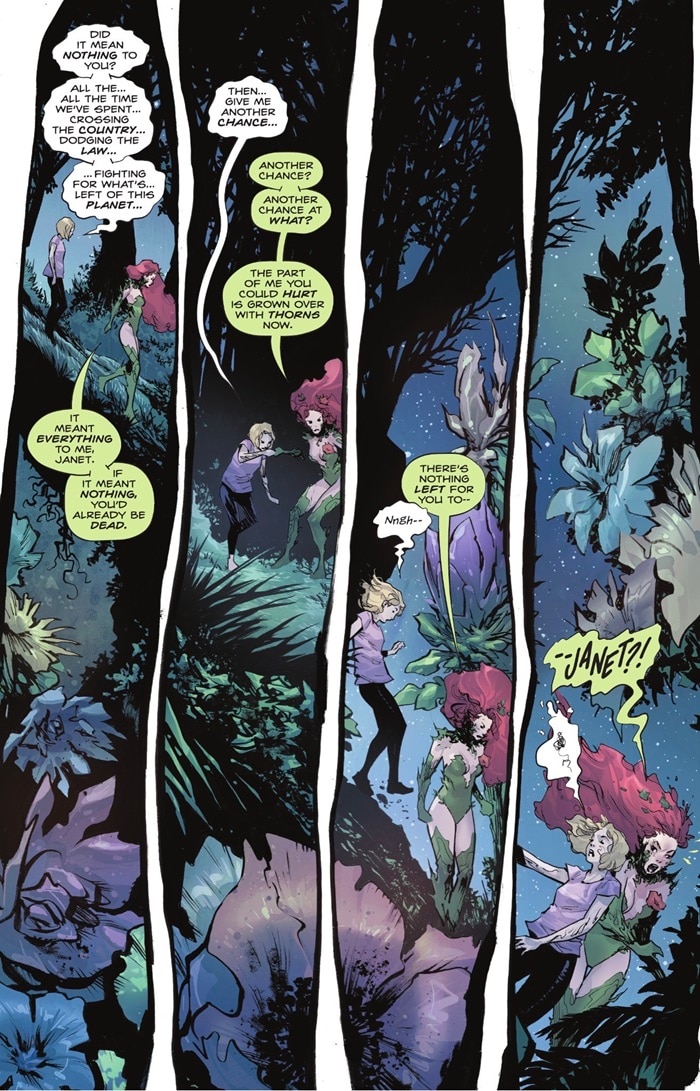
Perhaps that’s why she turned her back on humanity and embraced nature. Ivy almost says as much in Poison Ivy #38. “The part of me you could hurt is grown over with thorns now,” she tells Janet after learning of her betrayal.
Unfortunately, nature has turned its back on her too. Ivy’s dealings with the Green, the Grey and Bog Venus have shown her that even nature isn’t immune to betrayal. So, what’s left for her after that?
Maybe the answer is forgiveness. As we see in Poison Ivy #39, Ivy has forgiven Janet and opened her heart. Perhaps the thorns she claims to have grown over her feelings aren’t as sharp as she thought. Of course, Gotham is a rough city, and Ivy’s return in issue #40 has already tested her resolve. Still, if there is one thing G. Willow Wilson has proven, it’s that Poison Ivy remains full of surprises. Count her—and her impressive ongoing comic book—out at your own peril.
Joshua Lapin-Bertone writes about TV, movies and comics for DC.com, is a regular contributor to the Couch Club and writes our monthly Batman column, "Gotham Gazette." Follow him on Bluesky at @joshualapinbertone and on X at @TBUJosh.
NOTE: The views and opinions expressed in this feature are solely those of Joshua Lapin-Bertone and do not necessarily reflect those of DC or Warner Bros. Discovery, nor should they be read as confirmation or denial of future DC plans.