It’s a great time for Superman fans, with the Man of Steel soaring into movies, TV, animation and comics. To help us stay on top of it, writer Tim Beedle shares what's grabbed his attention and why in this monthly Super-Family column.
One of the most interesting things about Elseworlds is that despite being a line of comics that reimagines aspects of familiar DC characters, the impact comes from what it teaches us about the versions we already know. How is Batman as a character changed by taking him out of modern-day Gotham and putting him in Victorian England? Would he still be driven to fight crime and keep his city safe? Would Superman’s idea of justice and truth be altered if he were raised in the Cold War era Soviet Union rather than in Smallville, Kansas? Which of the DC Universe’s super-powered residents would emerge as heroes and which would become threats if they were to find themselves living in a realm of high fantasy? During a zombie apocalypse? In an outbreak of vampirism?
In putting DC’s characters into wholly unfamiliar situations and environments, you’re really asking what aspects of them remain consistent and what might change. What can be said to be fundamental to who they are and what is a result of circumstance?
In the recently concluded Superman: Father of Tomorrow, writer Kenny Porter and artist Danny Earls explore what might change about Superman if Jor-El were the sole survivor of Krypton’s destruction rather than his son. It’s a simple, straightforward change, but dig even a little beneath the surface and it’s easy to see how it could change nearly everything.
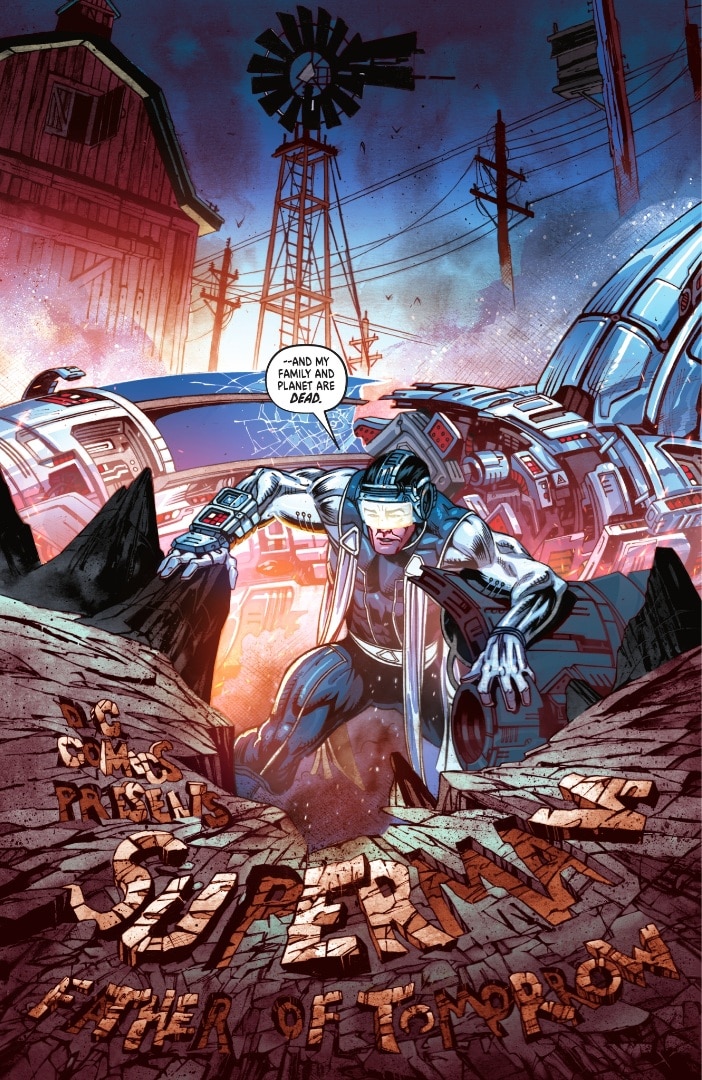
For starters, the Kents become much less important. They play a similar role in Father of Tomorrow in that they’re the ones who find Jor-El’s crashed ship, but as a fully grown adult, Jor-El doesn’t need them to raise him as his adoptive parents and teach him fundamentals like right and wrong, kindness, empathy, understanding and integrity. For Jor-El (who adopts the name “Jordan Kent” as a way of blending in) the Kents serve as more of a friendly, welcoming source of hospitality and information. They try to tell him how Earth operates, so he can learn the differences between it and his homeworld of Krypton. They’re more peers than mentors. That’s still important, but it’s a big difference from the role they play with Kal-El, who frequently credits John and Martha Kent for shaping him into the person and hero that he is.
More importantly, however, is their relationship with Krypton. For Kal-El, it’s almost nonexistent. He realizes it’s where he’s from, but he has no memory of living there and what Kryptonian life was like. He doesn’t carry the trauma of seeing it explode and losing every single person he loved and cared about in an instant. He never had to undergo the difficulty of having to learn an entirely different language, culture and way of life as an adult. Father of Tomorrow’s Jor-El must deal with all of that and more.
It’s not hard to see how that could lead to some serious unresolved issues that as a super-powered Kryptonian, could have some larger-than-life repercussions.
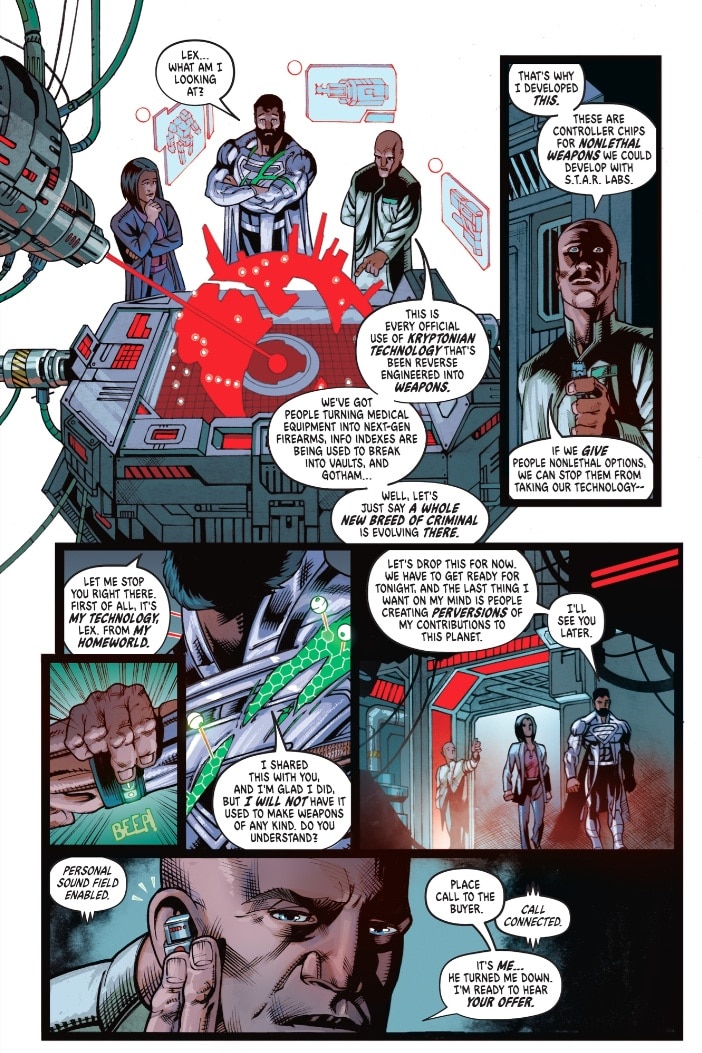
To be clear, in Father of Tomorrow, Jor-El is every bit as good a person as Kal-El. He genuinely wants to help. His goal, at least at first, is to save lives and improve society. And he has a way of doing it that was never available to Kal-El: through the sharing of Kryptonian technology.
I won’t go into the resulting consequences because that’s kind of what the entire series is about. But what’s probably most revealing is Jor-El’s relationship with that technology. He’s a scientist, and while the comic never says he created a lot of the technology he’s now utilizing, he clearly possesses a thorough understanding of it and is able to creatively adapt it to Earth’s needs.
That shouldn’t be surprising. Let’s not forget that it’s Jor-El who invented the rocket that saves Superman and sends him to Earth. Only here, that Superman is Jor-El himself, and we eventually learn that a solo escape wasn’t Jor-El’s intention. The rocket was built to save his entire family, but Jor-El’s obsession with improving things to the point of near-perfection led to a tragic accident that resulted in the death of Lara and Kal-El.
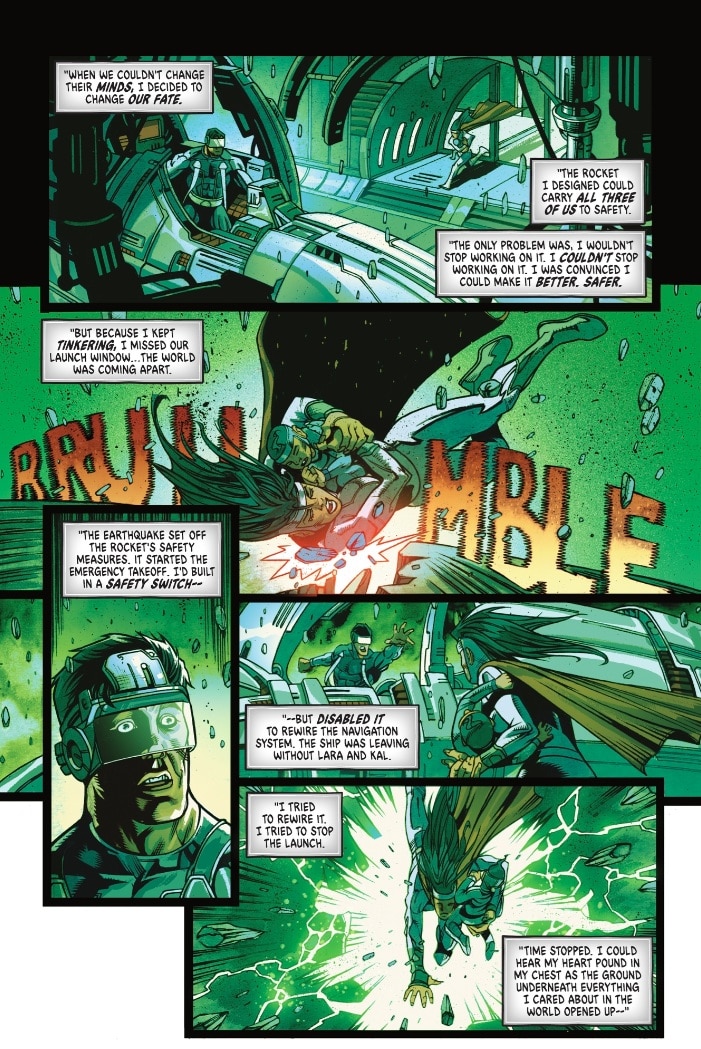
Reading it, I had a hard time blaming Jor-El. I mean, if there’s one thing you want to make sure you don’t get wrong, it’s a rocket that will be launching immediately prior to the complete destruction of your world. The guy should absolutely triple check everything and make whatever improvements he knows he can make. It’s an awful tragedy that doing so led to the inadvertent death of his wife and son, but it wasn’t his fault.
But it doesn’t matter what I think. Jor-El blames himself, and that guilt drives his actions over Father of Tomorrow’s six issues. And while he truly does mean well, and much of what he does saves lives, his continued obsession with trying to improve things and make them even better eventually causes unintended problems. It’s a painful lesson that’s not easily learned for this much different Superman, but he does what he can to undo the damage and save the world from the threat his actions have unleashed.
So, to get back to my initial point, what does this teach us about Superman in the DCU? Well, certainly the road to becoming a superhero is easier when your powers don’t arrive alongside a planet’s worth of trauma. But really, it’s that Superman’s role has never been one of trying to fix or improve society. That’s actually dangerous. That tends to get us things like Injustice and the end of The Dark Knight Returns.
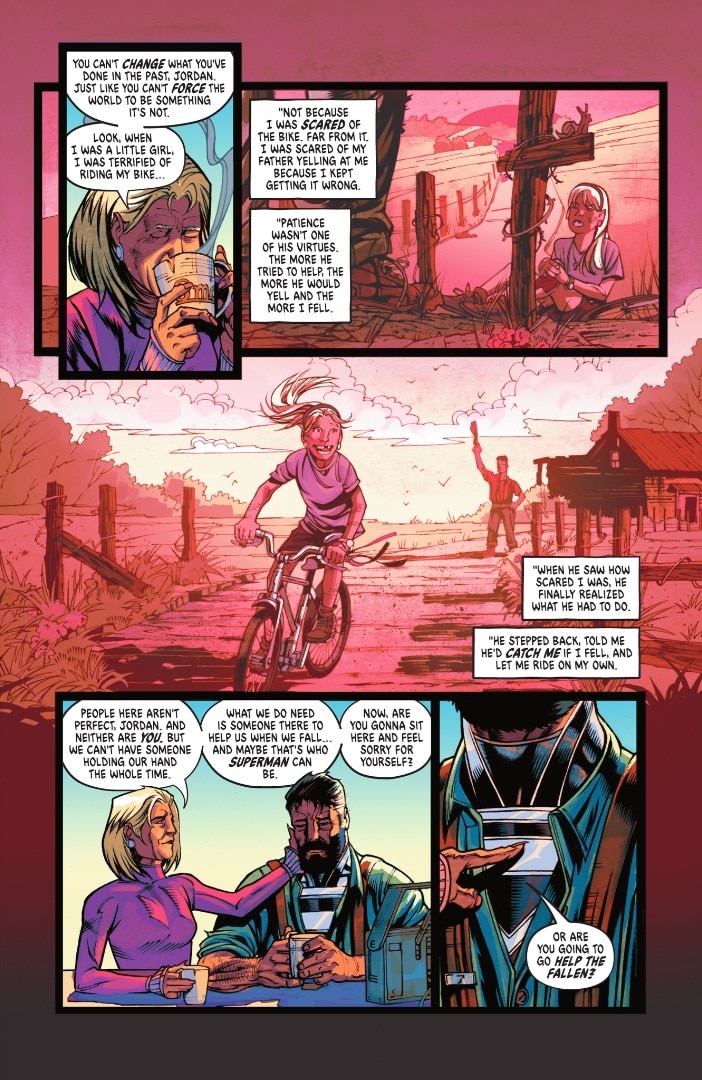
Rather, Superman’s role is much closer to what Martha Kent suggests to Jor-El in Superman: Father of Tomorrow #5.
“People here aren’t perfect, Jordan, and neither are you,” she says. “But we can’t have someone holding our hand the whole time. What we do need is someone there to help us when we fall…and maybe that’s who Superman can be.”
Superman has always been about leading by example. He shows us that it is possible for someone with great capability and power to use his strength and abilities for good and to help people in trouble who are unable to help themselves. That’s true whether the Superman in question is Kal-El or his father. There may be a life’s worth of differences between the two men, they may possess different skills and hold different relationships with the people of Metropolis, but when they take to the sky in the cape and crest, you know you’re in for something Super.
Tim Beedle covers movies, TV and comics for DC.com, writes our monthly Superman column, "Super Here For...", and is a regular contributor to the Couch Club, our recurring television column. Follow him on Instagram and Threads at @notabard and on Bluesky at @TimBeedle.
NOTE: The views and opinions expressed in this feature are solely those of Tim Beedle and do not necessarily reflect those of DC, Warner Bros. or Skydance, nor should they be read as confirmation or denial of future DC plans.