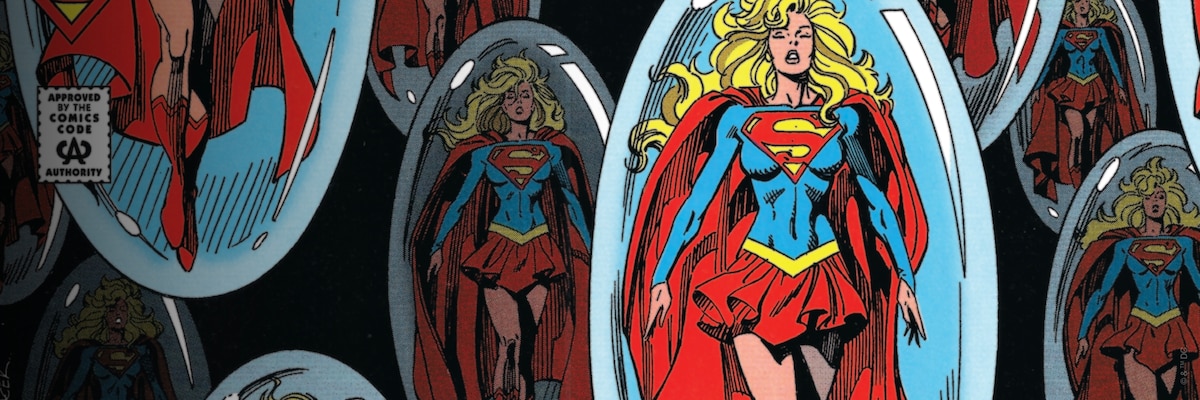
Here at DC.com, Supergirl has been on our minds a lot lately. This is largely due to Milly Alcock taking flight in Craig Gillespie’s film and the resulting Summer of Supergirl we’ve been celebrating since May. As we think about the Girl of Steel and her legacy, it’s important to remember every version of the character, and that includes Matrix, the Supergirl of the ’90s. More specifically, she was Supergirl from 1988-2002…though technically she shared the role from 1996 onward. It’s a bit tricky and I’ll explain why later.
If you’re reading a Superman comic published during that time period and you see Supergirl, that’s not Superman’s cousin. She might look like Kara Zor-El, with a similar costume and haircut, but this is another character called Matrix. No, she has nothing to do with the Keanu movie. In fact, she came first.
Questions about Matrix come up often due to her role in The Death of Superman. It’s one of the most reprinted and reread Superman stories of all time, and when people see Supergirl turn into purple goo, they understandably have questions.

In short, Matrix Supergirl isn’t Superman’s cousin. She’s an artificial lifeform made of protoplasmic material using DNA from a pocket universe version of Lana Lang who wound up merging with a former Satanist and becoming an Earth-Born Angel. Oh, and she dated Lex Luthor.
Okay, I realize that’s a lot to take in, but there is beauty in how complicated Matrix is. Ironically, the reason she exists is because DC and John Byrne were trying to streamline and simplify the Superman mythos after the reality-altering events of Crisis on Infinite Earths. One key change was making Superman the only survivor of Krypton, which meant no Argo City and no cousin Kara. Another change was removing Clark Kent’s teenage career as Superboy, something which would have unintended consequences and lead to Matrix’s creation.
When the Legion of Super-Heroes was introduced in Adventure Comics #247, it was established that the group formed because they were inspired by Superboy. But if Clark Kent were never Superboy, then how could the Legion exist? This discrepancy was solved in Action Comics #591, which revealed that a villain called the Time Trapper had created a pocket universe, which contained an Earth that resembled the world seen in Superboy’s Silver Age adventures. Unbeknownst to the Legion, when they looked back in time, they weren’t seeing their past, but Superboy’s adventures in this pocket universe.
(You might be wondering what any of this has to do with Supergirl. I promise it will make sense soon.)
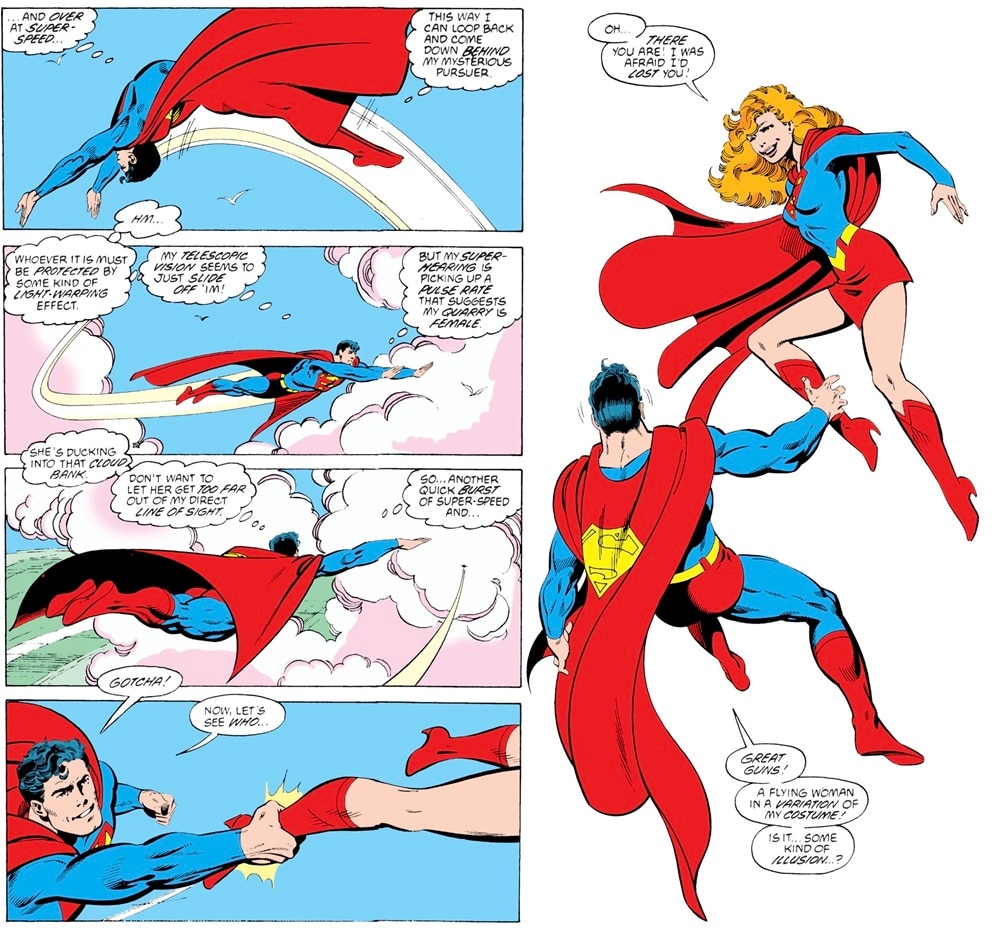
When the pocket universe version of Superboy died, there was nobody to protect the planet from General Zod and the Phantom Zone criminals, who had tricked the pocket universe version of Lex Luthor into releasing them. Lex led a small group of freedom fighters against Zod, which included Lana Lang. When Lana was killed, Lex used his scientific talents to create an artificial lifeform from her molecular matrix using protoplasm. Or put another way, he made a clone of Lana Lang out of purple goo. Her artificial origin is the reason the character has been given the nickname Matrix.
In order to help combat Zod and his Phantom Zone allies, Lex gave Matrix powers similar to Superman. While he wasn’t able to mimic the Man of Steel’s Kryptonian physiology, Lex was able to give her flight, super-strength, super-speed and a few powers Superman doesn’t possess, like the ability to turn invisible, shapeshift, fire energy blasts and use telekinesis. This not only set her apart from Superman, but from the Pre-Crisis version of Supergirl as well.
For a time, Matrix believed she was the original Lana Lang, but the truth of her origin was revealed after an attack by Zod reverted her body back to its original protoplasmic state. Zod’s assault on the pocket universe Earth killed everyone on the planet, leaving Matrix as the only survivor of a dying world. Superman (the real one) took her back to his Earth and placed her with his parents Jonathan and Martha Kent to help heal and guide her.

That process took time, but ultimately, Matrix decided to stay in her Supergirl form, embracing it as her true identity. This is around the time she began dating Lex Luthor, but to be fair, Lex was disguised as his own Australian son Lex Luthor II, complete with a long flowing mane of red hair. Lex and Matrix broke up eventually, but if you see them snuggling together during the Death and Return of Superman Saga, that’s why.
But wait, it gets even crazier! In 1996, Supergirl was given her own ongoing comic, and it took the character in an imaginative, but pretty out-there new direction. A young Satanist named Linda Danvers was betrayed by other members of her cult, who tried to sacrifice her in a twisted ritual. When Matrix saved her, her unique biology caused their bodies to merge. This wasn’t a Firestorm situation where two people were inside a single body—Linda and Supergirl became one person, sharing a body, a mind and a life. The process made Supergirl lose her invisibility and her shapeshifting powers. However, she was still able to switch her appearance back and forth between Linda and Supergirl.
As you can imagine, this wasn’t an easy adjustment. Supergirl had never lived a human life before, and as Linda, she now had to deal with her parents, friends and all the trappings of a secret identity. She also had to come to terms with Linda’s past as a Satanist cult member and rebuild her life. The series also wrestled with theological questions, as Supergirl was told the transformation made her an “Earth-Born Angel,” an angelic being that serves as a bridge between Heaven and Earth. As a result, she began to exhibit new angelic powers, such as flame wings, flame vision and teleportation.
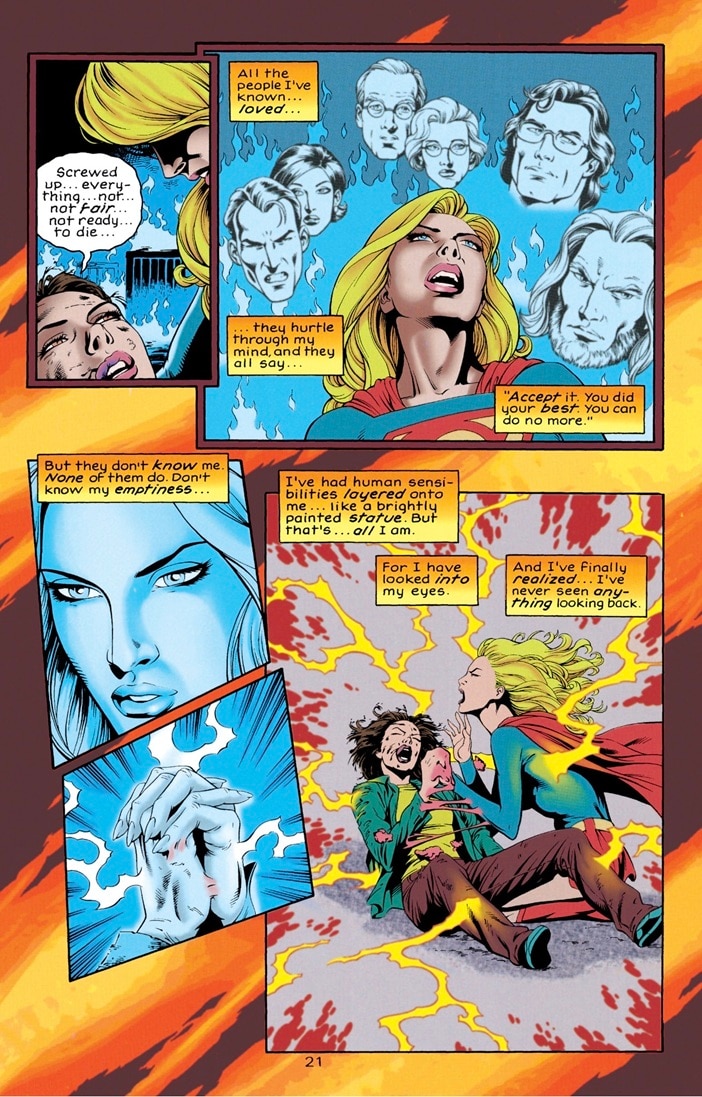
Ultimately, her time with Linda would lead to Matrix’s demise. After nearly dying during an intense battle, Supergirl and Linda were separated. Thankfully, Linda still possessed a portion of Supergirl’s powers, which allowed her to continue playing hero as she searched for her missing half.
After two years, Linda found Matrix, who was being held captive by an agent of Hell named Lilith. Matrix was saved, but she and Linda mutually agreed that instead of fusing again, Matrix should merge with a dying heroine called Twilight, giving her a second chance. After the merge, Matrix gave Linda a portion of her powers, officially passing the Supergirl mantle onto her.
Yes, Matrix Supergirl was the very definition of “it’s complicated,” but that’s why longtime DC fans love her. From a Pre-Crisis Lana clone, to Luthor’s lover, to an Earth-Born Angel, it’s been an interesting journey. Plus, shapeshifting and invisibility are pretty cool powers. Kara Zor-El may be the most iconic Girl of Steel, but for fifteen years Matrix was Supergirl, and she made the identity her own.
…Well, except when she shared it with Linda. And technically, she was always a clone of Lana…but you know what? It was the ’90s. We’re just going to leave it at that.
Joshua Lapin-Bertone writes about TV, movies and comics for DC.com, is a regular contributor to the Couch Club and writes our monthly Batman column, "Gotham Gazette." Follow him on Bluesky at @joshualapinbertone and on X at @TBUJosh.