Gotham City is a busy place, with a lot going down each and every week. In this monthly column, Joshua Lapin-Bertone helps you stay on top of it all by letting you know what you should be paying attention to within the Bat-Family…and why.
Gotham has a new mayor, and her agenda is shaking up the city and causing big problems for the Dark Knight.
Earlier this year, I wrote that G. Willow Wilson is doing amazing stuff with her Poison Ivy series, and now she has upped the stakes by making Ivy mayor. That’s right, Pamela Lillian Isley, the eco-terrorist and longtime Batman villain is now mayor of Gotham City. This wasn’t a villainous plot with voter tampering—Ivy was duly elected. In fact, she received 70% of the vote, which raises some questions about Gotham’s electorate (and Ivy’s opponent).
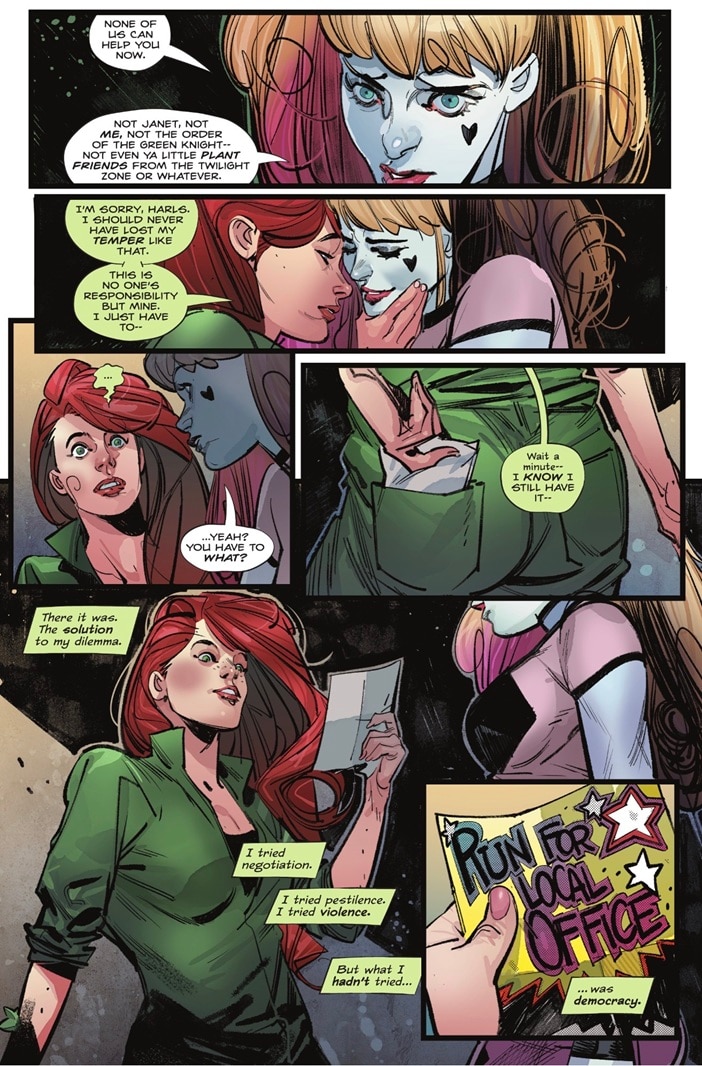
Why did Ivy run? As we see in Poison Ivy #41, Pamela was tired of trying to take down the system as an outsider.
“I tried negotiation,” she says. “I tried pestilence. I tried violence. But what I hadn’t tried was democracy.”
Even in our current political moment, you have to wonder how the citizens of Gotham could elect someone like Ivy. I certainly did, but then I remembered that Gotham has had its fair share of criminal mayors. Considering the sheer number of criminals within the city, I suppose that isn’t surprising. Perhaps a corrupt city populated by corrupt voters electing a murderous eco-terrorist isn’t so surprising after all?
There’s also the fact that Ivy ran on an appealing platform. According to Poison Ivy #42, she ran on improving roads and bridges, increasing affordable housing, improving health outcomes and making Gotham carbon neutral in two years. That’s the kind of platform that can make voters forget you’re a killer. However, in Ivy’s case, being a killer actually wasn’t a liability.
Since Vandal Savage became police commissioner, Gotham has evolved into a police state. Cameras have filled the streets, tracking everyone’s movements, while armored officers enact their own violent brand of justice. No one likes living under those kinds of conditions, so Ivy took matters into her own hands and killed Commissioner Savage’s tech czar Marie Henley. This made Ivy a hero to all of Gotham, setting the stage for her mayoral victory.
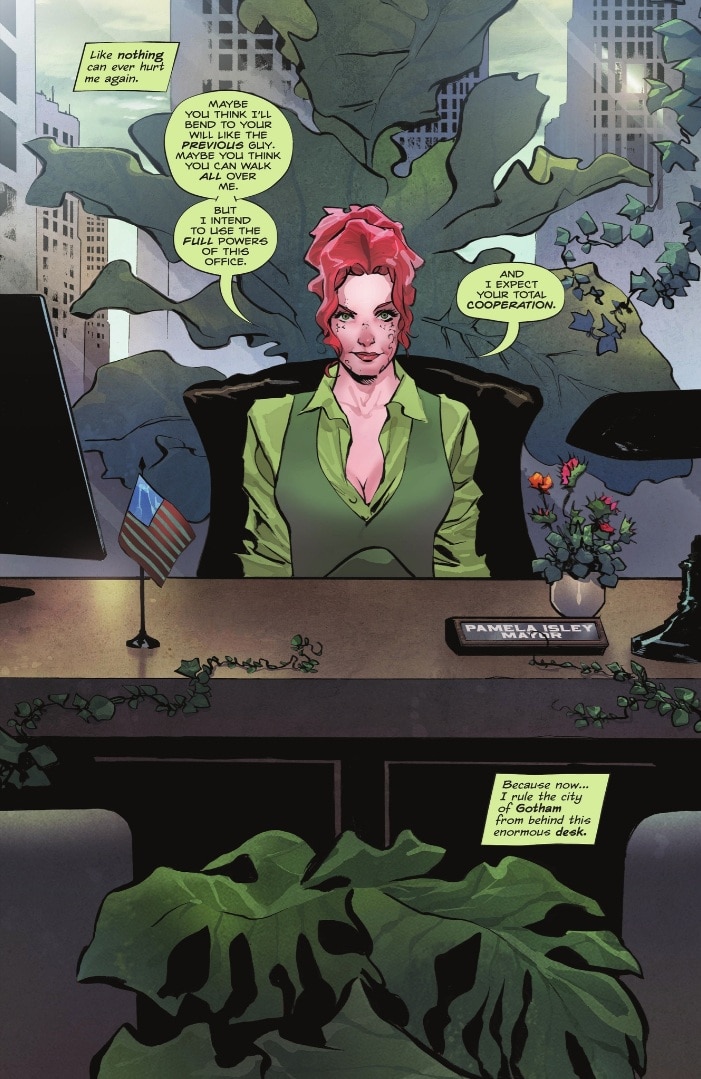
In Poison Ivy #42, we learn that Ivy’s first-week poll numbers put her at 92% approval, which is amazing. While most politicians enjoy a honeymoon period after being elected, numbers that high are extremely rare. You can’t help but wonder if Ivy’s pheromones are somehow influencing the way that voters are thinking of her, but there is nothing on the page to indicate that this is the case. I think the public legitimately loves Ivy.
Has the mayor’s office changed Ivy? Yes and no. As we see in Poison Ivy #43, Pamela’s new title has caused her to be more conscious of her political image. She tells Harley Quinn that it isn’t a good idea for them to be seen together, which tells me that Ivy is starting to lose herself. After all, since when has Ivy cared what people thought of her? When you’re an eco-terrorist trying to commit genocide, you learn to accept being disliked.
And…it’s Harley! Harleen has always had a special place in Ivy’s heart. She’s one of the few humans Ivy genuinely likes. (Some might even argue that Ivy loves Harley more than nature itself, though that is up for debate.) The point is, Ivy pushing Harley away for political purposes is a surprising move that speaks to how the office has changed Pamela.
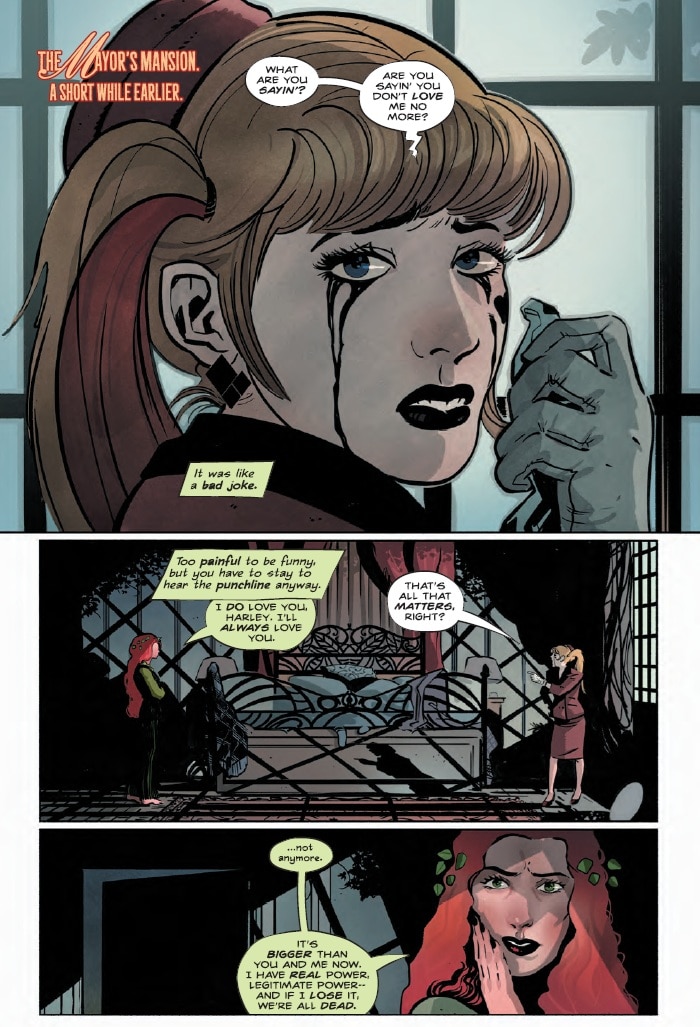
On a side note, check out the Jackie Kennedy-inspired outfit Harley sports in Poison Ivy #43. You can tell Jaime Infante had fun penciling it.
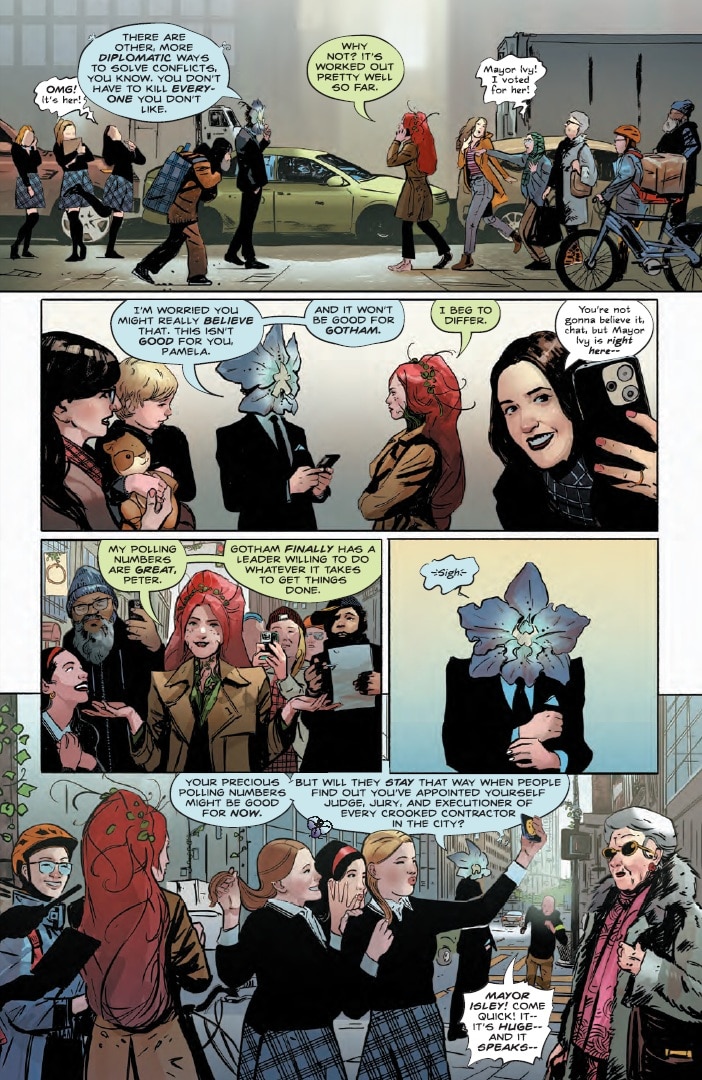
As for the parts about Ivy that have stayed the same, she’s still solving her problems by murdering people. In Poison Ivy #43, Pam kills a corrupt plumbing contractor, which is one thing when you’re a criminal, but another thing when you’re an elected public servant. The difference is now that she’s mayor, she calls the head of her office’s HR department before committing the murder. (Yes, I’m serious.)
“There are other, more diplomatic ways to solve conflicts, you know,” Ivy’s green construction czar, Peter Undine, tells her. “You don’t have to kill everyone you don’t like.”
“Why not?” Ivy replies. “It’s worked out pretty well so far.”
We’re still early in Ivy’s tenure as mayor, but I’m curious to see how this will affect the other Gotham titles. We’re already starting to get a sense. Over in Batman #8, we see Mayor Ivy sign off on Commissioner Savage’s war on the Bat-Family, which will definitely have some repercussions for the Dark Knight and his allies. Meanwhile, in Harley Quinn #60, we see some smalltime crooks talk about how great things have been since Ivy took over, and we get some hints about the toll this has taken on Harley’s psyche.
Mayor Poison Ivy wasn’t one of my predictions for 2026, but it’s an exciting development and I can’t wait to see where it leads us. This has the potential to leave a lasting mark on the Batman books for years to come. At the very least, it further cements G. Willow Wilson’s Poison Ivy as one of the best Bat-comics on the stands, and one you absolutely should be reading.
Joshua Lapin-Bertone writes about TV, movies and comics for DC.com, is a regular contributor to the Couch Club and writes our monthly Batman column, "Gotham Gazette." Follow him on Bluesky at @joshualapinbertone and on X at @TBUJosh.
NOTE: The views and opinions expressed in this feature are solely those of Joshua Lapin-Bertone and do not necessarily reflect those of DC or Warner Bros. Discovery, nor should they be read as confirmation or denial of future DC plans.