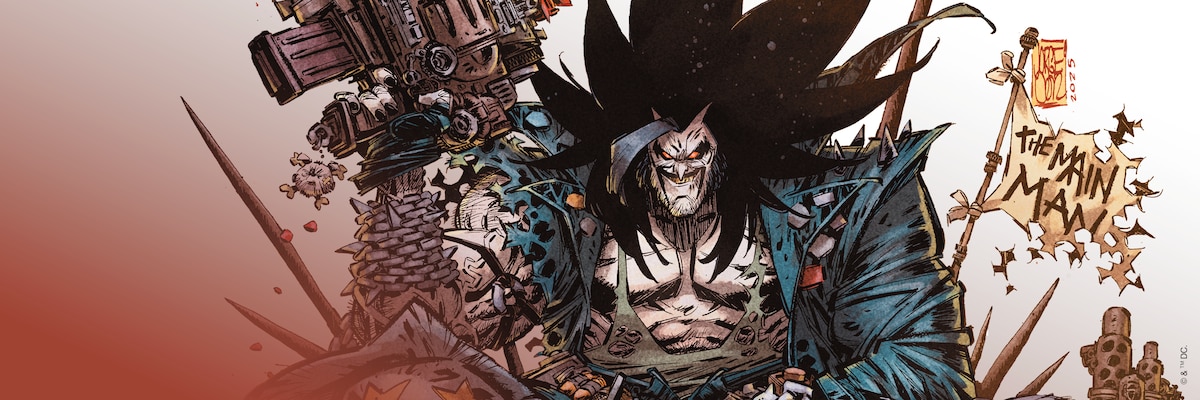
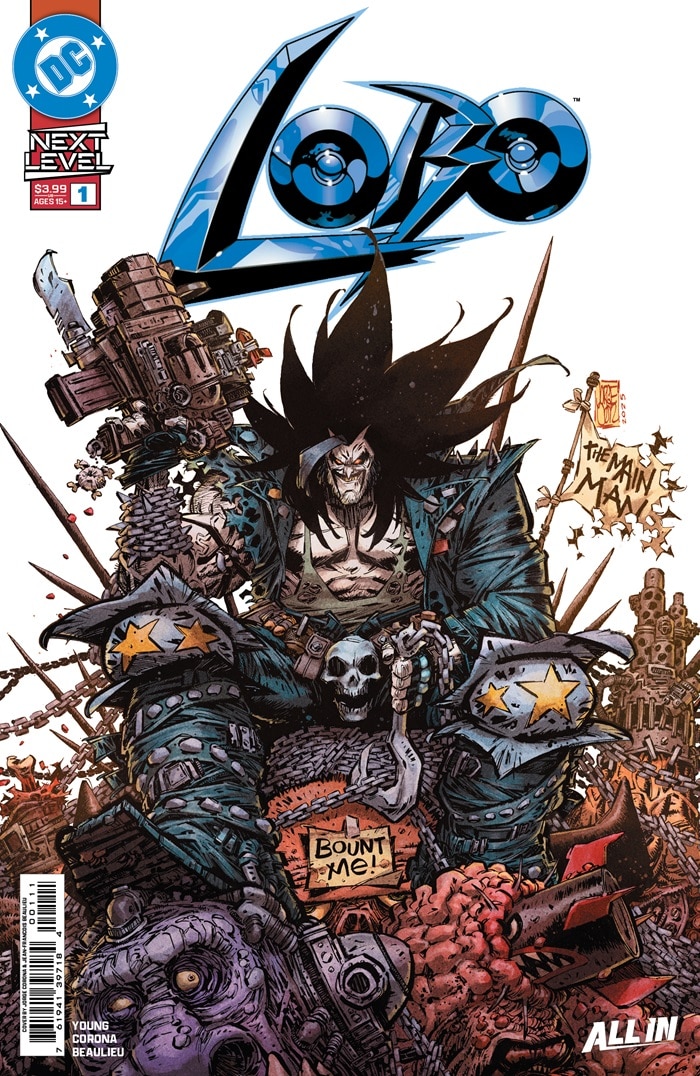
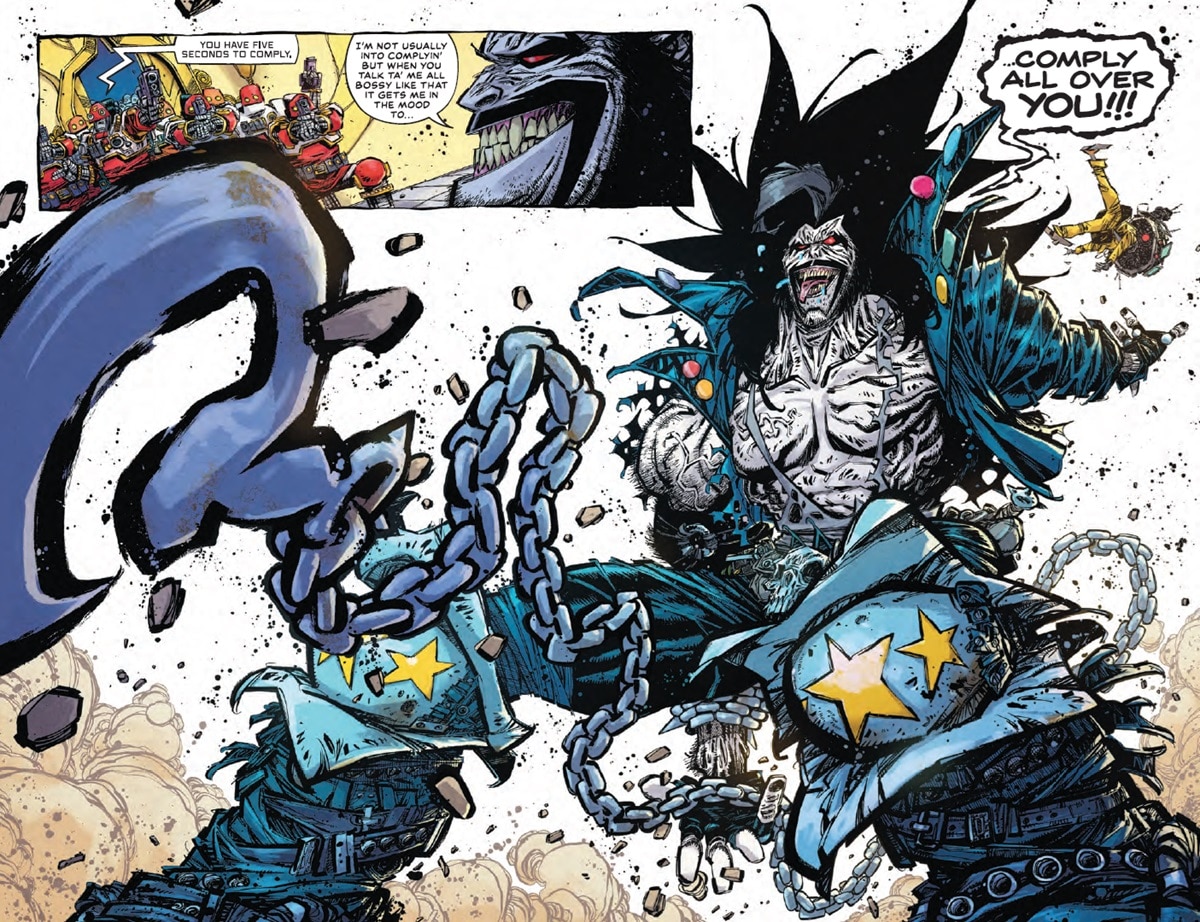
The Main Man, the Last Czarnian—call him what you will, Lobo is returning to DC in high style this year. Poised to become DC’s latest breakout movie star with his appearance in this summer’s Supergirl (where he’ll be portrayed by Aquaman’s Jason Momoa), he’s also getting his own new solo series, a part of DC Next Level. Debuting today, Lobo is written by Skottie Young and illustrated by We Are Robin artist Jorge Corona—two stylistically distinct creators who have a history of collaborating with each other on books like Middlewest, The Me You Love in the Dark and Ain’t No Grave.
We recently caught up with Young and he told us why his first major DC Universe project is perfect for new and old fans of Lobo, as well as anyone who loves to laugh at the world we live in…
What brought you to Lobo? Were you a longtime fan?
I have been a massive Lobo fan since Infanticide in the early ‘90s. The miniseries that Keith Giffen and Alan Grant did is one of my favorites. I discovered that as a teenager. It just cracked me up. So, I went back and devoured all the Lobo stuff I could that had been out up to that point. Throughout my 25-plus years in comics, I wanted to get a Lobo job—on any book that I would do. I'd just be like, “Let's channel some Lobo!”
I'm a MAD magazine kid. I grew up reading MAD, and so satire and parody and comedy have always been in me. Lobo spoke to my inner 15-year-old. It’s like MAD magazine, but also edgy.
I had never worked at DC before, but some friends came up to me at San Diego a couple years ago. They had just got done with a meeting at DC and they said, “Hey, Lobo came up, and we said, ‘You know who loves Lobo?’” So yeah, they just came to me. We talked about it. It took a little while just because of timing and stuff like that, but I was instantly like, “Yeah, this is it! I'm finally going to do it!” So, it was just as easy as me being a fan and people knowing I'm a fan.
What’s the elevator pitch for this series?
The tagline that I wrote down—before I even wrote any words or even put a plot together for issue #1—my first plot card just says, “All anti, no hero.” Because the anti-hero has been popular for decades now, and I think Lobo is the perfect person to be like, “What the f*ck is an anti-hero? I'm only the anti side. I don't need to be a hero.”
So, that's my North Star for Lobo—all anti, no hero. If he's going to make a choice, it's going to be bad, or at least funny. Probably bad and funny… Then after that, it’s “Keep it fresh, keep it fast, keep it open for new readers and absolutely check the boxes for the old readers.”
If you know Lobo, you're going to love it. If you've never read Lobo, you're not going to be confused on what you're getting into. It's a perfect jumping on point for old fans and new fans alike. The first story's a little two-parter. Then we're jumping in and we're going to treat it like episodes, telling a satisfying story in every issue.
What’s Lobo facing in the series’ first story?
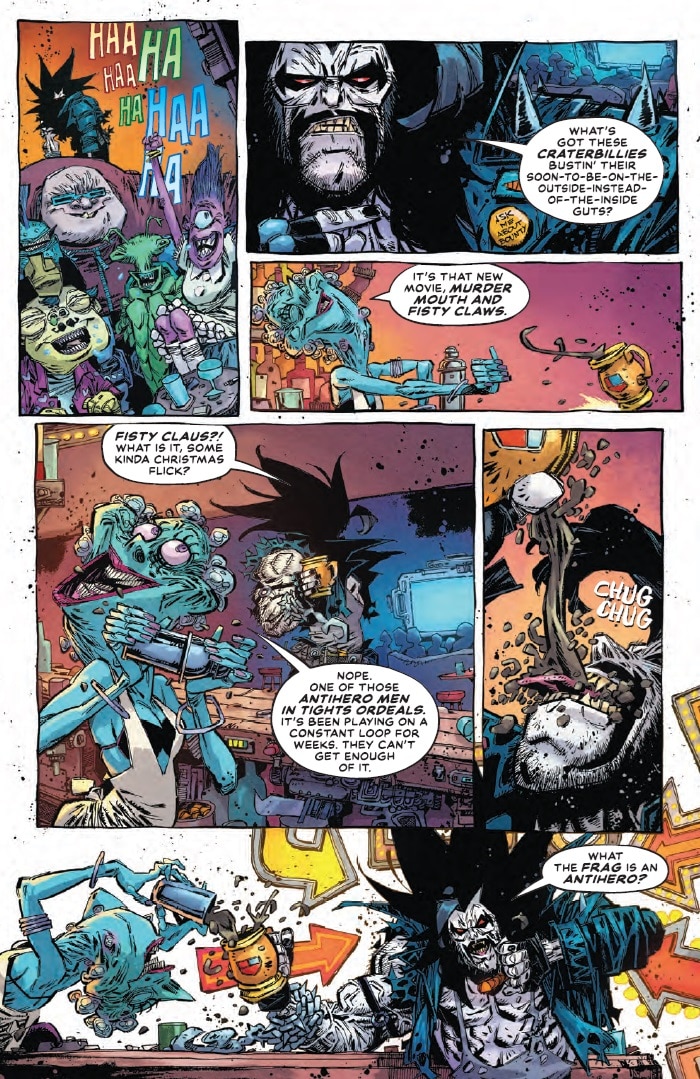
The principal antagonist is a corporation. An entertainment corporation. In the first story, a TV network wants to do a bounty hunter reality show and they want Lobo to be the star. Basically, a TV network buys the entire bounty-hunting industry because they are very into anti-heroes. They're a very lucrative entertainment business based on some very popular movies that have come out. So, they want to do a show about the gritty underworld of bounty hunting, but they don't want to just go find it, they want to control it. And the best way to control it is to just buy it: “We own it now. So we decide who you kill or who you don't kill. We're going to decide who based on how entertaining it is.”
How did artist Jorge Corona get involved with the book?
Jorge and I have done several creator-owned books together. We've been working together for almost ten years. Thousands of comic book pages together. So, when they offered me this job, he was the only person in my head. I was kind of afraid he was going to say no because he was working on Transformers, then after that he was going to write and draw his own book—a creator-owned book. I just was like, “Man, we got this opportunity. Could you just come do at least six issues with me?”
It didn't take much convincing. Then as soon as we started on the first issue, he was having so much fun. He goes, “Don't worry about six. Let's just go. We’re here together.”
It's almost telepathic how well we work together now. We can finish each other's proverbial sentences on the page. It's such a smooth, easy working relationship. Then on top of that, we brought our longtime colorist Jean-Francois Beaulieu over with us, and our longtime letterer Nate Piekos from all of our books. So, our creative team is a well-oiled comic-book-making machine. We've made thousands of pages together. I was lucky that Kathleen [Wisneski], our editor, was someone I've worked with on big projects before over at Marvel.
So, not only am I getting a character who feels like home to me because of how long I've liked them, we're all a family coming to do it. It just feels so comfortable, which I love for my first DC project.
In addition to your series, what would you recommend to someone who’s never read Lobo before?
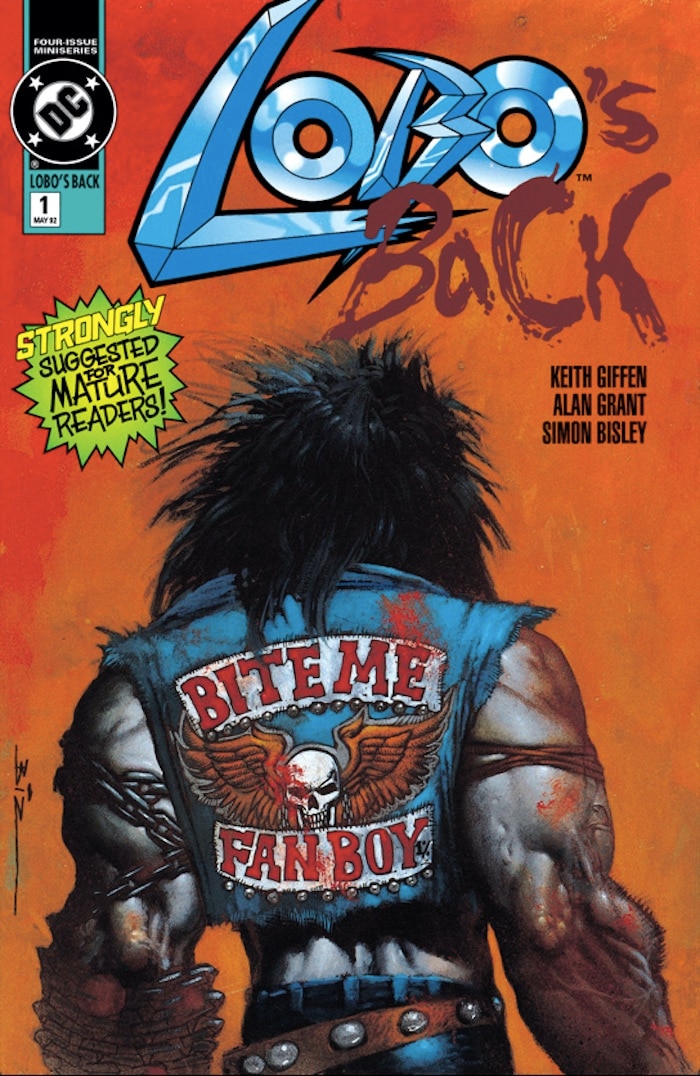
The cool thing about those early Lobo stories, with Giffen and [Simon] Bisley, and Alan Grant scripting, is it just always felt so consistent. The Last Czarnian is so good. I mean, that's probably what I would tell everybody to read first. Infanticide's my favorite, but The Last Czarnian is probably the benchmark for me. Then if you really want to understand the power of the character being able to do anything, it's the Paramilitary Christmas Special and Lobo's Back. They’re two bonkers ass stories. You have a storyline where Lobo gets kicked out of Heaven, gets kicked out of Hell. Nobody wants him, and then he gets sent back reincarnated as a female Lobo. You're just like, “What the f*ck? This is crazy.”
There's clearly a reason I fell in love with this book when I was a teenager. You know Bisley's Lobo's Back cover? Lobo’s “Bite Me Fanboy” vest? As soon as I got this job, I ordered a custom-made “Bite Me Fanboy” Lobo vest. I have it at my studio. It hangs on my studio door. So yeah, I went full method on this. [laughs]
What’s the secret to telling a great Lobo story?
The heart of a Lobo story is satire. Lobo is always commenting. The book itself was always commenting on society or something in the world. That's why I loved MAD magazine, because MAD looked outside the window, looked at what movies we were watching, looked at what was going on culturally, at what's going on politically, and it had fun with it. Nobody was off limits. What I always loved about MAD and what I've always loved about Lobo, is they made fun of everybody. Everybody got a shot, even the side that I agree with. Because it's all a little messy, right? Satire is important.
That's a little bit of why we thought it'd be fun. Like in the original Lobo's Back, Heaven and Hell were set up like corporations. I wanted to bring back that spirit. Not just portray Lobo as a cool, metal-looking dude who smokes cigars and says “frag.” That's there. Don't get me wrong. But I want to make sure we're reinserting that concept of pop culture parody and satire and plugging back into that old heart of Lobo, just in today’s world.
Lobo #1 by Skottie Young, Jorge Corona and Jean-Francois Beaulieu is now available in print and as a digital comic book.