Over the past few years, the sisterhood of villains known as the Gotham City Sirens has been steadily making a comeback. Now, in Sirens: Love Hurts, they’re growing in every way imaginable. They’re growing creatively through Love Hurts’ fashionable writer and artist team, Tini Howard and Babs Tarr. They’re growing in prestige, with the title serving as the first Sirens book to be released under DC Black Label. They’re even growing literally, as Howard and Tarr add Black Canary to the usual lineup of Harley Quinn, Poison Ivy and Catwoman.
Sirens: Love Hurts also marks Tarr’s first DC book as interior artist since the culmination of her beloved Batgirl ten years ago, so you’d better believe we were going to take the chance to sit down with her and Howard to discuss just what it is about the series that brought her back. Plus, we dive into what the team’s collaborative process is, what it’s like working out of continuity, which designers influenced each of their Sirens and which member of the team they’d most like to hang with.
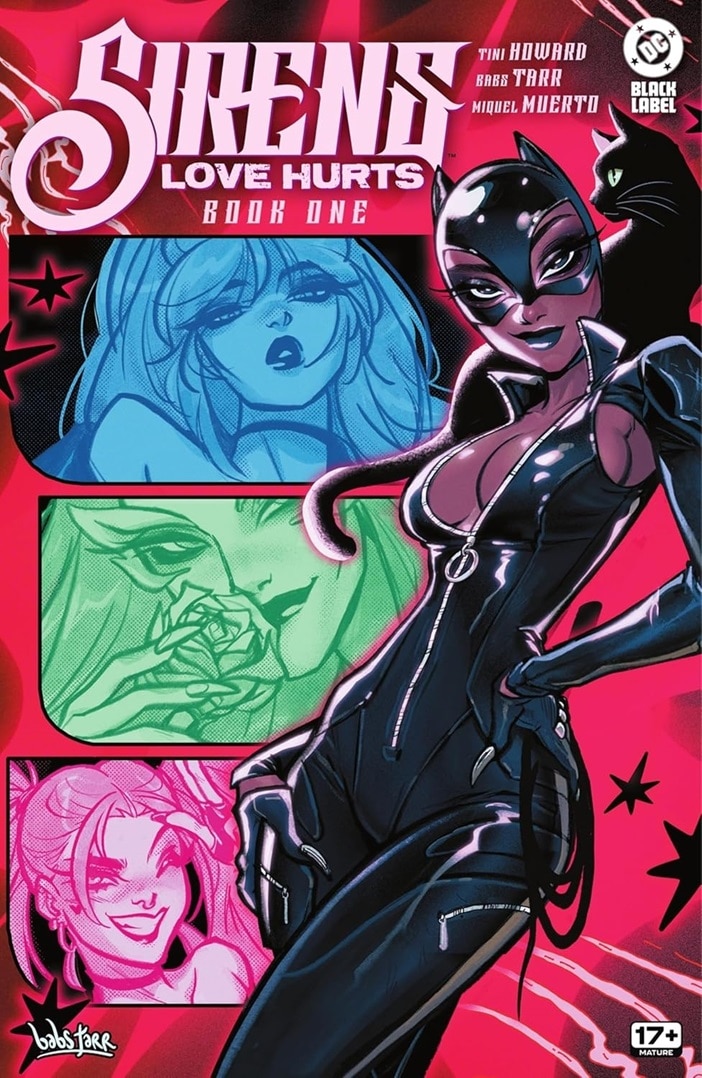
Babs, you’ve been drawing the Gotham City Sirens for years unofficially and doing a phenomenal job at it. As such, Sirens: Love Hurts seems like the perfect project for your DC return. Is that how it feels for you? Were you hoping for a chance to draw a Sirens comic someday?
Babs Tarr: This was my dream book. If I had been on a panel after I finished Batgirl and they were like, "What would make you come back to DC?" My answer would have been, "If I could do a book about any of the Sirens or all of the Sirens, that would be what would bring me back."
I loved my time on Batgirl, but when we started, it was kind of written for older teens and young adults. But then so many young kids kept coming up to our tables at cons that we started to make it more all ages because it meant so much to those young readers. And I love that we could give them that because I certainly didn't have a book on the shelf that made me feel like it was for me when I was younger. So, I was happy to do it, but in my heart, drawing sexy baddies is really my truth. It's been such a joy to be on this book and get to draw these girls officially.
Tini, you’ve written both Catwoman and Harley Quinn before, but both those series were in continuity. This one isn’t. Does that change how you write them in any way?
Tini Howard: Yeah, I mean, it's freeing, right? I really love that aspect of Black Label, where we're able to nudge timelines and continuities to put the versions of the characters together that work best for the narrative. When this book starts, Harley's just been through her breakup with the Joker, which we saw at the end of a ten-page story Babs and I did in Harley Quinn: Black + White + Red. Dinah's just been proposed to by Ollie and they're planning a wedding. Catwoman and Batman have kind of a friends with benefits situation going on, and we learn what Selena knows about Bruce and how that relationship goes on. Ivy is a loner and loving it. She has friends, but that's as much intimacy as she wants in her life.
We were able to do that deliberately since we're not shackled by the timeline. We structured this book the way we wanted to. We chose to make it four issues, four seasons, four girls, one year in their life. Because of the magic of Black Label and getting to be kind of timeline agnostic, we were able to put them all in the place in their lives we want them to be in so we can tell the story we want to tell.
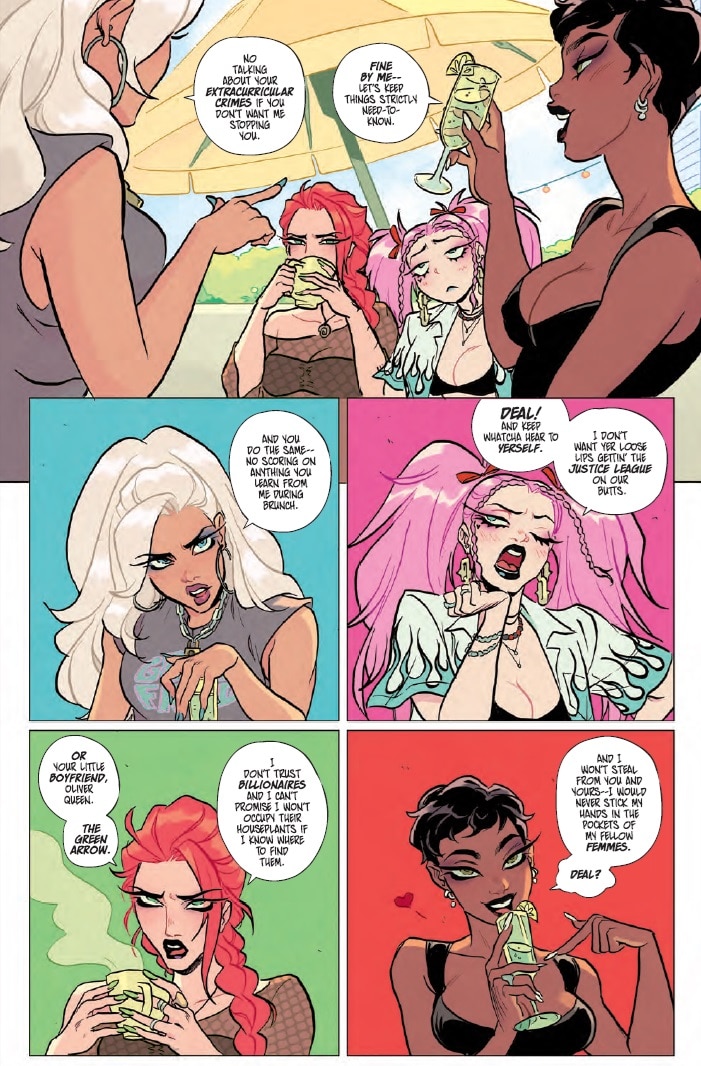
How would you describe your collaborative process? What’s it been like working with each other?
BT: So fun. It's my first time. I worked on another project with a female writer, but our editors kept us separate, so it didn't really feel like as big of a team book, which I don't love. I like to get along with my writer. It just helps with the creative flow. And working with Tini, it's almost like...this sounds so cheesy, but I feel like we could finish each other's sentences. We're so on the same page about every aspect. It's been really easy and I feel very blessed to be working with Tini.
TH: Yeah, it's just fun. It's pure fun. We just let ourselves go, and that's kind of the joy of this comic and the thing I'm excited about—connecting with other women. We're just girls having fun making a comic that is just fun. We're having a great time, and we're also saying real things. We've made each other cry. Not in the mean sense, but in the emotional sense. All the stuff that happens in this book, in some way or another, it's stuff that connects to all of us. We've all had moments where we've said, "Hey, I think this moment should go like this, because it reminds me of this thing that happened to me."
There's a lot of real feeling in this book, both the fun stuff, but then also just the catharsis of us getting to share our experiences as a team.
DC Black Label gives creators a chance to push the envelope a little bit with DC characters and perhaps take a few risks. Babs, is there anything you’re doing visually with the characters and world that you haven’t done before? Or maybe haven’t done before with DC characters?
BT: When I was on Batgirl, a lot of people don't know this, but that was my first comic ever. I think I was maybe not as confident as I am now. I tried my best to have my voice come through and push for things here or there, but I feel like the art I've been doing for this book is not only some of the best pages I've ever drawn in my life, but I've never been more proud. And it feels wholly me, which I'm really thankful for the opportunity to do that.
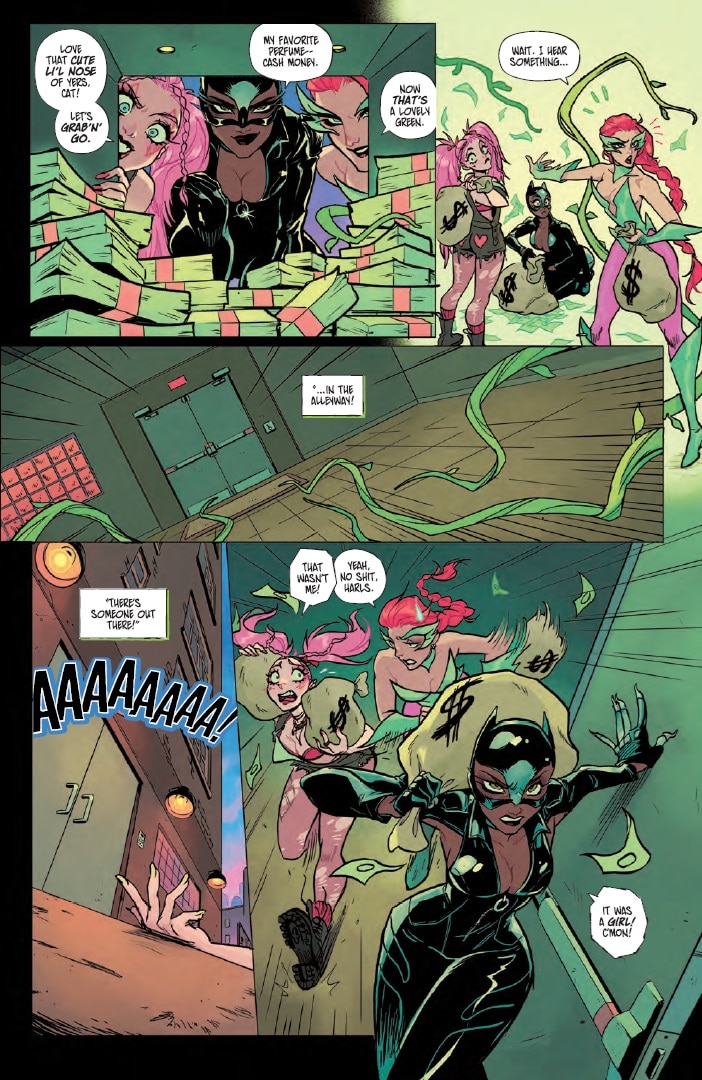
I’ve been seeing Catwoman, Harley and Ivy referred to as “villains” in the discussion around this series, but do you see them that way? Or are they perhaps more villainous here than they currently are in the DCU?
TH: When we start off, they're definitely the hottest bank robbers in Gotham, and Dinah is definitely Black Canary, who's a hero and who is engaged to a guy on the Justice League. That's a big source of tension in this story. We learn what brings them together. There are these murders that are happening in Gotham and they're targeting women, and these are four women who have Gotham in their blood, so they come together.
Some of my favorite comic stories start that way, with unlikely people coming together to fight for a cause they believe in. But they end up spending a lot of time together, and just like in the real world where you might end up at work or on a team with someone that you may not initially get along with, you find things that you have in common. It's kind of a love story in its own way, of how these four women become friends and how they find the ways they're important to each other, outside the borders of things like Hero, Villain, Justice League, Joker and all that.
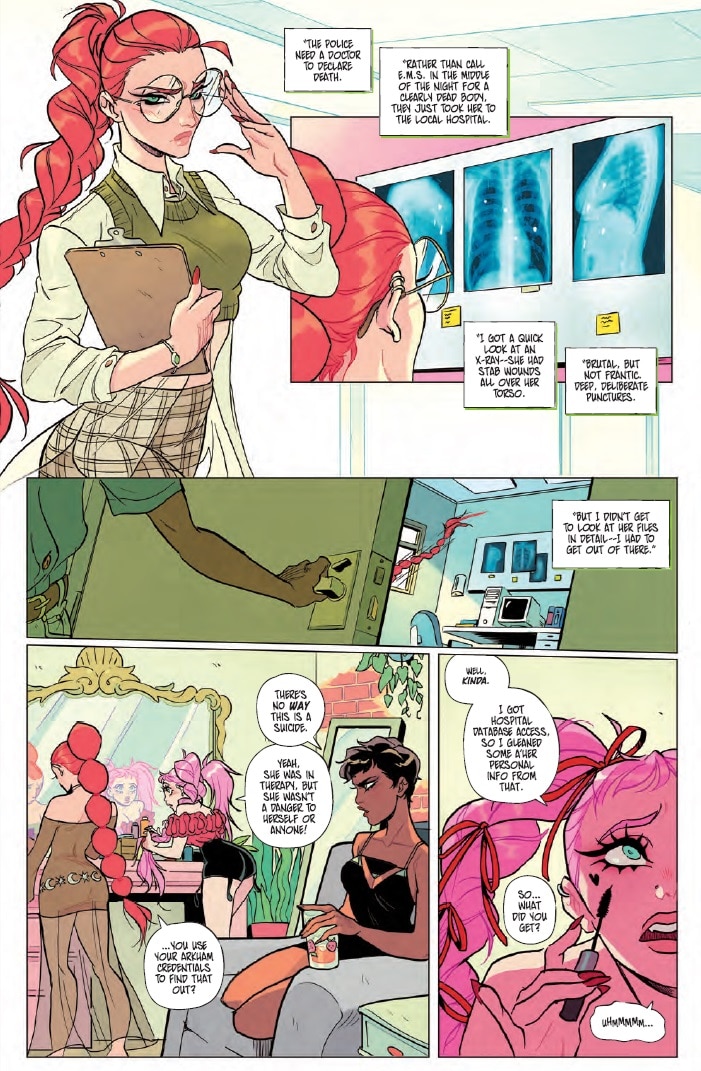
Babs, in a nutshell, how would you describe the personal style of all four of your main characters, and is there one whose style aligns most closely with yours?
BT: Tini gave me a really good guide when we started that was like, "Look at this designer for this girl and that designer for that girl." I think Black Canary is probably the closest to me. She's kind of got a rock and roll edge.
TH: But she's still kind of blonde and All American.
BT: Yeah, so I think that would be my closest one. But what were some other designers? We had whimsigoth…
TH: Oh, yeah. Ivy is very '90s whimsigoth. Also, Iris van Herpen. Designers that have kind of like organic, flowy stuff. Harley is very Heatherette.
BT: Camp, over the top, loud, big patterns and bold colors.
TH: I really like how much pink you've put in her, because I feel like in every group of women our age, there's always one friend who really likes pink and it's kind of like her personality. So, I feel like Harley is that girl. And then yeah, Dinah was a lot of All American rock and roll.
BT: Rock and roll t-shirts, fish nets, chunky leather jackets.
TH: Yeah. And then Selena is all Prada, Miu Miu, expensive, black, shiny, money, but also a bit of that Audrey Hepburn classiness.
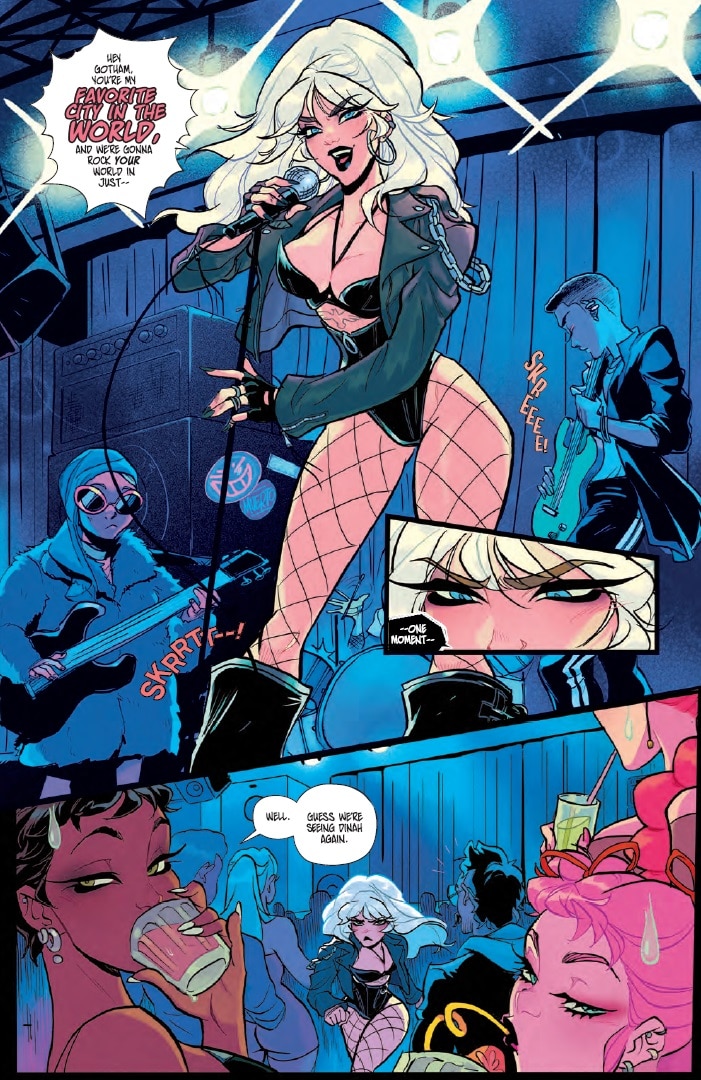
When you think of Gotham City, you have the Bat-Family, which is a figurative—and in many ways literal—family, but between the Sirens, Birds of Prey and the Batgirls, the superteams there all seem to be female-centered. Why do you think that is?
TH: I think a lot of living in Gotham is about feeling powerless against whatever is wrong with that city, and I think women, when we feel powerless, we have this great thing where we often turn to each other, and men don't always do that.
I love that answer, actually.
TH: So yeah, I think it just reflects the way that we don't have the ego to avoid numbers. We're happy to work in numbers, but then also, they all get to be individuals on the team.
So, on that note of women coming together, you can hang out with one of your four Sirens for a day. Who would it be and why?
BT: I think I would want to hang out with Harley. I would like to go shopping with her slash maybe steal stuff because I would imagine she wouldn't want to pay for anything. But I think she would be a hoot to hang out with.
TH: The part of me that likes to stay inside and water my plants and watch documentaries says Ivy, but Catwoman would probably get me into a lot of places I wouldn't otherwise see and I do like that.
Sirens: Love Hurts #1 by Tini Howard, Babs Tarr and Miquel Muerto is now available in print and as a digital comic book.