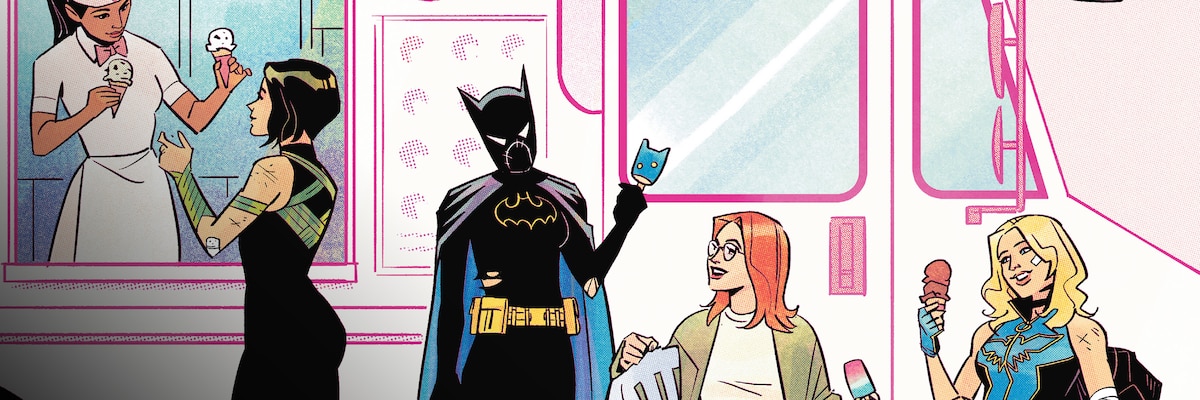
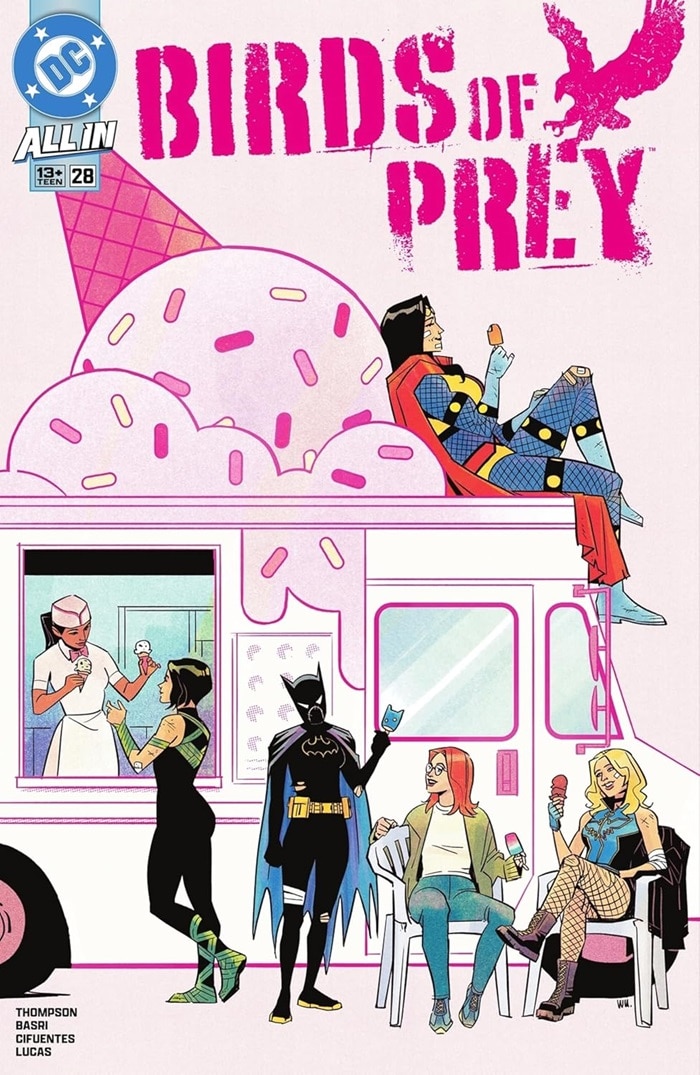
This month, with the publication of Birds of Prey #28, we close the curtain on what has become one of the most beloved runs on the series of all time, from Absolute Wonder Woman’s Kelly Thompson and a slew of incredibly talented artists. It’s a time for reflection on what Big Barda so appropriately deems “The Barda Era”—not just for her presence on the roster, despite stealing every panel that could accommodate her frame, but for the commensurate largeness of this period itself. Just as the Justice League has ballooned in size to Unlimited proportions, so too did we see a Birds of Prey over these past two years on the title that felt bigger than ever before. Bigger in size, bigger in missions and bigger in possibility.
At some point in the past 25 years, a team which began in the 1990s with a depowered Black Canary taking cryptic orders from an unknown handler has become about something else entirely. It’s something that Thompson’s Birds of Prey emphasizes over and over again in its eclectic roster choices, unlikely emergent friendships, foundation in Paradise Island and story arc after story arc about separated siblings. What Thompson’s Birds of Prey always understood, and what it always expressed, was that at its core, Birds of Prey is a comic about sisterhood.
Fans were abuzz when Thompson, off the success in her work on emotionally robust and inspirational female characters at other publishers, was first announced as the new writer for a Birds of Prey series. A fever pitch boiled over as the initial roster was unveiled piece by piece, day by day. Black Canary was a given. A natural center of the book, given her history with the team. Could you truly call anything a Birds of Prey without a Canary or an Oracle?
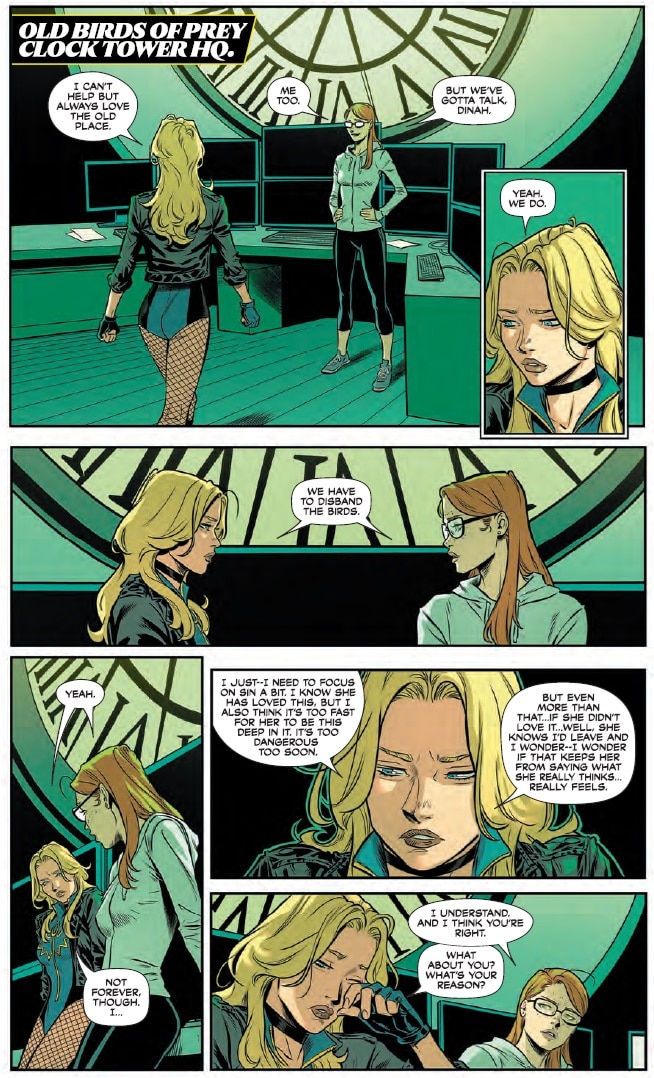
The advantage of making Black Canary the focal point of the series is that it got to explore dimensions of the character many had thought were long lost—like her lost relationship with Sin, a surrogate family member whose dismissal from her life almost twenty years ago still leaves an emotional scar. The new Birds of Prey’s first order of business was getting Dinah Lance her Main Character Energy back, so she could grow into a leader who could handle just about anything.
The tenor changed when the next two characters revealed were Big Barda and Cassandra Cain, two extremely distinct characters with extremely passionate fan bases, neither of whom were obvious choices for the team. What we couldn’t know at the time, what nobody could have imagined except an absolute genius like Thompson, was that the relationship between Big Barda and our team’s tiny Batgirl would coalesce into everyone’s favorite part of the series by highlighting exactly what makes these so seemingly different characters, who appeal to vastly separated corners of the sweeping DC fanbase, so alike.
But it was the next two selections that really raised some eyebrows: Zealot, of WildStorm’s WildCATS infamy, and Harley Quinn—always a controversial wildcard on any team. By the end of the first issue, readers were endeared. And within just a few more, they were rotated out for further guest stars, in a fractally expansive network of women all connected as spokes to the true hub of the DC Universe. No, not Batman, but Barbara Gordon.
While Barbara does suit up as Batgirl in Thompson’s Birds of Prey, it’s almost always her Oracle persona that takes prominence. There’s a reason for that. The story of Oracle is a timeless lesson that no woman should ever be discarded, disregarded or left behind. There is a space where women can be the heroes of their own stories, even after they are cast as supporters, romance objects or victims in others. Why does Big Barda and Batgirl’s friendship feel so refreshing? Because in Thompson’s Birds of Prey, the DC Universe’s entire array of fascinating women can coexist together, without more prominent, more platformed male voices crowding them out.
Spaces for men in comics are never in any danger. But take a look at your average Justice League roster, and you’ll find there are rarely ever more than a single woman or two on the team. As the roster has expanded over time from two, to three, to dozens, Birds of Prey has been the book where the heroines you never thought would get the space to see each other can actually share their lives and develop their own relationships.
(And also, sometimes, for some reason, John Constantine. Don’t ask. He’s as confused about being here as we are.)
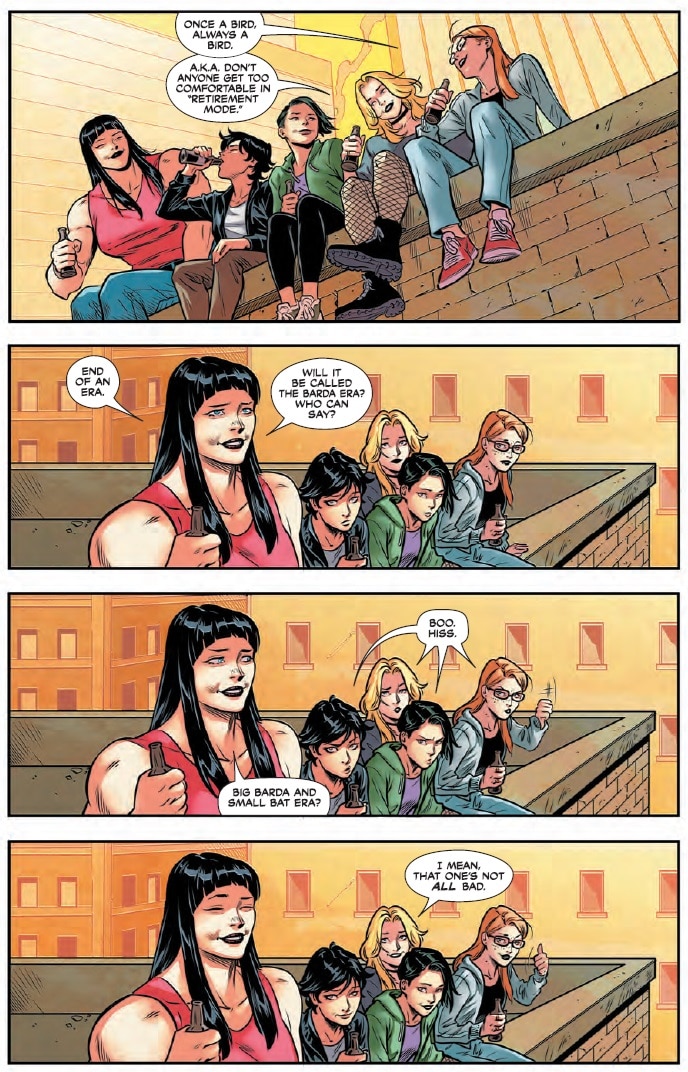
Thompson’s Birds of Prey is a book that is built on the shoulders of giants. One that wouldn’t exist without the work of Dixon and Simone before her, but also one that celebrates one of the most powerful assets the DC Universe has ever offered—its incredible female characters. Fighting together, growing together, forming the kinds of relationships you never see in most team-up books. The Birds of Prey are deeply entwined and invested in each other’s lives because they aren’t a tactical strike force—they’re a sisterhood.
Thompson’s run, now finished, has been a celebration of the fact that birds are strong because they fly together. In leaning on one another, Dinah, Barda, Cassandra, Barbara, Sin, Vixen, Grace, Onyx, Inque and this entire expansive cast will be all the richer going forward than they’ve ever been before. This “All In” Birds of Prey run has been a little bit of a miracle. And nobody loves a miracle more than Barda.
Birds of Prey #28 by Kelly Thompson, Sami Basri, Vicente Cifuentes and Adriano Lucas is now available in print and as a digital comic book.
Alex Jaffe is the author of our monthly "Ask the Question" column and writes about TV, movies, comics and superhero history for DC.com. Follow him on Bluesky at @AlexJaffe and find him in the DC Official Discord server as HubCityQuestion.
NOTE: The views and opinions expressed in this feature are solely those of Alex Jaffe and do not necessarily reflect those of DC or Warner Bros. Discovery, nor should they be read as confirmation or denial of future DC plans.