Gotham City is a busy place, with a lot going down each and every week. In this monthly column, Joshua Lapin-Bertone helps you stay on top of it all by letting you know what you should be paying attention to within the Bat-Family…and why.
It turns out electing a supervillain to run your city is a bad idea. A few months ago, I used this column to write about Pamela Isley becoming Gotham’s new mayor. Things started out well, with Ivy having a 92% approval rating.
That didn’t last.
As I’m writing this, Gotham City is currently overrun by giant plants, turning every block into a hostile primordial landscape. All communication systems have been cut off, and by sunrise, the oxygen will be unbreathable to normal humans, killing everyone who hasn’t managed to get out.
Let’s be real, the moment Ivy was elected mayor, we all knew giant plants would overrun the city at some point.
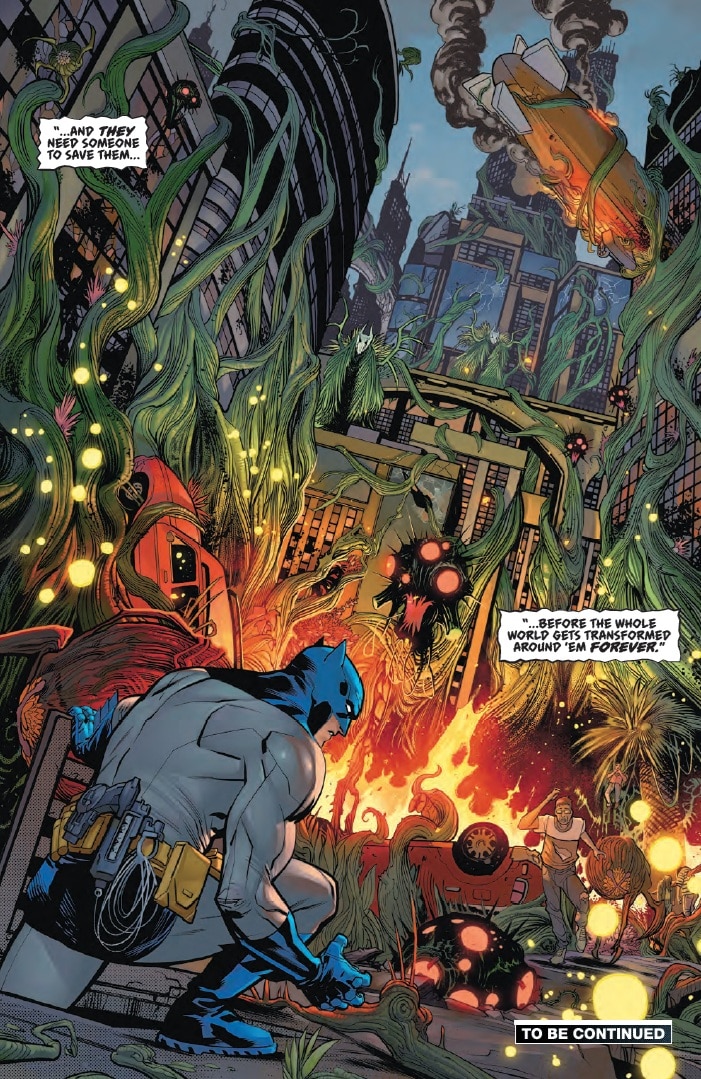
This is all playing out in Batman: Bad Seeds, a ten-week crossover running through the Bat-Family titles. One thing that sets Bad Seeds apart from other crossover events is that all of the action takes place across one night. Time is of the essence, as Batman and his allies have to stop Ivy’s attack before sunrise when the air becomes unbreathable.
Another thing I’m enjoying about Bad Seeds is how we get to see the night from different angles. We get to experience Cassandra Cain defending her favorite noodle shop over in Batgirl and Jim Gordon struggling to maintain law, order and public safety over in Batman: Bad Seeds – Gotham Central.
Gotham City overcoming disaster is nothing new (just look at Alex Jaffe’s recent article) but Bad Seeds presents the theory that it’s self-inflicted. After all, what kind of city appoints a supervillain like Vandal Savage as Police Commissioner and elects another supervillain like Poison Ivy as mayor?
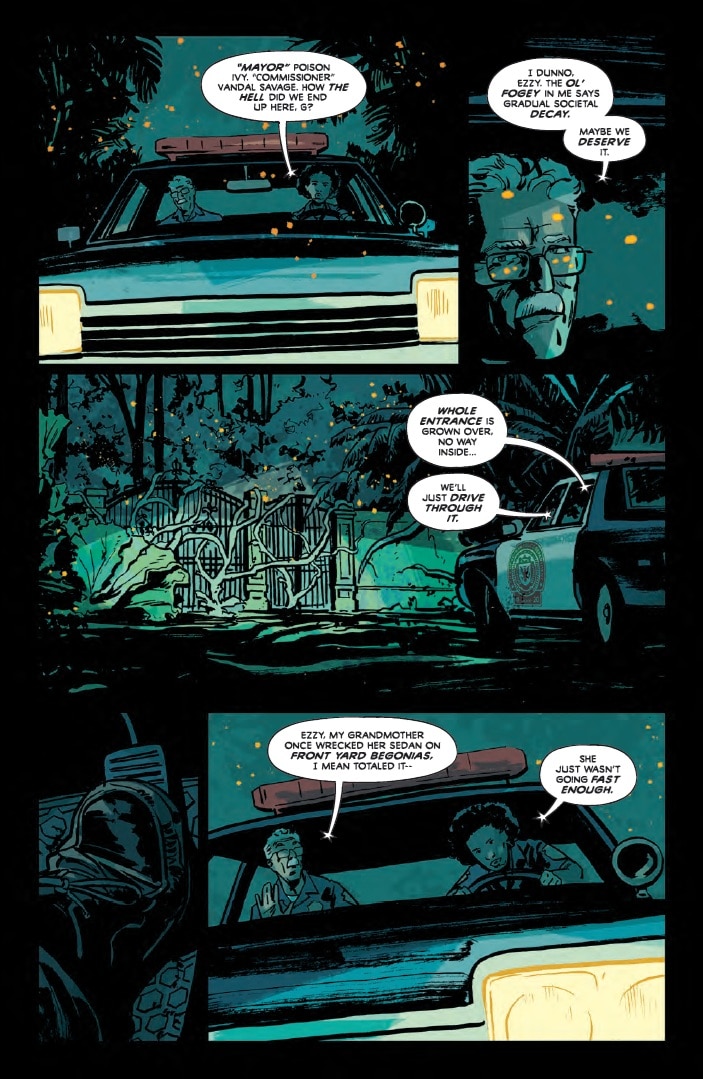
“How the hell did we end up here?” Officer Espinoza asks Jim Gordon in Batman: Bad Seeds – Gotham Central.
“I dunno, Ezzy,” Gordon responds. “The old fogey in me says gradual societal decay. Maybe we deserve it.”
This line makes me recall a moment in Contagion, another Batman crossover where Gotham is in peril. A young boy watches his family slowly die after contracting a deadly plague known as the Clench and asks his father why fate dealt them the cruel hand.
“What did we do wrong?” the boy asks.
“We moved to this wicked city,” his father answers.
It’s a harsh referendum on Gotham, and one that echoes in my brain as I read Bad Seeds.
One reader at my local comic shop took the idea even further, saying that Bad Seeds was Gotham literally turning against its citizens. Batman and his allies aren’t trying to fight the Joker, solve a mystery or round up escaped inmates. This time around, the city itself is the enemy, or at least the environment developing around it. Yes, you can make the argument that it’s not actually Gotham, it’s Ivy and the Parliament of Trees warring against Vandal Savage, but I feel like that only reinforces the point, since they were two of the most powerful people in the city government. If they aren’t the city and the environment isn’t the city, then what is?
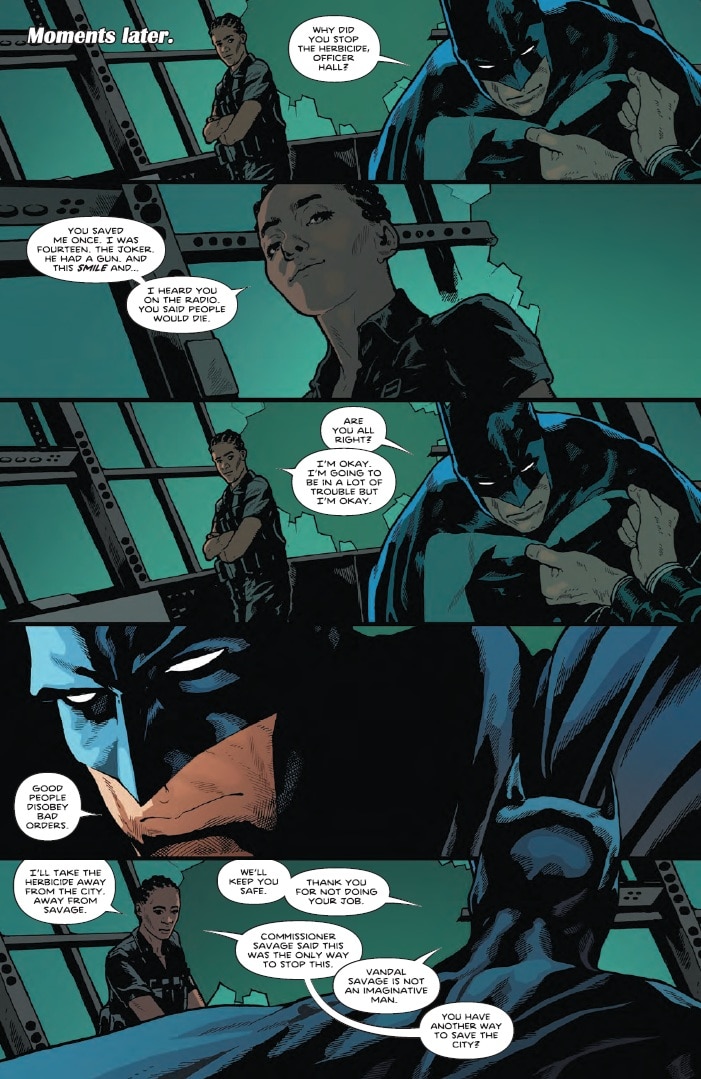
And yet, there’s a moment in Detective Comics #1113 that flies in the face of that. Vandal Savage has ordered his officers to blanket the city with a lethal herbicide, even though it has the potential to kill thousands of citizens. Batman fails to reach one of the zeppelins in time, but a police officer named Hall decides to go rogue and disobey her superiors, even if it means she’ll be shot. Fortunately, Batman saves her before her angry coworkers shoot her in the head, but Hall had no way of knowing this would happen. She knew people would die, and she knew she had to stop the herbicide.
“Good people disobey bad orders,” Batman tells her.
So yes, Gotham is the city that put multiple supervillains in charge of the government, but it’s also the city that produced Batman and good cops like Hall. While it’s true that Gotham has had its fair share of plagues, criminal takeovers and natural disasters, we might be looking at it from the wrong angle. Consider all the things that Gotham has had to overcome—things that would break a normal city. People like Batman and Officer Hall are the reason Gotham has been able to persevere and come back even stronger.
It’s going to be a long night for the city (about ten weeks to be exact), but once sunrise comes, we’ll see what has ultimately grown in Gotham. The seeds might be bad, but their blooms may wind up being quite beautiful.
“Bad Seeds” continues this week in Poison Ivy #48 and throughout all of October in the various Bat-titles.
Joshua Lapin-Bertone writes about TV, movies and comics for DC.com, is a regular contributor to the Couch Club and writes our monthly Batman column, "Gotham Gazette." Follow him on Bluesky at @joshualapinbertone and on X at @TBUJosh.
NOTE: The views and opinions expressed in this feature are solely those of Joshua Lapin-Bertone and do not necessarily reflect those of DC or Warner Bros. Discovery, nor should they be read as confirmation or denial of future DC plans.