Each Friday, we'll be letting a different DC.com writer share what they'll be reading over the weekend and why you might want to check it out. Here's this week's suggestion for a perfect Weekend Escape!
Pamela Isley is out to save the world, even if it means killing every human being on the planet. Poison Ivy Vol. 1: The Virtuous Cycle puts the classic Batman villain in the spotlight as she stars in her own solo ongoing series for the first time. The storyline finds Ivy operating away from Batman, Gotham City and Harley Quinn, as she embarks on an angry and far-too-timely quest to remake the Earth. This debut collection kicks off what’s become one of DC’s best comics, a brilliantly expanding saga that’s been growing in popularity and acclaim over the years and is now approaching its 50th issue—a remarkable run for a dark book that often segues into body horror and isn’t centered around a Justice Leaguer.
THE PREMISE:
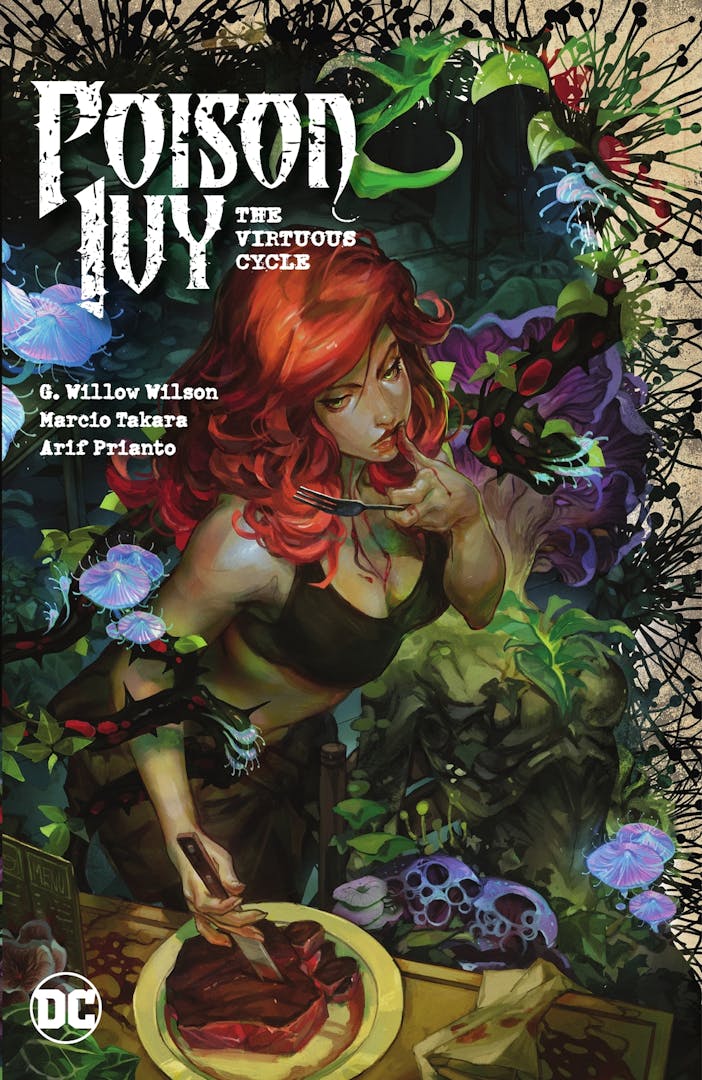
Poison Ivy hasn’t been feeling like herself. She received a big power boost during 2021’s Fear State storyline, but a series of transformations has left Ivy with a fraction of her original power and a weaker connection to the Green. Now she’s out for revenge, even if it means taking the entire world down with her. In order to save the Green and preserve the planet, Ivy is preparing to release a parasitic fungus that will wipe out every human being—including herself. Little does she realize that her plan for planetwide extinction may become the very thing that gets her to look at the human race and the Green in a new way. Ivy’s also being watched by someone from her past, and if she has any hope of forging a new future for herself, she’ll have to kill her past traumas…even if it means getting her hands dirty.
LET’S TALK TALENT:
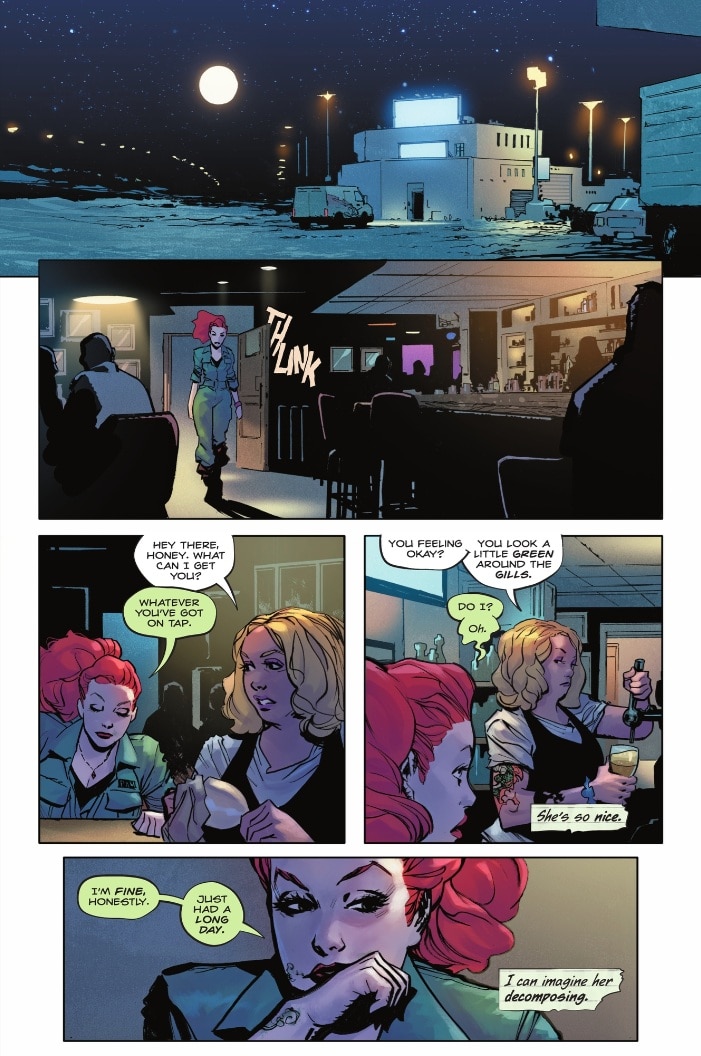
Poison Ivy: The Virtuous Cycle is written by G. Willow Wilson, an Eisner Award-winning writer who is known for her work on Wonder Woman, The Dreaming: Waking Hours and Vixen: Return of the Lion. Pamela here is on a quest to wipe out the human race, but as readers we still care about her and somehow want her to succeed, which is a testament to Wilson’s writing. Wilson presents Ivy as a sympathetic character without removing her villainous edge. She also uses the story to touch on complex themes such as trauma, trust, humanity, betrayal and more.
The Virtuous Cycle is penciled by Marcio Takara, an artist who has worked on Blue Beetle, Detective Comics and Smallville Season 11. And yet, one could certainly make the case that Poison Ivy has become his signature work. Ivy’s world is a mix of beauty and danger, and Takara’s artwork captures that dichotomy perfectly. The hallucinogenic sequences are stunning, the scenes of Ivy gardening are captivating and the moments where people are ripped apart and decay are horrifying. Takara does it all.
In addition, Brian Level lends a hand co-penciling the final two chapters, adding some menace (and body horror) to Ivy’s final confrontation with her former mentor Jason Woodrue.
A FEW REASONS TO READ:
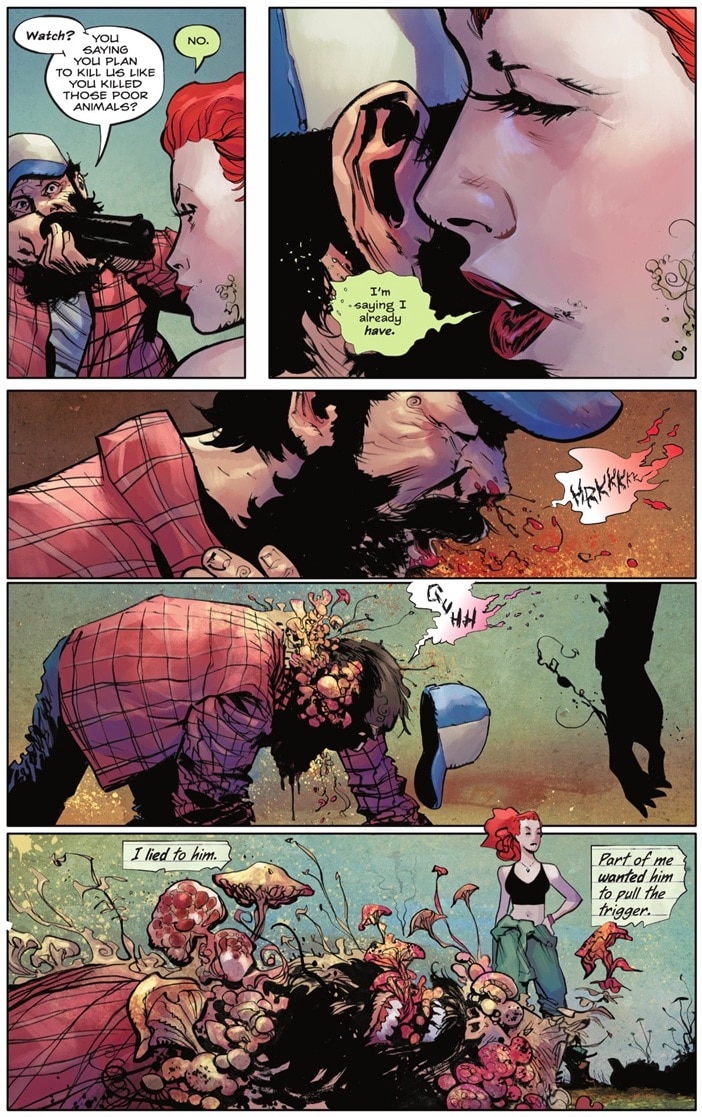
- Poison Ivy has starred in her own limited series and one-shots before, but this is the first time the character has headlined her own ongoing series. The comic was originally commissioned as a six-issue limited series, but readers loved it so much that DC made it an ongoing. That’s how good it is!
- If you’re reading Matt Fraction’s Batman series or other Gotham titles, you may have noticed that Poison Ivy is currently the Mayor of Gotham. This development came from G. Willow Wilson’s Poison Ivy saga, and The Virtuous Cycle is the first chapter. Think of it as a Mayor Ivy prequel.
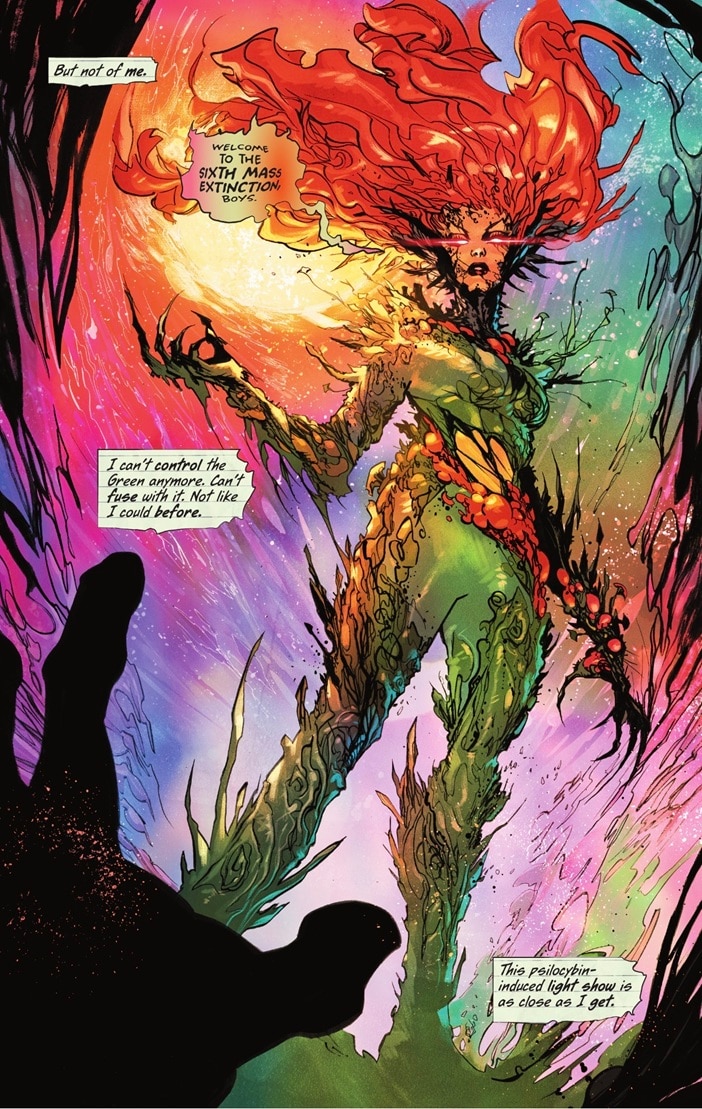
- Sometimes when a villain gets their own series, their villainous tendencies are toned down. That’s not the case here. G. Willow Wilson isn’t afraid to show Ivy committing cold-blooded murder or making genocidal plans to wipe out the human race. Ivy is a complicated character, and Wilson embraces that without shying away from the complicated stuff.
- The Virtuous Cycle is filled with gruesome body horror, including Ivy eating the rotted corpse of her former mentor Jason Woodrue. This is a comic that isn’t afraid to go there.
- G. Willow Wilson uses The Virtuous Cycle to dive into some deep themes, including leftover COVID trauma. While the COVID-19 pandemic is not mentioned in the story, Wilson wrote in the commentary section (which can be read in the trade paperback) that her leftover pandemic trauma got her thinking about how nature spares no one, which inspired her to write this storyline.
WHY IT’S WORTH YOUR TIME:
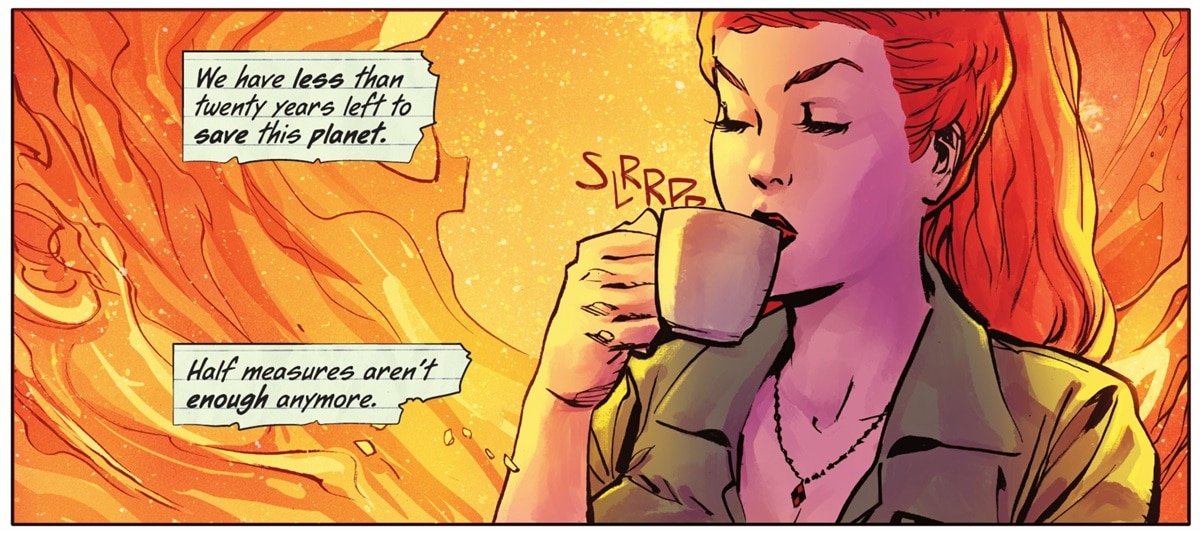
Poison Ivy Vol. 1: The Virtuous Cycle isn’t your typical DC Universe story. It isn’t a hero vs. villain story starring a good-hearted protagonist. It’s a more nuanced tale centered on an eco-terrorist who wants to save the world in her own way. Poison Ivy doesn’t behave like a hero or a villain, she marches to the beat of her own drum. She’s a character who can murder innocent bystanders in one scene and help a property owner tend her garden a few pages later.
G. Willow Wilson will change the way you look at Pamela Isley. The Virtuous Cycle is the beginning of a transformative run that is redefining the character for generations to come. It’s an exciting story that isn’t afraid to get weird, make you uncomfortable and push the boundaries of what you can do in a comic book. Poison Ivy: The Virtuous Cycle is the best thing to happen to Poison Ivy since she was created in 1966, and a perfect choice for your next Weekend Escape.
Poison Ivy Vol. 1: The Virtuous Cycle by G. Willow Wison, Marcio Takara and Arif Prianto is available in bookstores, comic shops, libraries and digital retailers as a softcover graphic novel. It can also be read in full on DC UNIVERSE INFINITE.
Joshua Lapin-Bertone writes about TV, movies and comics for DC.com, is a regular contributor to the Couch Club and writes our monthly Batman column, "Gotham Gazette." Follow him on Bluesky at @joshualapinbertone and on X at @TBUJosh.
NOTE: The views and opinions expressed in this feature are solely those of Joshua Lapin-Bertone and do not necessarily reflect those of DC or Warner Bros. Discovery, nor should they be read as confirmation or denial of future DC plans.