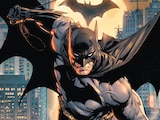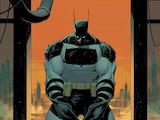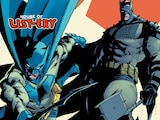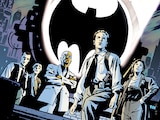
Even now, a few months on, it’s a little unbelievable that we have two separate crossovers featuring Batman and Deadpool. But for a man who so famously loves to claim that he works alone, there are few heroes who get into as many strange team-ups as Batman. There have been entire comic books and animated series dedicated to showcasing a new crimefighting partner he takes on in every adventure. At this point, it’s harder to name a DC hero that Batman hasn’t teamed up with than one he has.
In fact, as we know from Batman/Deadpool, DC isn’t even the end of his horizons. We’ve seen Batman fight side by side with Spawn, Judge Dredd, the Teenage Mutant Ninja Turtles, Elmer Fudd and Scooby-Doo. But there are some guest stars even beyond comics who really stretch the bounds of Batman’s significant rolodex. For our money, here are some of the most out there team-ups Batman has ever had.

The Window Watchers
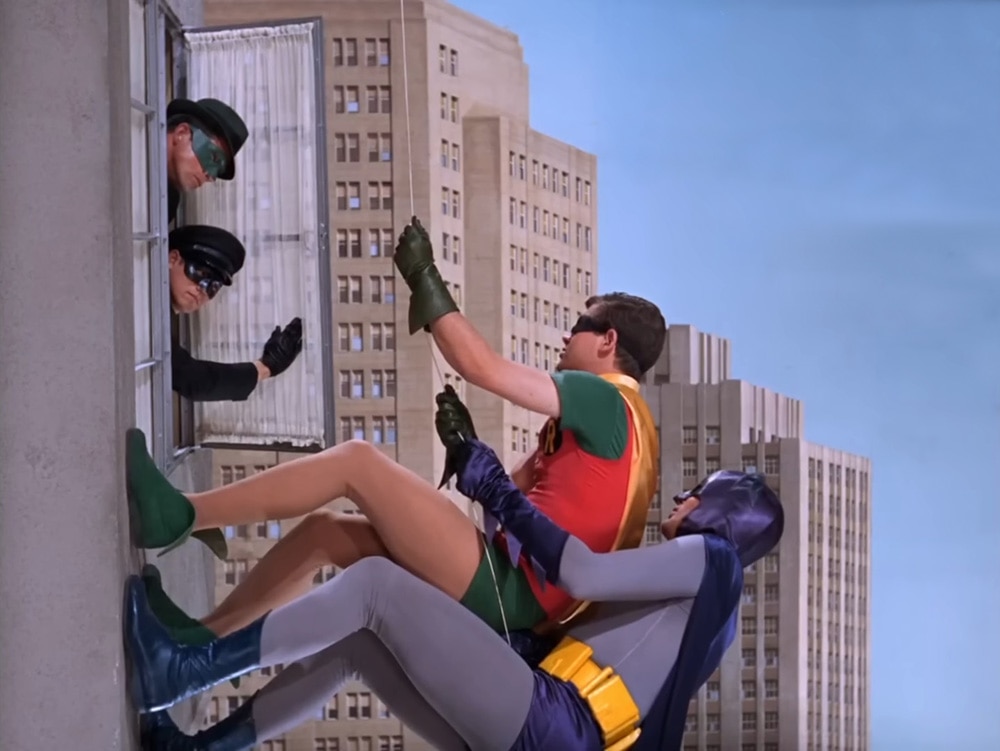
One of the great thrills of the 1960s Batman TV show was that you never knew who was going to show up in Gotham City from week to week, whether in costume as one of Batman’s colorful villains, or popping out of a skyscraper window to cheer him on as he and Robin climbed to the roof. These fifteen to thirty second cameos were some of the most anticipated scenes of the show each week. Jerry Lewis, Dick Clark, Lurch from The Addams Family, Colonel Klink of Hogan’s Heroes and even Santa Claus could be seen peeking their head out for a brief chat with Batman and grant him the confidence to take down the villain of the week—or next week, as was often the case with the two-part format.
Jerry Lewis in particular would get to know Batman and Robin better as he took on the identity of “Ratman” in 1966’s The Adventures of Jerry Lewis #97, while fellow crimefighters and window watchers Green Hornet and Kato would get the full team-up treatment in Season 2’s “A Piece of the Action.”

The World’s Greatest Detective
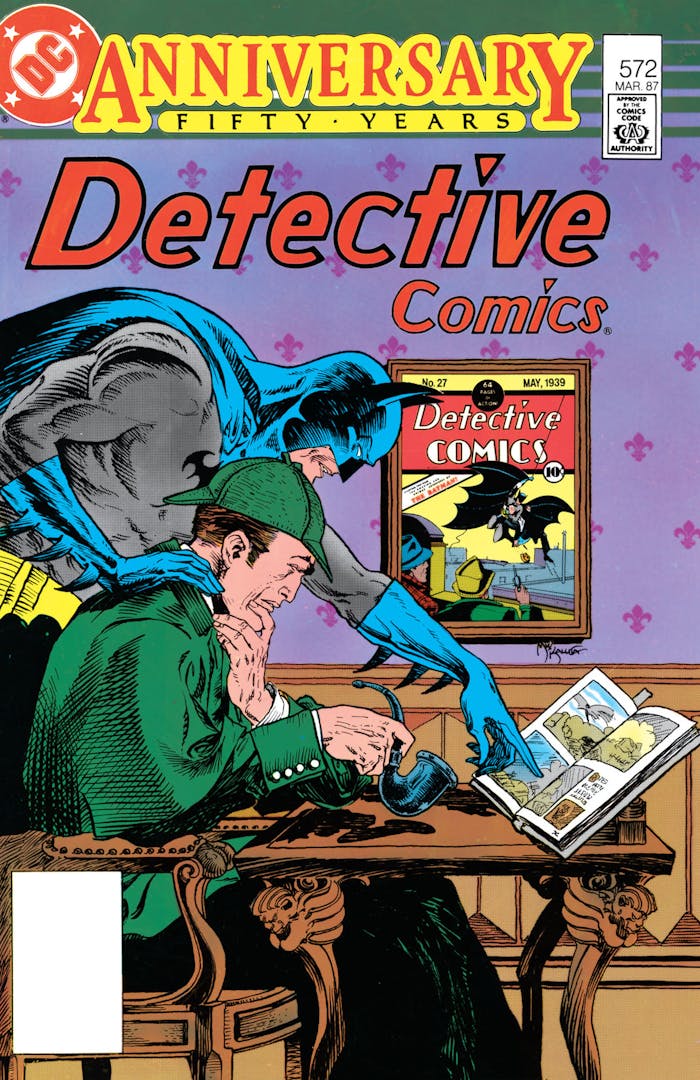
In 1987, DC Comics posed itself a particularly challenging mystery: how do you celebrate fifty years of Detective Comics? The answer was enlisting the greatest detective in the history of fiction. No, not Batman, he’s already in the book every month. The real greatest detective, invented by Sir Arthur Conan Doyle, operating as a consulting detective for Scotland Yard from 221B Baker Street since 1887—coincidentally, another fifty years prior to the first Detective Comics issue.
Detective Comics #572 teams Batman up with some of the magazine’s other biggest stars over its many years—Detective #1’s Slam Bradley and breakout backup star Elongated Man—in a mystery which puts them on the tail of a modern day descendant of the “Napoleon of Crime,” Professor Moriarty. In the tale’s dramatic finale, which also includes an illustrated retelling of one of Holmes’ most famous cases, an incredibly aged, yet still fairly spry, Sherlock Holmes appears to make a final assist, giving our modern day crime solvers his personal seal of approval. Holmes and Batman would team up again years later in Batman: The Brave and the Bold, where the great detective of Baker Street comes seconds away from deducing Batman’s identity within moments of meeting him.

Celebrity for the Cause
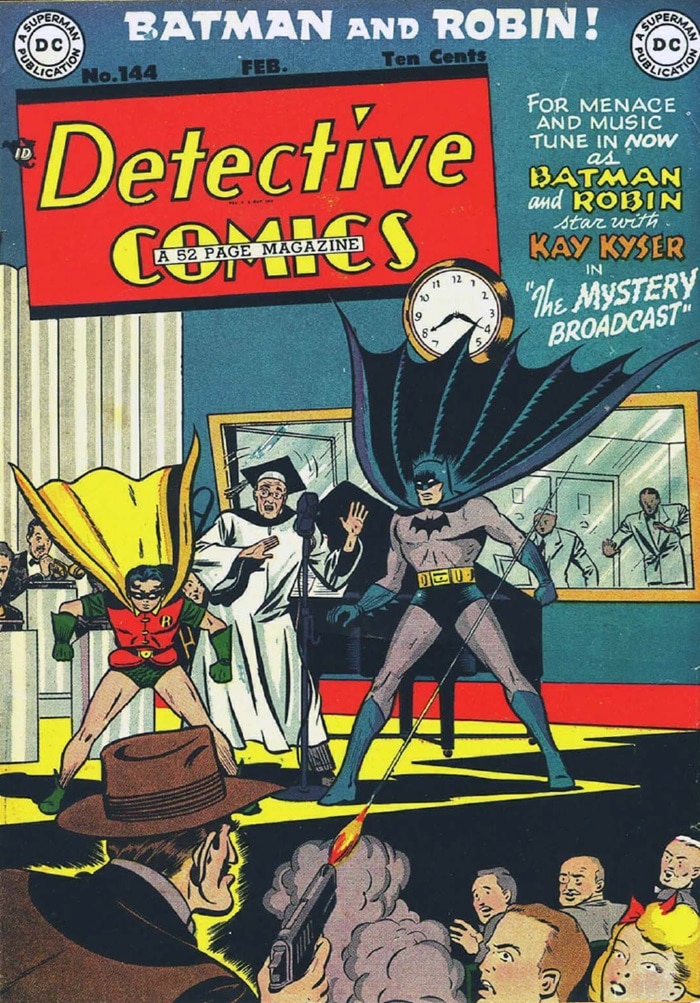
One of Batman’s most startling guest appearances might have been band leader, radio/television host and comic actor Kay Kyser. If you didn’t live through World War II, we wouldn’t blame you too much for not recognizing the name. But Kyser, known best at the time for his know-it-all persona in films like 1939’s That’s Right – You’re Wrong, and the 1940s television program Kay Kyser’s Kollege of Musical Knowledge, holds the distinction of being the first real life celebrity to co-star with Batman in a comic book story, “Kay Kyser’s Mystery Broadcast” in 1947’s Detective Comics #144.
Batman and Robin end up crossing paths with Kyser when a wanted criminal on the lam embeds himself into his band while traveling through Gotham City for a special show. Using an irregular arrangement of their typical musical performance, Kyser manages to conduct a special show intended to musically tip off Batman and Robin that a criminal is hiding in his midst. Batman gets close to Kyser by booking himself as a guest on Kyser’s Kollege, using Robin’s knowledge of contemporary music to keep himself on the air long enough to zero in on Big Jack Bancroft.
Imagine, if you will, the Golden Age equivalent of Batman teaming up with Stephen Colbert to take down a stowaway fill-in member of the Tonight Show band, and you have a pretty good idea of the first celebrity team-up in Batman history.

A Forgotten First Wave
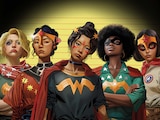
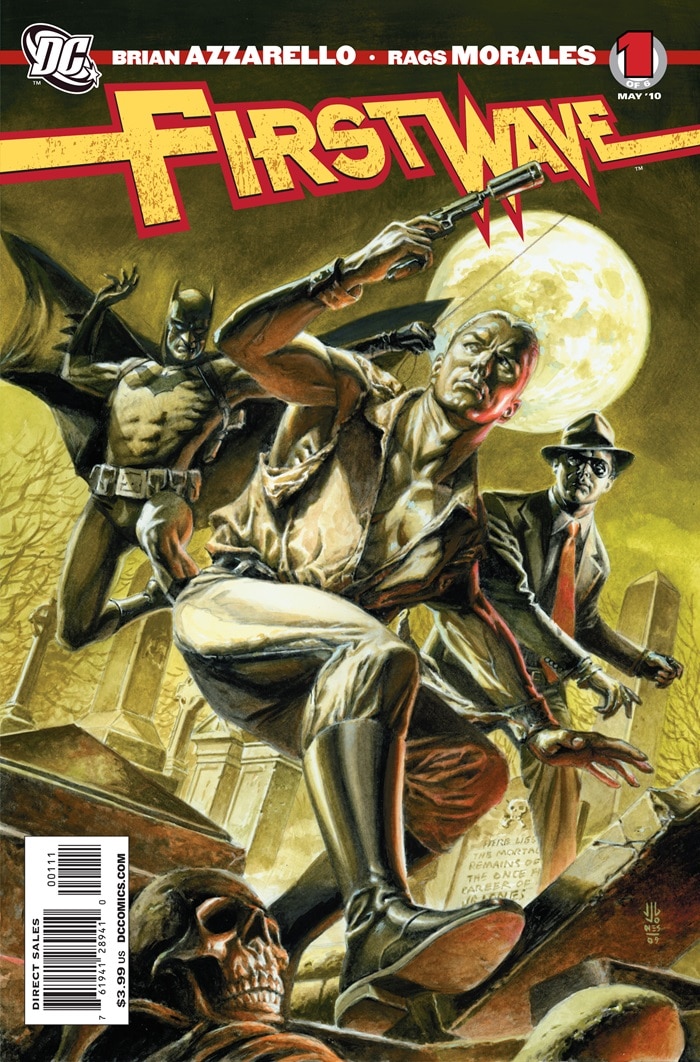
Between the years of storytelling that culminated in the high point of Blackest Night and the entire table reset that was Flashpoint and the New 52, there’s this strange period of DC history from 2010 to 2011 that tends to get overlooked. With so much swept away so quickly, it’s easy to forget some of the more interesting moves that were just getting off the ground, like the “Generation Lost” Justice League, Wonder Woman in jeans and a little publishing initiative from 2010 called “First Wave.”
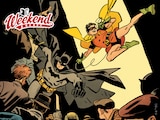
“First Wave” was an ambitious project to cultivate a publishing line that paid homage to the roots of the comic book medium by casting a Golden Age Batman alongside a cast of pulp heroes like Doc Savage, the Spirit and Rima the Jungle Girl. You might say the spirit (if not, you know, the Spirit) of the project lives on today in Dan Jurgens’ The Bat-Man: First Knight and its ongoing sequel, Second Knight, under DC Black Label. We can only imagine what it might have been like if the project continued beyond its first steps. Maybe the Man of Bronze and the Man of Steel could have compared Fortresses of Solitude.

The Carter Nichols Files
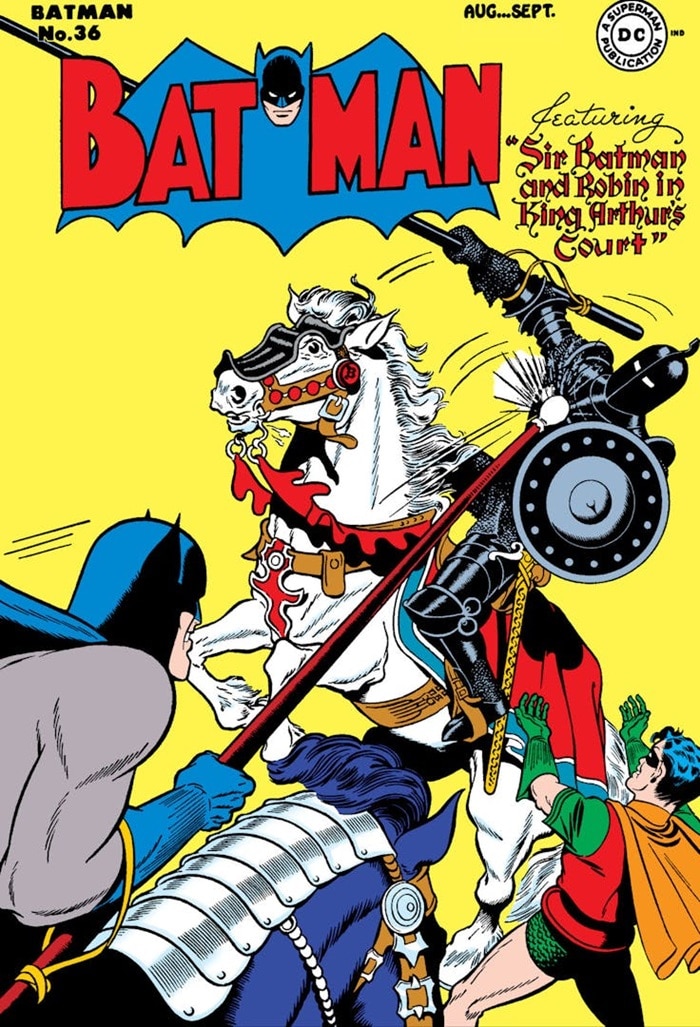
Some of the most interesting team-ups from Batman’s early history were…well, from early history. We’re not talking about the superheroes of the Golden Age, but icons from our own distant past, as Batman and Robin used a strange technique developed by scientist Carter Nichols to travel into the distant past through…hypnosis.
There’s a strong argument to be made that none of these adventures ever actually happened, but they were certainly real to our heroes at the time. Through their hypnotically-induced Golden Age time travel adventures, Batman and Robin got the opportunity to team up with the likes of the Three Musketeers (1945’s Batman #32), King Arthur and the Knights of the Round Table (1946’s Batman #36), Robin Hood and his Merry Men (1946’s Detective Comics #116), American founding father Benjamin Franklin (1947’s Batman #44), Renaissance Man Leonardo da Vinci (1948’s Batman #46), the original Frankenstein (1948’s Detective Comics #135), Marco Polo (1949’s World’s Finest Comics #42) and Cleopatra (1950’s Detective Comics #167). So, next time someone tries to tell you that Batman stories used to be a lot more grounded than they are today, ask them if they know about Professor Nichols’ Time Travel Hypnosis Adventures. Batman’s never not been getting nuts.
Alex Jaffe is the author of our monthly "Ask the Question" column and writes about TV, movies, comics and superhero history for DC.com. Follow him on Bluesky at @AlexJaffe and find him in the DC Official Discord server as HubCityQuestion.
NOTE: The views and opinions expressed in this feature are solely those of Alex Jaffe and do not necessarily reflect those of DC or Warner Bros. Discovery, nor should they be read as confirmation or denial of future DC plans.